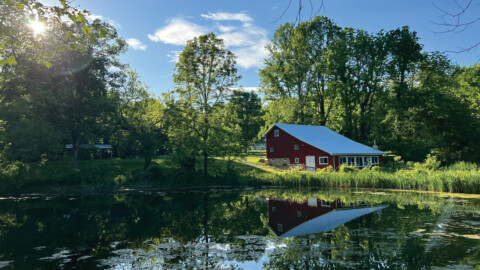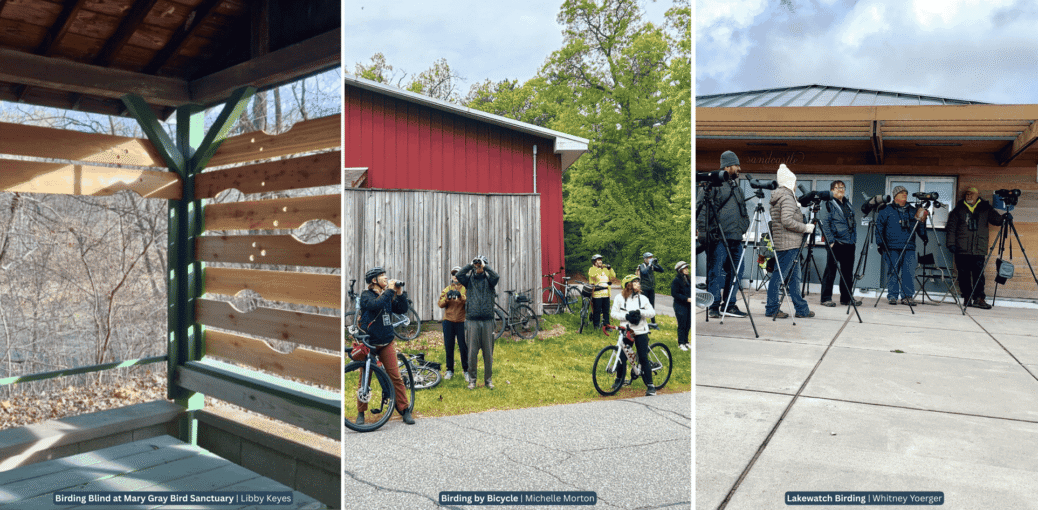
Collage: Three side-by-side photos showing different ways to go birding: a wooden birding blind overlooking woods at Mary Gray Bird Sanctuary (photo by Libby Keyes); birders with binoculars standing beside bicycles near a red barn (photo by Michelle Morton); and a group of birders using spotting scopes during a lakewatch at Miller Beach in Lake County, Indiana (photo by Whitney Yoerger).
BY OLIVIA BAUTCH
We’ve enjoyed spotting sparrows on a short stroll through the wooded park, and successfully identified a few other songbirds foraging nearby. Are you ready for your next birding trip? Historically, events centered on birding have been billed as bird walks. Contrary to that label, you needn’t be on your feet to watch birds; you don’t even need to cover any distance.
In fact, some species groups are best observed while stationary or in a vehicle. Think back to the multitude of habitats we discussed: can you imagine trying to sift through monotonous-looking gulls, terns, kittiwakes, and loons flocking 1,500 yards into Lake Monroe… from a trail off the shore? What about those shorebirds we mentioned in the article? Often landing on private properties, there may not be a path around the pond, field, or beach allowing guests closer to the birds. That’s one reason why we need multiple modes of access.
There’s another useful tip hidden in the modes of birding. The term bird walk isn’t all-encompassing, and neither is the term bird watching. Listening (we’ll go more in-depth on that another time) is just as important as looking when it comes to observing and enjoying birds. Many fellow birders—possibly even yourself—only listen or look at nature due to disability or aging. With varying ways to bird at our disposal, all people can engage in this hobby.
Trail Traversing
This first mode speaks for itself. Any instance of scouting out birds while covering distance on the ground can be trail birding. What constitutes a trail requires a bit more definition though. Let’s take the National Park Service categories as an example: they list foot trails, bikeways, boardwalks, interpretive/nature trails, and multi-use paths.
Again, these definitions are not all-inclusive; one can use a wheelchair on a foot trail and push a stroller along a bike trail. They are mostly categorized by location, material, length, activity (like bike or horse riding), and features like educational signage.
The plus sides of birding from the trail are numerous: you’re right there in the habitat with unobstructed sound and view, may encounter greater species diversity while passing through different habitats, and are free to follow a bird that moves out of view (as they do). The catch is, birds are more aware of your presence, too. Plus, once you’re out there, you must return to the parking lot, rain or shine.
Stationary
When you submit a checklist on eBird, you are presented with three standard observation types to help data scientists better understand your checklist. One is Traveling (any form), the second is Stationary, and the last is Incidental—that’s when you weren’t intending to record birds, but you found something to share anyway. This tells us stationary birding is very common.
Stationary birding can either take you to a location or bring wildlife to yours. This is why you might stop by the nature center at parks and preserves. Most have bird feeding stations visible to visitors outside and inside the building, complete with seating, field guides, binoculars, and bird-safe glass to protect feathered friends from colliding with large viewing windows.
If you’d prefer some fresh air, trailside bird blinds are an option. Settle into these cozy, natural nooks—like this new accessible blind at Mary Gray Bird Sanctuary—to see and hear birds at nearby feeder stations or gathering spaces. Have a naturally busy backyard? A favorite picnic shelter at a park? Perhaps even a high-rise office overlooking urban raptor territory? Settle in at any of the above locations to go birding. It’s that simple!
Travel by Car
Car birding blends two approaches to birding: travel and watching or listening from a fixed spot. On one hand, you or your driver can cover miles through an auto tour or inconspicuously stake out Sanderlings from a safe, comfortable, vehicular bird blind. Large parks such as Indiana’s Muscatatuck National Wildlife Refuge and Brown County State Park are built with this wildlife observation mode in mind. The U.S. Fish and Wildlife Service explains, “By using your car as a viewing blind, you can often see more wildlife than you can see on foot.”
Nick Lund of Maine Audubon notes even more perks of car birding, “When you’re far away, a car door with the window rolled down is the perfect place to rest binoculars or a scope to get a steady, long range view.” He’s right, and there are products made just for this.
Lund also reminds us not to bird while driving. I’m not going to pretend teen me didn’t terrify my mother by identifying an Osprey when I was learning to drive in the city. Do as I say, not as I do. Car birding should only be done while parked or as a passenger.
On the other hand, it should be mentioned that overutilization of vehicles can do harm to the very environment we are enjoying through vehicle emissions and noise pollution. In moderation, it’s a great mode to mix into your birding routine.
Lakewatching and Pelagics
Lakewatching and pelagic birding are two more specialized approaches. Open water species are formidable to birders, not only for their biannual molts of near-identical plumages, sometimes distinguishable by a single feather, but for the difficulty of accessing them. Gusting wind and crashing waves, sea spray, lake effect snow, and bitter cold are all possible obstructions to the hundreds of white, black, and gray specks far in the distance we call birds.
A lakewatch is done from the shore, using a spotting scope to scan as far as your eyes can reach. These may utilize shelters on dunes and beaches. But to really bridge the distance between yourself and your target birds, take a pelagic—or boating—trip out. You may get seasick, even on Lake Michigan, but you’ll also get a closeness that allows you to discern those minuscule plumage details. Like car birding, both lakewatching and pelagic birding combine traveling and stationary observation. On pelagic trips, passengers typically have 360-degree views from the small boat and can move around to change their vantage point.
It’s not just your average parking lot gulls on pelagics and lakewatches. Species of jaegers, loons, terns, gulls, shorebirds, and sea ducks who may live almost exclusively on the water or nest in the Arctic are in reach. And in the fall, hurricane season may blow in unexpected Caribbean visitors, such as American Flamingo or Brown Pelican. No matter what, open water birding modes reveal many of our most elusive bird species.
Even More Options
The possibilities don’t stop here. The way you enjoy birding is up to you and your own personal rhythms. You might be an avid cyclist, river kayak enthusiast, or a virtual world traveler. If birds are present and you’re observing them, you’re birding! If one of these modes of birding sounds exciting to you, join Indiana Audubon on one of our diverse field trip opportunities.
Tags: birding 101