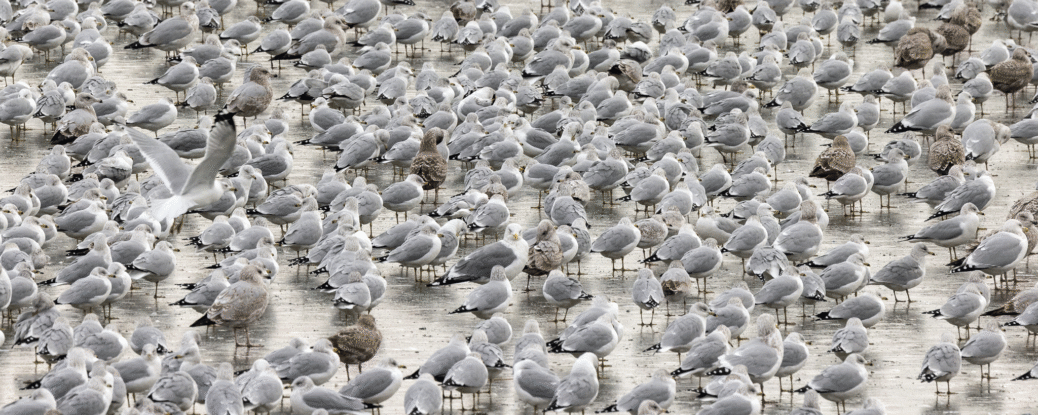
Image: An overwhelming sea of gulls standing shoulder to shoulder, illustrating why gull identification can test anyone’s patience. Photo by Bill Sharkey.
BY BILL SHARKEY
Gull identification is challenging. However, learning the topography of a gull’s primaries is a great way to start. This is an introduction to gull identification. For more detailed information, I suggest time in the field observing gulls and a great gull guidebook like The Gull Guide: North America by Amar Ayyash.
Why the Primaries?
Gulls, particularly American Herring Gulls, are highly variable. You will see variation in many field marks, making identification frustrating. Thus, we will ignore marks like bill shape and coloration, leg color, head shape and markings, overall size, et cetera. We will instead focus on one group of feathers, and in the end you will understand why.
Primary feathers are the principal flight feathers of gulls: the outermost ten feathers on the rear portion of the wing. Think wingtip into the outer half to third of the wing. They are the longest feathers in the wing, and generally carry the most significant information for gull identification.
In this article, we are focusing on adult birds. Aging gulls is fun as you gain experience. It’s a great way to focus on individual birds versus looking at a mass of gulls with no place to start. But the primary marks on adult birds are easier to spot and are a better place to start.
How to Get Started
Go to habitats where the gulls are usually found. These birds are best in the winter months of December through February, when Indiana hosts the best variety. Large reservoirs in Indiana will likely have some gulls. Lake Monroe near Bloomington hosts a good variety in winter. So does Eagle Creek Park in Indianapolis. Check eBird.org for American Herring Gull sightings near you. If there are none, fall back on Ring-billed Gulls as a starting point. You’ll find more gull species in Northern Indiana, and the diversity diminishes as you move south in the state.
Study gulls, both in flight and at rest. Remember to only study the primaries to start. You will want binoculars at a minimum. A spotting scope is really helpful, though a camera and the opportunity to review your photos later may be super helpful. Practice and field time are essential for confident and correct ID.
Review eBird photos of the species you are interested in. There are plenty on the site.
I have a self-confession to make. I spent a lot of my early gulling looking at the wrong marks, always looking at the head and the legs. And while there are good marks on both, I can now sort through gulls much faster by reviewing their “tails.” The primaries project over the tails of resting or swimming gulls. When you look at the rear of the bird, you are looking at the primaries, not the tail.
American Herring Gulls and Ring-billed Gulls are the two most common gulls in Indiana. You are more likely to see them, so they are great for field practice. And American Herring Gull is a bird often confused with our more rare winter visitors. Knowing this species and how to exclude it from an identification scenario is very helpful as your gulling interest expands.
I will also touch on Iceland Gull identification at the end of the article, but don’t skip ahead.
Primary Feather Marks – Of Mirrors and Apical Spots
Mirrors are larger white areas on the outer portion of the primaries, most often on P10 (the outermost feather) or P9 (just inside P10). They vary in size and shape and are best seen in flight. At rest, they can be difficult to see, but are most often visible on the underside of the feather. Most mirrors are subterminal – not at the very end of the feather – with some black between the mirror and the tip of the feather.
Apical spots are the white tips of the primary feathers. Adult American Herring Gulls and Ring-billed Gulls both have apical spots, and while they can be visible in flight with a good view, they are most useful on a bird at rest. On a resting bird, they are seen on the top of the folded feathers.
Take a quick look at the featured photo below. Spend a moment looking at the top of the folded wings of these gulls. See the apical spots?
Separating American Herring Gull and Ring-billed Gull
I have included photos that show marks you can use to identify the birds even without the primaries. This allows you to confirm your identification. However, how often do you see birds facing away from you, or with a tucked head that hides the bill? For me, it is often. Primary feathers can help us overcome those issues.

Image: Three Ring-billed Gulls and one American Herring Gull standing in shallow water, showing differences in size and primary pattern. Photo by Bill Sharkey.
When looking at the photo, I see an adult American Herring Gull and a couple of Ring-billed Gulls. As I focus on the primaries, I note several things. Most obvious to my eye is the shape of the folded feathers. On Ring-billed Gulls, the folded primaries have a much narrower appearance, whereas American Herring Gulls have broader primaries. And that is our first mark.
The next thing I note is the size and shape of the apical spots. What do you see?
I see very small outer apical spots on each of the Ring-billed Gulls, much smaller than those on the American Herring Gull. Notice you can see three sets of Ring-billed Gull primaries, including a third set projecting from behind the Herring Gull. The shapes are consistent, with similarly sized apical spots. You just did your first identification using only the primaries.
I also note that the apical spots on the Ring-billed Gull are almost diamond-shaped, and the Herring Gull has more triangular-shaped spots. Lastly, I see more contrast in the Ring-billed Gull primaries than in the American Herring Gull. The white and black coloration is more stark.
Now go find those gulls in the field and expand your experience using this approach.
Iceland Gull
My personal mission is to see as many Iceland Gulls as possible. To do so, I need to spend time in northern Indiana near Lake Michigan, since few Icelands head into areas in central and southern Indiana. I learned the “primarily primaries” lesson to help me identify more Iceland Gulls correctly.
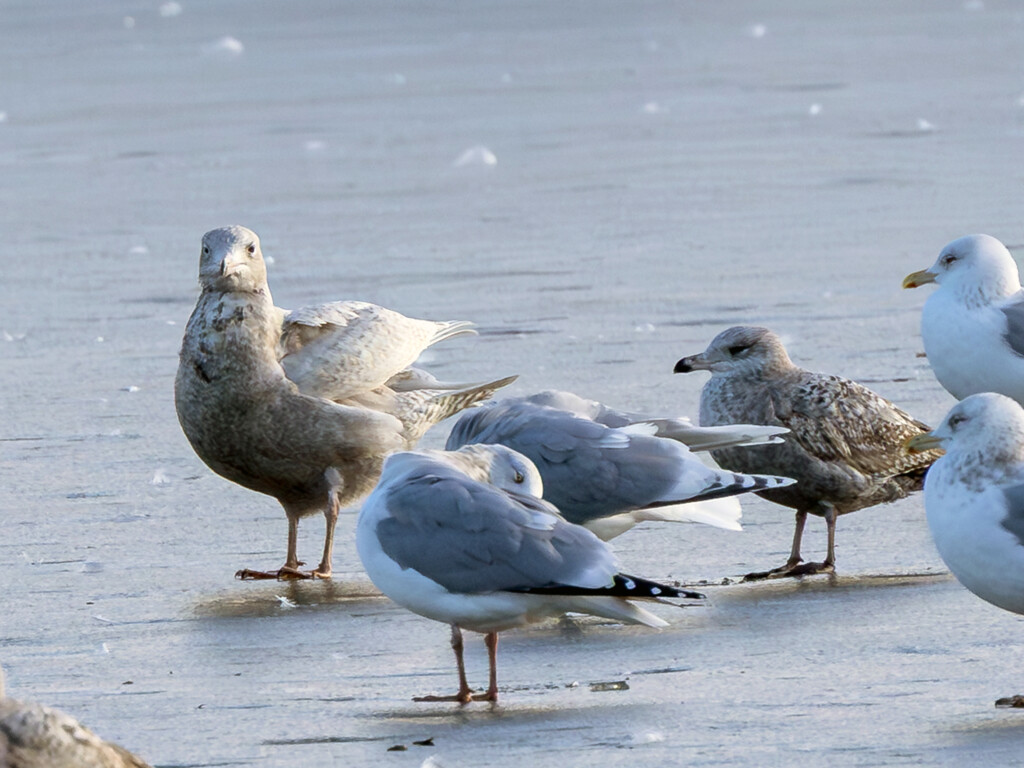
Image: Iceland Gull (middle behind the Ring-billed Gull) on ice next to a larger, pale Glaucous Gull (left), highlighting the Iceland’s gray primaries and large apical spots. Photo by Bill Sharkey.
In Indiana, we see mostly Thayer’s subspecies of Iceland Gull. They can be difficult to separate from American Herring Gulls. Kumlien’s subspecies generally has very white or light gray primaries, making it easier to separate.
Until I learned to focus on the primaries, I spent hours looking for “dove-shaped” heads on Iceland Gulls. It was a waste of time. Gulls can change their head appearance all the time. John Cassady, a birder who spends many hours looking at birds along Lake Michigan’s shoreline, finally got me to look at the primaries and ignore the head. It feels like magic, only real.
Look at the Iceland photo. Note the apical spots, including their size and spacing. They have large apical spots, and they are more closely spaced than on an American Herring Gull. In this bird, the remainder of the primary is a lovely gray, not black. And as an extra bit, you can see the fully white under portion of the far primaries, a dead giveaway for Iceland, though often not visible.
As a late holiday present, enjoy the young Glaucous Gull to the left of the Iceland Gull.
Get out in the field, observe, take photos, and dress warmly and learn.
Quiz Time
The four gulls mentioned in the article are in this photo. Can you identify each? To my eye, one is tougher than the rest.
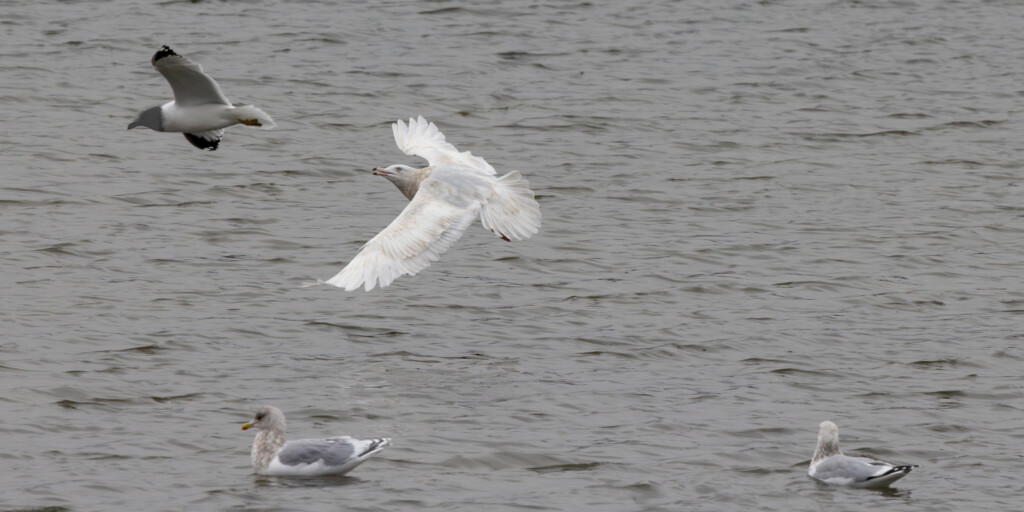
Quiz Image: Four gulls at Elkhart Co. Landfill. Photo by Bill Sharkey.
Tags: birding insights identification