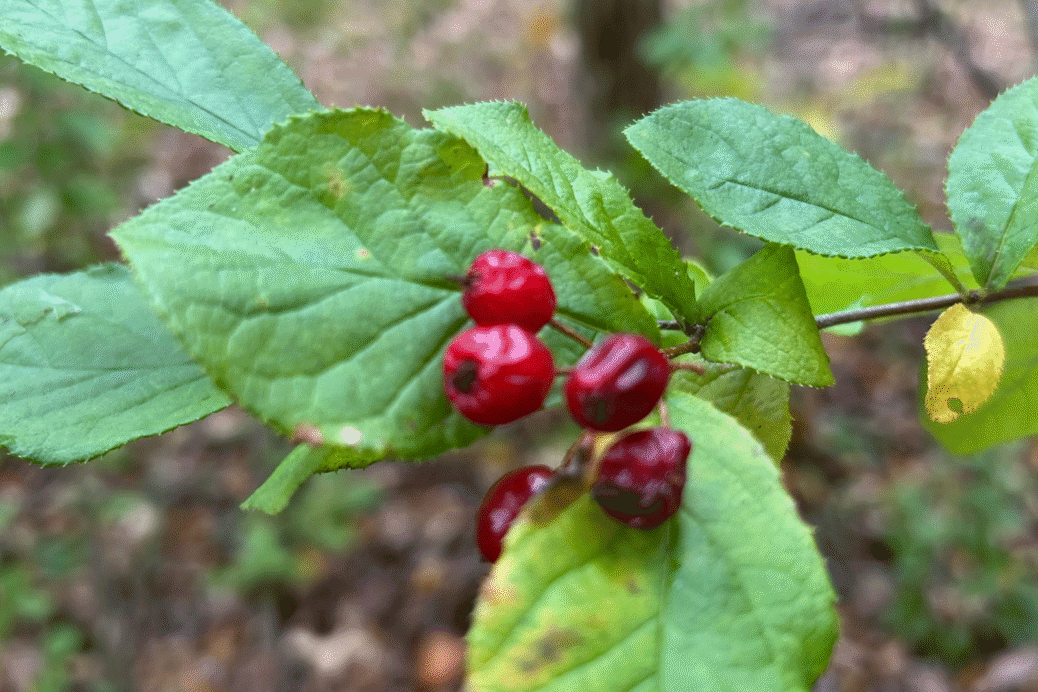
Image: Close-up of Christmas berry (Pourthiaea villosa) branch with small clusters of bright red berries and green leaves in a woodland setting. Photo by Mary Gray Bird Sanctuary Land Steward Alex Warchol.
BY LIBBY KEYES
During a Trick-or-Treat Weed Wrangle at Mary Gray Bird Sanctuary (MGBS) aimed at controlling burning bush on the property, volunteers — including Dawn Slack, coordinator of the Southern Indiana Cooperative Invasives Management (SICIM) partnership, and several others — made an unexpected discovery. While carefully scanning the area for the distinctive branching pattern of burning bush MGBS Land Steward Alex Warchol noticed a plant that at first glance appeared to be a native species. After asking Dawn if she recognized it and realizing it was not immediately identifiable, the group examined the plant more closely.
Using the Seek app to help identify the plant, they were surprised to find no nearby records of the species. Dawn collected samples to add to her collection and to confirm the identification, documenting what appears to be the first recorded occurrence of Christmas berry in the state.
Christmas berry (Pourthiaea villosa), also known as Oriental photinia, is a deciduous shrub or small tree in the rose family native to eastern Asia. It grows up to about 15-16 feet tall and produces clusters of small white flowers in spring, followed by bright red berries that often persist into winter. The species was introduced to North America as an ornamental landscape plant because of its attractive foliage and fruit, but it has since escaped cultivation and begun spreading into natural areas. Birds readily eat the berries and disperse the seeds, allowing the plant to colonize forest edges, riparian areas, and disturbed habitats, where it can form dense thickets that shade out native plants and reduce understory biodiversity.
While most established populations are currently concentrated in the Mid-Atlantic and Northeast, Christmas berry has begun appearing farther west and is considered an emerging invasive species in parts of the Midwest. Reports now extend to states such as Ohio, suggesting the species is continuing to expand its range. Because birds disperse the seeds widely and the plant reproduces readily by seed, identifying new populations in states like Indiana is critical, where early detection and removal could help prevent wider establishment.
Discoveries like this are exactly why we’re documenting biodiversity at MGBS on iNaturalist. Explore what’s been recorded so far in our MGBS Biodiversity Project on iNaturalist, and if you have an account, you can join the project and add your own observations.
Tags: mary gray bird sanctuary