Image: A White-throated Sparrow showing its classic yellow lores as it forages along a light dusting of snow. Photo by Ryan Sanderson.
BY OLIVIA BAUTCH
Isn’t it delightful to finally make our way into the field? It’s late November, and the biting wind has not stopped us from finding a fluffed-up flock of birds huddled atop the frosty ground. It hasn’t stopped other birders either. Listen in to their observations:
“Got a couple sparrows… brown back, dull white breast, no streaking…”
“White supercilium, white throat… crown is brown…”
“Right, and see the one on the right’s got the yellow lore…”
You’ve spotted the birds they’re discussing. About fifteen small, round, brown-and-white birds—with some black on them too—are hopping here and there, feeding on seeds scattered atop the snow.
Brown back, white breast… okay, you can follow that. But crown? Lore? Supercilium? Isn’t a supercilium the powerhouse of the cell? What does any of this have to do with a bird?
Why Birders Should Know Anatomy
I probably should have explained some terminology before we got to the field. After all, anatomical “field marks” are one of the keys to bird identification.
Though anatomy might sound a bit daunting, you don’t have to be a biology whiz to understand these features. And while birds make use of amazing mechanisms such as hollow bones, a unique voice box, and a four-chambered heart, internal anatomy is best tackled in its own article.
Cornell Lab of Ornithology describes field marks as “the distinctive stripes, spots, patterns, colors, and highlights that birds have,” noting that “one way [birds] use some of these markings is to recognize members of their own species.” They advise that birders “use them for the same purpose.”
Consider the sparrows in front of us. How did you conclude they were indeed sparrows rather than, say, a heron or a hawk? You might have drawn from several traits:
- Size
- Shape
- Pattern/Color
- Posture
Even the most experienced birders rely on these attributes to narrow down species or subspecies; the process only becomes quicker and more subconscious with familiarity.
Back to the sparrow with the yellow lores: a White-throated Sparrow. Let’s compare that with a few other species to learn the anatomical features all birds share.
Head Shape and Patterns
The head may be a small portion of a bird’s body, but it features a wealth of field marks that are both helpful for identification and functional for the species. Take a good look at the White-throated Sparrow’s head. Several stripes of brown and patches of white run across the face, and each has a name. The graphic below compares our bird to the nearby Dark-eyed Junco and Tufted Titmouse.
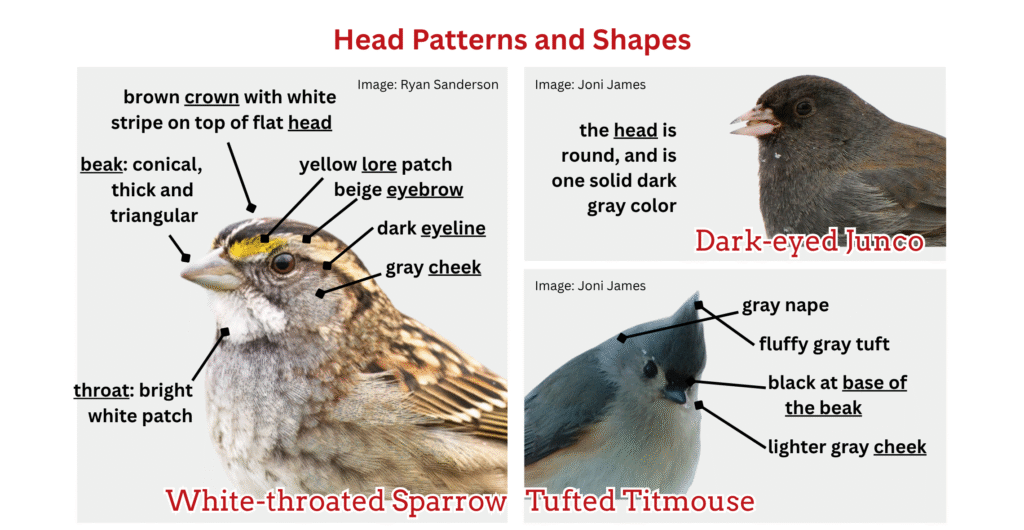
Image: Graphic showing head patterns and shapes for White-throated Sparrow, Dark-eyed Junco, and Tufted Titmouse, with labeled features such as crown, lore, eyebrow, eyeline, cheek, throat, and nape. Courtesy of Olivia Bautch.
The top of a bird’s head is generally referred to as the crown, but it can be flat, round, crested, colorful, peaked, or tufted—like the “ear” tufts on an owl. Speaking of ears, you won’t be able to point these out on feathered heads; pulling back the feathers reveals a funnel-shaped opening on each side. The placement is similar to ours but with built-in noise reduction and debris protection.
In this way, it may be helpful to notice how many of these field marks resemble the placement of features on a human face. Though not all features have an exact match (our nose is definitely not part of our upper mandible), remembering these terms allows you to understand and describe color patterns more efficiently.
As I hinted earlier, these features serve more function to birds’ body parts and color patterns than providing humans an easier identification experience. On the head, this may include patches of color that differ on male and female (and even young birds of the same species); ear tufts that help an owl disappear into bark on a tree; a diversity of beak shapes; feathered plumes grown solely to impress a mate; or a malar stripe that reduces sunlight glare for a fast-flying falcon.
Body Shape and Patterns
Now turn to the Red-tailed Hawk and Great Blue Heron in our field guide. Most of us can name major anatomical parts (think wings, legs, and tail), but we can always dive deeper.
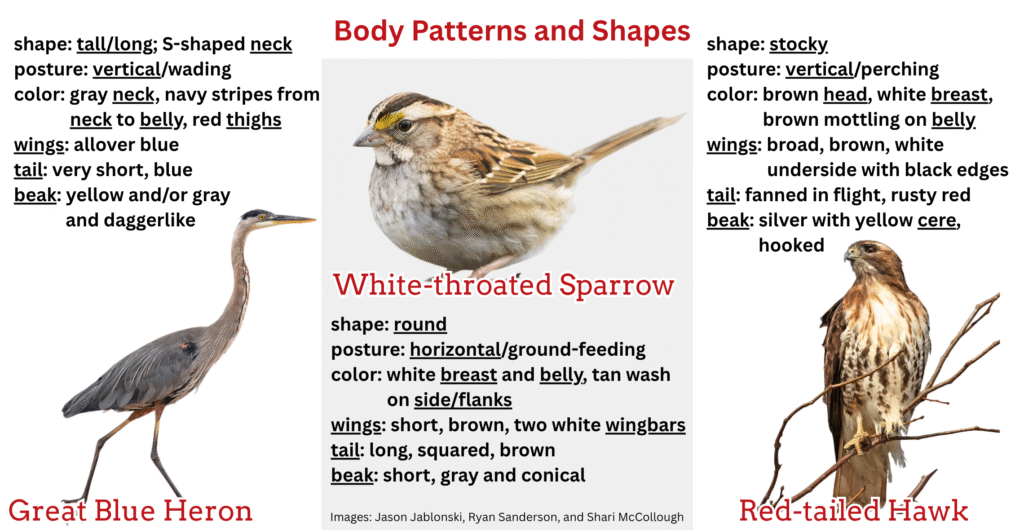
Image: Graphic showing body patterns and shapes for three birds: Great Blue Heron, White-throated Sparrow, and Red-tailed Hawk. Each bird is pictured with bullet points describing its shape, posture, color, wings, tail, and beak. Courtesy of Olivia Bautch.
Few birders know the intricacies of bird anatomy like bird banders. Armed with thick guides to plumage and measurements, these detectives analyze patterns across individual feathers. I don’t recommend jumping straight into the rabbit hole of numbered primaries, but knowing what a primary is can be practical. Regardless of species, feathers can be divided into groups: primaries, secondaries, primary and secondary coverts, alula, and tertials. When a bird has barring on inner feathers but not the outer ones, you can say it has barring on the secondaries.
Sparrows, herons, and hawks all forage differently, so naturally their legs, wings, and feet naturally take different forms. The long legs and equally long neck of the heron make sense in a wetland setting where lunch is reached just under the surface.
Broad wings and a fan-shaped tail create the necessary aerodynamics for a hawk that spends much of its day in the skies. And since that hawk isn’t wading in shallows or grasping its prey underwater, it can stand to lose some of the length, instead taking on piercing talons and beak.
But the sparrow is a lot less comfortable being out in the open, much less perched high on a power line. Its muted, earthy color palette resembles its habitat of leaves and dirt, and its short, thin legs and feet are the perfect build for hopping and scratching up dirt.
If I stress one thing, it’s that the build of a bird clues us into its behavior, and vice versa. Next time you observe a woodpecker clinging to a tree trunk, direct your attention to its stiff, stabilizing tail acting as a prop, a feature unique to woodpeckers. Whether walking, swimming, perching, or clinging all birds are fashioned with suitable feet, from the webbed to zygodactyl to the fluffy.
Back in the Field
These features are, as they say, just the tip of the avian iceberg. Start by looking at a few field marks at each avian encounter. Before you know it, you’ll be building a mental reference base and recognizing features without realizing it. As with all of birding, it’s important not to focus on memorizing facts, but rather allow the birds to tell you about themselves. If you take the time, they will.
Anatomy Terms Alphabetized
Back: Runs from nape to rump, may be partially hidden by the wings.
Belly: Part of the chest below the breast.
Breast: Part of the chest below the throat.
Cap: Typically used when the top patch of the head is prominently filled with a solid color.
Cere: Base of the beak where a bird’s nostrils are.
Cheek: Patch next to the beak.
Crest: Longer feathers on top of the head that may spike up or lay down.
Crown: The patch on the top of a bird’s head.
Eyebrow/Supercilium: Line above the eye.
Eyeline: Line through the eye.
Eye-ring: Ring around the eye.
Flight Feathers: Long feathers that make up the ends of the wings.
Legs: Extend from the breast of the bird. Knee is found internally.
Lore: Small patch of color between the beak and eye.
Nape: Back of the neck.
Rump: Patch of feathers on the lower back where the tail begins.
Side/Flank: Patch of feathers underneath each wing extending partially to the breast.
Speculum: Small, rectangular patch of shiny feathers on ducks.
Talon: The hooked “claw” of the toe.
Tail: Feathers extending from the back end of the bird.
Throat: Patch underneath the beak.
Toes: Typically three forward facing toes and one hind toe. Sometimes webbed.
Tufts: Feathers that stick up, may be one or two (ear tufts in owls).
Undertail Coverts: Patch of feathers underneath the rump.
Upper/Lower Mandible: Upper and lower part of the beak.
Wingbar: Formed when stripes on a few or more feathers that line up to create one long stripe across the wing.
Tags: birding 101 birding insights identification