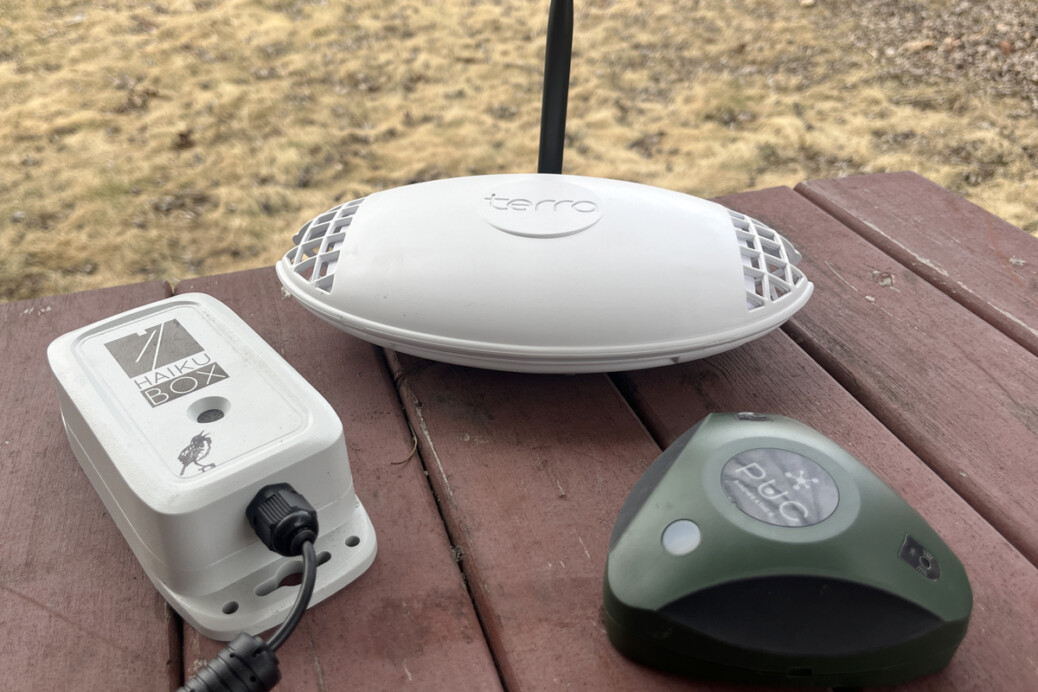
Photo: All three sound recording devices – HaikuBox, Terra, and BirdWeather PUC – by Brad Bumgardner.
BY BRAD BUMGARDNER
We live in a new golden age of birding. From advanced optics and new cameras to the latest apps, we have a remarkable set of new birding gear and toys at our fingertips. For years, the biggest hurdle has been cracking bird sound identification (or simply “ID”). Whether for migration tracking, population monitoring, or simply enjoying the diversity of birds around you, audio recording devices and AI-driven sound ID software have opened new opportunities for birders and citizen scientists alike.
As someone deeply fascinated by bird sounds, I’ve been exploring various new technologies that help refine bird ID through audio analysis. To provide a hands-on comparison, I installed three leading devices—HaikuBox, Terra, and BirdWeather PUC—side by side on my roof, allowing for a direct evaluation of their identification accuracy, app functionality, and usability as a citizen scientist. These units were tested both in the open and within parabolic cones to amplify the ambient sounds during the winter, putting their capabilities to the test.
BirdWeather PUC: The Clear Winner
The BirdWeather PUC is a compact, AI-powered acoustic monitoring device designed to capture and analyze bird vocalizations in real time. It utilizes a high-fidelity microphone to record ambient sounds, which are then processed using the BirdWeather platform’s machine learning algorithms, primarily leveraging an advanced version of the BirdNET model. The PUC provides users with extended nine-second recordings, allowing for more detailed analysis compared to shorter audio clips used by competing devices. It features customizable bird species detection settings, probability threshold filters, and species-specific filters, ensuring precise identifications tailored to your soundscape. The device continuously uploads data to the BirdWeather cloud, where it is cataloged and made accessible through a user-friendly web interface that supports community validation.
Without question, BirdWeather PUC stands out as the best-performing device. It offers superior detection accuracy, a well-designed and intuitive website, and an app interface that makes listening and verifying identifications seamless. Users benefit from extensive customization options, including gain control, bird probability and confidence filtering, and even species-specific adjustments. It also just feels “eBirdy,” with its data-driven format, making it a natural fit for users accustomed to that platform.
HaikuBox: A Strong Contender
The HaikuBox is another AI-powered bird sound monitoring device designed to help birders and researchers identify birds in their area. It continuously records environmental sounds and uses machine learning models to analyze and identify bird calls in real time. The device features a single built-in microphone optimized for capturing a wide frequency range, and its recordings are processed using similar BirdNET models. HaikuBox provides users with a web-based interface displaying detected species and their associated confidence levels. Unlike the BirdWeather PUC, HaikuBox records shorter two-second audio clips, which can limit verification potential. While it lacks advanced customization options such as gain control and species-specific filtering, it remains a reliable tool for automated bird monitoring, particularly for those who prefer a simpler, web-based platform for viewing the sightings. One downside is that some features require a subscription, and the current purchase prices include only one- or five-year subscriptions.
In my field tests, HaikuBox detected approximately 80% of what BirdWeather PUCs was able to detect consistently. While it identifies most of the same species, BirdWeather PUC captured a higher number of detections overall and correctly identified a few of the more unusual species. Both devices’ BirdNET models struggle with differentiating geese overhead and often misidentify finches, occasionally falsely reporting non-existent crossbills and siskins in my yard—likely due to probability ratings being higher elevated in a a non-irruption year.
The app experience is less refined, offering only a web-ported interface that is not optimized for mobile users. Additionally, HaikuBox records only two-second audio clips, compared to PUC’s nine-second clips, making verification of calls more difficult. Placement of HaikuBoxes must also take rain into consideration, as water can pool in the microphone opening, requiring regular cleaning if positioned upright. Filtering is available in three basic settings: Low (0-40% confidence), Medium (40-90%), and High (90%+).
Terra: Not Ready for Prime Time
The Terra device began as a Kickstarter project in 2022. Initially backed by a community of conservationists, researchers, and eco-enthusiasts, the project quickly gained traction and has been promoted as an evolving tool for acoustic monitoring and research. Like the other devices, it is designed to capture and analyze sounds using BirdNET. Terra is equipped with high-sensitivity omnidirectional microphones that record across a 20 Hz to 20 kHz frequency range. Unlike the smaller units, the Terra is a UFO-shaped disc, with attachable stakes or mounts. Like the other devices, it features a waterproof casing for outdoor durability.
Released in the fall of 2024, Terra unfortunately falls significantly behind its competitors. After 30 days of testing, the device showed limited species identification capabilities, lacks a user-friendly interface, and offers no way to validate detections as of this writing. While the developers promise future updates to improve functionality—including features already available on its competitors’ devices—its current form is underwhelming.
One of Terra’s potentially unique advantages is its integration with Motus for tracking migratory birds, but reported connectivity issues and a lack of core functionality make it difficult to use effectively. Additional sensors are also available but must be purchased separately, unlike BirdWeather PUC, which includes them in the base unit. One possible upside is that Terra is the only device among the three that allows for live listening through the app. If your phone is synced to a Bluetooth audio device, it can create a live soundscape in your home. The backend editing site, Featherworks, allows for specific sound filtering at the source, including both low/high pass filtering and notch filters for specific noise cadences. However, until major updates are implemented, Terra is not yet a viable option for serious bird monitoring.

Photo: The Haiku Box, Birdweather PUC, and a similar recording device (called a Micro2), installed on Brad’s rooftop for sound testing.
Future Considerations
One of the most exciting aspects of this comparison is the potential for future advances in audio detection technology. As BirdNET and similar AI models improve, these devices may become even more valuable to citizen science efforts. I am currently experimenting with 3D-printed funnel horn attachments to test whether they can amplify nighttime detections and be useful in nocturnal flight count studies of bird migration. With the open-source BirdNET continually evolving, these devices will only improve with time.
Final Verdict
For those looking to explore bird sound monitoring or move beyond the Merlin Bird ID app’s capabilities, BirdWeather PUC is the clear winner in terms of detection accuracy, app usability, and user customization. HaikuBox is a solid second-place contender but falls short in terms of app design and data access for citizen science. Terra, while promising, is not yet ready for serious use. I look forward to monitoring the growth of these innovative tools as new updates and improvements continue to propel us into a new modern age of bird understanding.