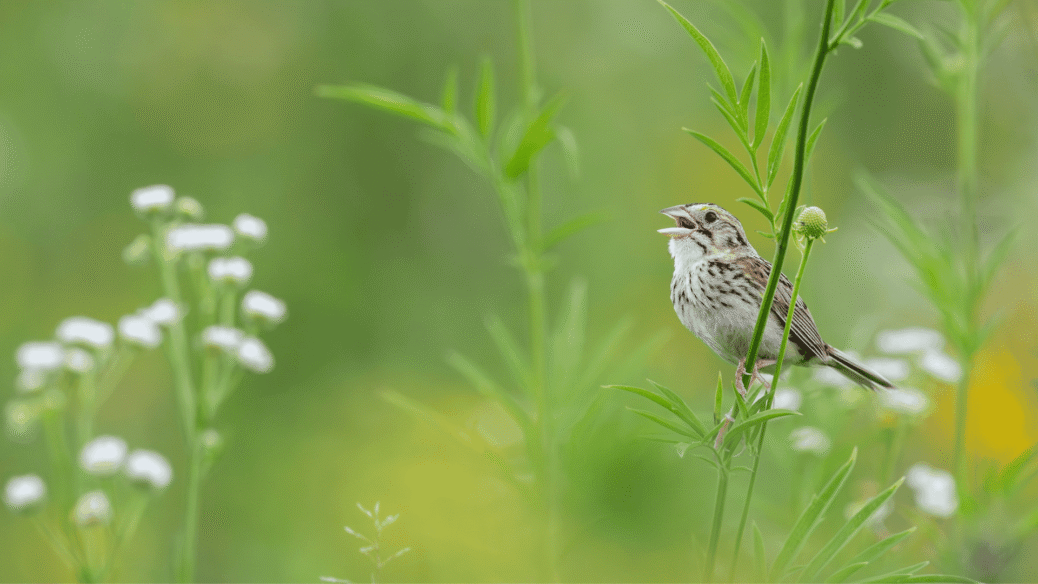
Image: State-endangered Henslow’s Sparrow perched and singing amid dense native grassland with tall grasses and wildflowers. Habitat loss and fragmentation have driven widespread declines in grassland birds across North America. Photo by Ryan Shean.
How We Advocate
Indiana Audubon works to make sure birds and the habitats they depend on are part of the decisions that shape conservation across the state. With a small staff, we focus on the moments that matter most, drawing on a statewide and regional network of board members, partners, and community experts with experience in science, policy, law, and conservation.
Our advocacy is practical and selective. When an issue reaches a real decision point, we share clear, science-based context and outline ways people can engage effectively. Local Audubon chapters and partner organizations often lead on place-based issues, while Indiana Audubon helps connect the dots, clarify the stakes for birds, and support public participation.
That work reflects the same foundation as everything we do: conservation, education, and research. Advocacy might start with everyday choices at home or in a neighborhood and extend to public comments or outreach to elected officials when larger decisions are on the table. Because birds move across landscapes and borders, the issues we engage with in Indiana are often connected to regional and national conservation efforts.
To learn more about our work, see our Programs and Initiatives page.
State-listed Species and Conservation Priorities
Indiana Department of Natural Resources uses Species of Greatest Conservation Need (SGCN) to guide conservation priorities statewide, and we use it to help focus our advocacy. Visit their website to learn what endangered, threatened, and special concern designations mean and to access the SGCN Explorer.
Where We Have Taken Action
Over the years, Indiana Audubon has participated in advocacy efforts on the following issues, often in partnership with other conservation organizations.
- Mounds Reservoir proposal (Anderson, 2014): Opposed due to habitat impacts
- Wind energy standards (2018): Supported through a coalition letter
- Natural prairie concentrated animal feeding operation (Newton County, 2018): Opposed and supported related litigation
- Indianapolis Motor Speedway mass balloon release (2020): Advocated to end the practice
- County Line Orchard mowing during nesting season (Hobart, 2024): Advocated for delayed mowing to protect nesting grassland birds
- Migratory Bird Treaty Act protections for bird collisions (2024): Urged stronger protections through a petition with the Center for Biological Diversity
- Federal bird science and monitoring programs (2025): Opposed proposed defunding
- Federal public lands transfer (2025): Opposed through a joint letter with Indiana Wildlife Federation
- LEAP Project and Eagle Creek water withdrawals and discharge (Indianapolis to Lebanon, 2026): Opposed due to water and habitat impacts
- Federal environmental policy changes (2026): Raised concerns about impacts to bird habitat and science-based environmental review
Guidance and Resources
We regularly hear from people about local issues that may affect birds and habitat, from development proposals and nesting-season mowing to Bald Eagle activity near construction, free-roaming cats, infrastructure near wetlands or parks, and issues like light pollution and bird-window collisions.
Typically, our role is to share bird-focused context and help point people in the right direction. For place-based concerns, starting with a local Audubon chapter or another community conservation group is usually the most effective next step.
If you need more support, these are organizations we often look to for additional guidance, resources, or partnership:
- Local Audubon chapters (place-based support and local contacts)
- Soil and Water Conservation Districts (county-level conservation planning)
- Indiana DNR’s Division of Fish and Wildlife (state-listed species, guidance for wildlife concerns)
- USDA Natural Resources Conservation Service’s Indiana Office (habitat practices on working lands)
- Hoosier Environmental Council (statewide policy, land use, water, energy)
- Indiana Wildlife Federation (statewide conservation policy and advocacy)
- Indiana Land Protection Alliance and their partner land trusts (site-specific land protection and stewardship)
- Sierra Club Hoosier Chapter (grassroots organizing and state policy)
- Citizens Action Coalition of Indiana (energy and utility policy, public engagement)
- Pheasants Forever and Quail Forever (habitat programs and grassland needs)
- Audubon Great Lakes (regional bird policy and advocacy)
- American Bird Conservancy (national bird policy, cats, bird-safe glass, lights-out guidance)
Support Our Advocacy Efforts
Support from memberships and unrestricted donations helps Indiana Audubon maintain the capacity to respond to emerging issues and engage in advocacy when it matters most.
How to Speak Up for Birds
Bird-friendly decisions are often made locally through city and county plans, local ordinances, state agency rules, and public comment periods. With limited capacity, Indiana Audubon focuses on public lands and public decisions that can affect birds and habitats at a broader scale. We do not get involved in private land disputes. Local organizations and residents are often best positioned to lead.
If you want to take action locally, here are high-impact ways to help the birds.
- Watch for real decision points. Track agendas for your city council, county commissioners, planning commission, parks board, and state agency public meetings so you can show up when votes, permits, and management plans are actually on the table.
- Make one clear ask in a public comment. Keep it short, specific, and tied to the decision being made. Request one action (delay mowing until after nesting season, add a bird-safe lighting standard, protect a buffer, require mitigation).
- Submit useful evidence. Share photos, dates, and simple documentation like repeated sightings, nest activity, or seasonal use. Point to existing plans or rules (park management plans, state wildlife action goals, seasonal mowing policies).
- Talk to the person who manages the site. The most effective first contact is often the land manager or parks superintendent. Ask what policy guides their timing and maintenance, and offer a bird-friendly alternative.
- Bring birds into the conversation. Invite staff or local officials to a short site visit or bird walk. Seeing the habitat and hearing what is using it can shift the discussion from abstract to real fast.
- Use local media strategically. A short letter to the editor can help, especially when it is local, respectful, and ends with a specific request tied to an upcoming decision.
- Work with others. Find the people already invested, such as a local Audubon chapter, bird club, park friends group, neighborhood association, or watershed group. Coordinated outreach carries more weight than one-off messages.
- Help in ways that fit you. Not everyone needs to speak at a meeting. Tracking agendas, drafting a template comment, gathering documentation, or following up with officials is just as valuable.