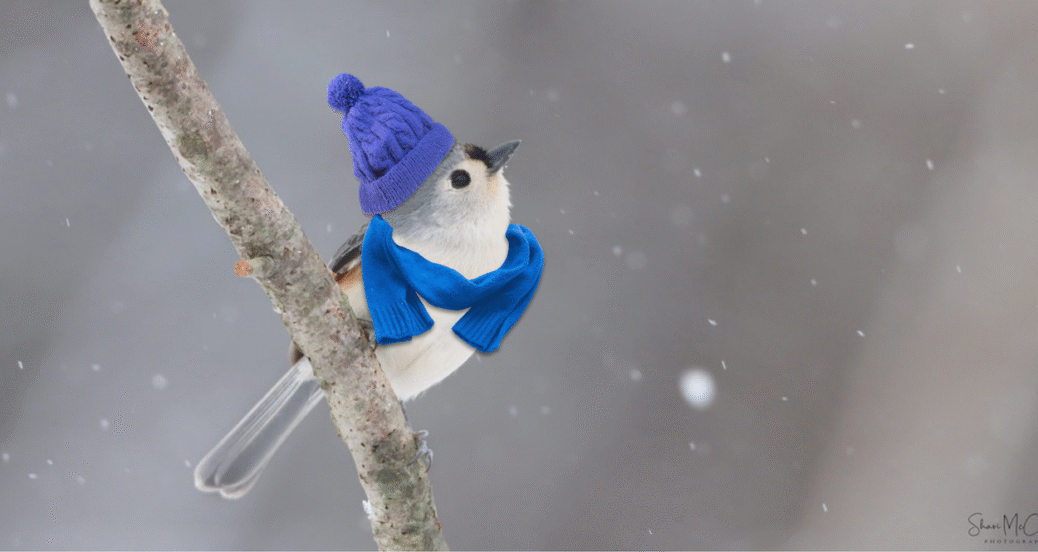
Image: Tufted Titmouse perched on a tree branch in falling snow, shown wearing a blue knit hat and scarf in a stylized graphic. Photo by Shari McCollough.
BY OLIVIA BAUTCH
Have you heard about the annual bird-counting event that takes place this time of year? Perhaps you have, but considering that some areas of Indiana have not seen such steady snowfall since 1989, right now you would rather cuddle up by the fireplace with a toasty mug of cocoa and hibernate there until March. It’s a good thing you’re not a bird.
What birds remain over the winter to count anyway? Whenever the season rolls around, we receive questions and comments such as this from curious bird lovers wondering when their robins will return or if all the birds have left the northern half of the country.
While it’s true that many species of birds are limited to specific habitats and ecological niches, including intolerance for below-freezing temperatures, many are highly adaptable. This includes birds like herons and bluebirds you probably associate with spring nesting or summer streams.
Keeping Warm
When on occasion you emerge from your civilized abode, you likely see pigeons crowding power lines or find a pom-pom-shaped wren deep within a wooden nook. Is that a pregnant mama wren in December?
Nope. That “pom-pom fluff” look is a mechanism birds use to warm themselves. Peter Marra of the Smithsonian Migratory Bird Center explains, “Birds fluff up in the cold to trap as much air in their feathers as possible. The more trapped air, the warmer the bird.” This not only applies to the pigmented coat visible to us, but also the thousands of down feathers underneath. That’s why you may see geese sit with their long legs tucked under them and their long necks bent to hide their faces under a wing.
We’ve all been told that our head, hands, and feet are the quickest to lose heat, so if you’re reading this with gloves on, take them off for a moment. Can you feel your fingers grow stiff in the cold? Tuck your hand into your jacket, sweater, or shirt. Immediately, your exposed skin is wrapped in warmth, your own body heat radiating in the fabric pocket. Now imagine your body covered in thousands of these little layered heated pockets. That’s toasty!
Some species of raptor wear even more downy protection over their legs, like feather snow pants, to pluck rodents from deep snow. Plus, in the fall molt, many birds quite literally put on a thicker coat. “Chickadees double their body feathers in the winter,” notes Columbus MetroParks naturalist Stephanie West, “increasing to nearly 2,000 feathers from a summer average of 1,100.”
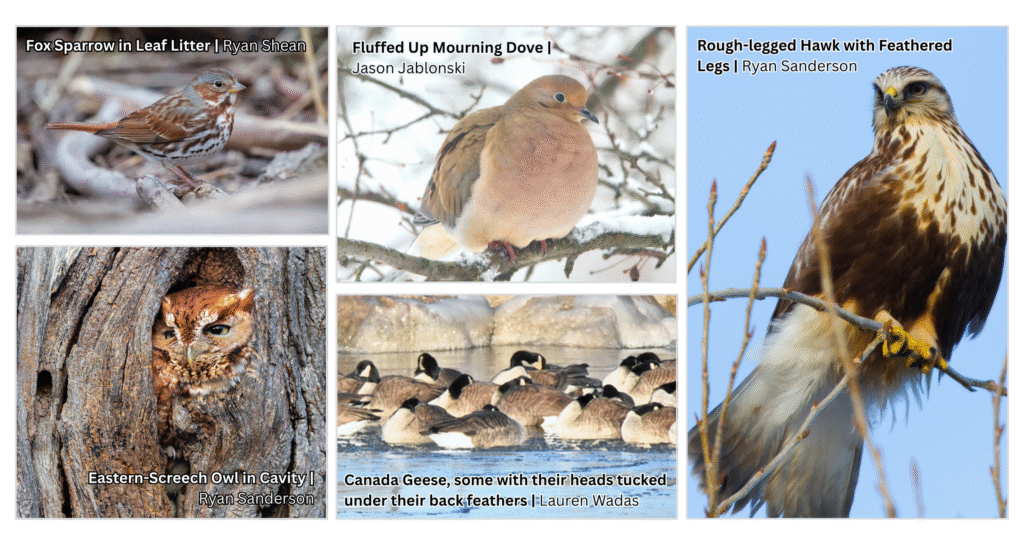
Graphic: Collage of winter bird adaptations, including a Fox Sparrow foraging in leaf litter, a fluffed-up Mourning Dove on a snowy branch, an Eastern Screech-Owl roosting in a tree cavity, Canada Geese resting on ice, and a Rough-legged Hawk with feathered legs perched on a branch.
No-So-Cold Feet
Speaking of feet, a goose can tuck its legs into its feathers, but its feet still stand on ice. How do they do that? First off, the feet of geese, gulls, herons, or ducks do not hold as many nerve endings as ours do, so they are not as prone to frostbite in the first place.
Internally, birds warm their feet through a “countercurrent heat exchange system.” This term describes how warm blood flowing through arteries runs close to cooler blood returning through veins, allowing heat to transfer between them and keep the birds’ feet warm. I imagine it probably feels like wearing toe warmers under our boots.
Feeding Frenzy
Most of us haven’t held a chickadee or a goldfinch in our hand, so it’s hard to conceptualize their lightweight form, the number of interlocking feathers, or legs so paperclip-thin you wonder how they don’t snap. This perspective makes even more amazing the design that keeps birds not only hardy, but also bossy at winter feeders. These small species look fidgety at feeders, but there’s a good reason for that.
After a long workout or hike, an environment that was chilly now feels toowarm. So it makes sense that high activity keeps small birds’ body temperatures regulated. The benefit is twofold, because chickadees, titmice, and nuthatches also engage in foraging behavior called caching. Beginning in fall and continuing through the coldest months, they stash extra seeds and insects in crevices and crannies to find again in harsh weather. It’s one for now, and one for later.
Where are they finding these insects? Whether you like it or not, not all insects die off after the frost. You might find them under bark, leaf litter, and the frozen layer of a pond. Insects have their own mechanisms for waiting out winter, and since many bugs are beneficial, it’s best to leave them for the birds to snack on. Similarly, many of the mammals, invertebrates, and fish that feed raptors and waterfowl are still within reach when a habitat is not completely frozen over.
Sleep and Snowstorms
Let’s put our cold in context for a minute. Our 30-degree, four-inches-of-snow days and 15-degree nights are nothing compared to an average day on the breeding grounds for Northern Saw-whet Owls. Projected winter highs for Winnipeg in Canada often average in the teens, with lows reaching -12 degrees and windchills lower than that.
Right, but it’s still cold here, especially overnight and during ice and snowstorms. Birds have an adaptation for that. In fact, they have several. Your initial guess as to where a bird sleeps might be its nest from springtime. Some cavity-nesting species—think the ones that use nestboxes like bluebirds, owls, and woodpeckers—will roost in cavities from sunset to sunrise. But a nest really is not the equivalent of our bed or even our home, instead serving as a temporary nursery.
Non-cavity nesters might tuck their fluffed-up selves deep in coniferous boughs, hedges, against a tree trunk, amongst tall grasses, or even floating on the water. Clearly, some of these locations offer more cover, not to mention protection against predators. As an extra level of defense, birds such as ducks, Golden-crowned Kinglets, and Northern Bobwhite roost huddled close to maximize shared body heat and resources. And though it seems counterintuitive, American Goldfinches have even been observed burrowing into the snow to spend the night.
How Can I Help Birds in Winter?
Winter is considered one of the most critical bird feeding seasons. Fewer resources are readily available during the months when maintaining fat stores is a matter of life or death. Check out our recent Instagram primer on what to feed your backyard visitors.
If you’re up to braving snowy winter weather, do yourself a favor and find some of the species sticking around for the holidays. Just remember to layer up, warm your hands and feet, keep yourself well nourished, and gather with your flock—just like the birds do.
Tags: birding insights