
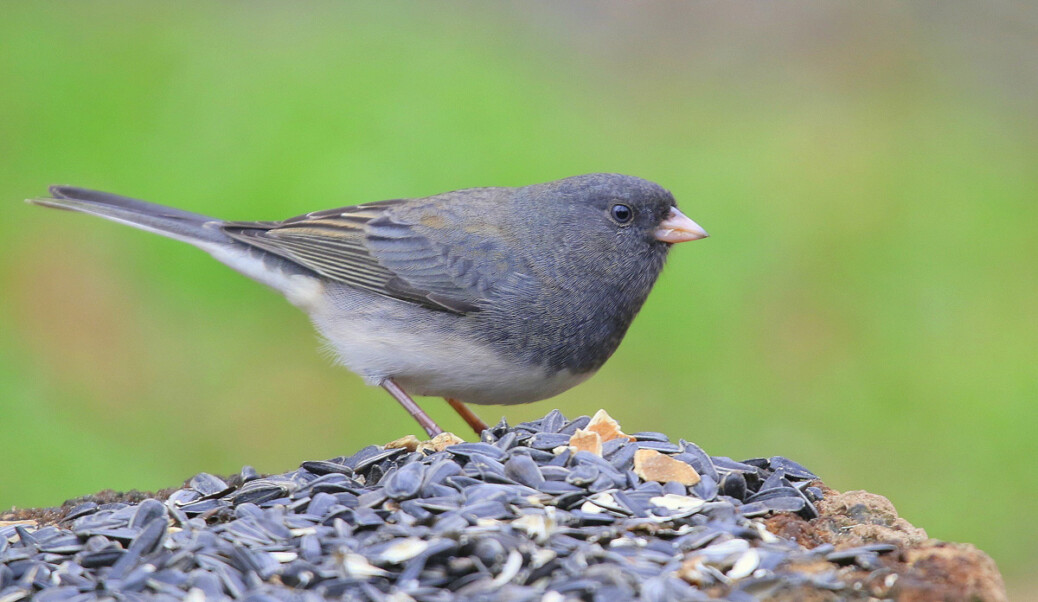
Image: A Dark-eyed Junco perched among sunflower seeds at a backyard feeder in LaPorte, Indiana, its slate-gray plumage contrasting with the soft green background. Photo by Julie Gidwitz.
BY WHITNEY YOERGER
“Where have all my birds gone?”
It’s the question that lands in our inboxes and Facebook comments every fall, starting as early as August. The truth is, those familiar birds at your feeders really have disappeared—not mysteriously, but for good reason. They’re doing what birds have always done, moving on as food sources fade and the season shifts.
A quiet feeder is something nearly every wild bird lover notices this time of year. Some wonder if their seed mix could be more appealing, while others are concerned that there may be fewer birds around than there used to be. The truth is that both hunches are partly right.
Migration, habitat shifts, and long-term population changes all play a part. Understanding what’s happening, both in bird biology and in the landscapes they depend on, helps explain why your yard feels less birdy in fall. The ten questions and answers below unpack what’s behind the quiet, and what you can do to help.
When do birds actually migrate in fall, and do they all leave at the same time?
Right now, the sky is a kind of avian highway, one running quietly and mostly at night. Birds are in the middle of their second big flight of the year. But unlike spring, when the urge to breed turns migration into a sprint, fall migration unfolds more slowly. The urgency is gone. Birds are done raising families, and freshly minted adults are figuring out where to spend their winters (and how to get there) for the very first time.
Migration occurs in overlapping waves from August into November. The earliest travelers are Arctic-breeding shorebirds leaving drying wetlands, night migrants that pause by day to refuel on exposed mudflats. As late August turns to September, the pace quickens with nocturnal flights of thrushes, flycatchers, and a dazzling variety of warblers. Calm, clear nights bring the heaviest movement as mixed flocks ride north winds. By early October, the rhythm changes again as sparrows, blackbirds, and other late-season migrants follow cooler air southward, marking the final surge before winter’s quiet.
By November, the shape of migration shifts. The colorful songbirds of summer have mostly cleared out but raptors, cranes, and waterfowl are on the move, riding cold fronts and gathering on wetlands, marshes, shorelines, and reservoirs. These migrating species generally don’t visit backyard feeders, which can make yards feel unusually quiet during this “shoulder season.” Even resident birds like chickadees, titmice, and cardinals keep a lower profile, caching food and building up fat reserves for the cold ahead.
Want a deeper dive into the mechanics of migration and the differences between short- and long-distance migrants? The Cornell Lab of Ornithology has an excellent overview.
Is migration dangerous for birds?
Migration is one of nature’s great endurance tests. Many species migrate at night, when widespread artificial lighting, including bright LEDs, can disorient them and increase the risk of collisions with buildings, towers, and other structures.
Rest stops matter on their flights. When forest edges shrink, wetlands are drained, or open fields are converted to monoculture crops or mown lawns, birds lose critical stopover habitat. Pesticide use also reduces the insects they need to rebuild fat reserves, while excessive nighttime light can pull them off course. Each missing patch of habitat or shift in their natural navigational cues means less energy for the next leg south and higher odds of not making it. Every mile they travel is a calculation of energy, weather, and luck.
Are there fewer birds than there used to be?
The quiet we notice each fall is expected, but it has grown quieter in recent years. Across North America, bird communities are declining. The 2025 State of the Birds report confirms that more than one third of species are now of high or moderate conservation concern. That loss builds on the nearly three billion birds that have vanished since 1970, a figure first reported in 2019 by the Cornell Lab of Ornithology, the American Bird Conservancy, and partners.
It’s not only sensitive or endangered birds being affected. Some of the familiar backyard birds we see most often are also showing declines. A Washington Post analysis published in January 2024 used eBird data to map population trends for more than 500 species across the continent. The interactive tool lets you enter your city or town and see which species are most affected close to home. So if your yard feels quieter, it’s a change scientists are measuring too.
Do feeders actually make that much difference?
Several studies suggest that while feeders add little to birds’ overall diets, they deliver outsized benefits to people: peace of mind, connection to nature, and simple joy. Putting out a feeder feels like doing something helpful, a small favor to the birds that brighten our days. But in reality, birds were doing fine long before we came along with our seed mix.
Most species rely on a mix of natural foods—berries, seeds, insects, and tree sap—that vary with the seasons and the habitats they use. Some, like chickadees, jays, and sparrows, are generalists that can make easy use of feeders. Others are more particular. Finches such as American Goldfinches and Pine Siskins specialize in small, tough seeds, from nyjer and sunflower to the catkins and cones of birch and alder trees. Woodpeckers, nuthatches, and sapsuckers depend on living trees, drawing insects, sap, and larvae from beneath the bark.
A backyard feeder can’t match that diversity, but it can give birds a small boost in lean months, especially when snow or ice cover natural foods like seed heads or fallen nuts and acorns. Feeders help us notice birds, but what truly sustains them is what grows around them.
Is it still worth feeding birds in fall and winter?
By late fall, migration has thinned the flocks, and the birds that remain face long nights, frozen ground, and dwindling natural food. Feeders won’t decide whether they survive the season, but they can make the search for food easier through the cold.
If you do feed the birds, do it with intention. In winter, offer high-fat foods like suet and black oil sunflower seeds to support a variety of birds. And don’t underestimate the importance of water. A simple birdbath, or one with a heater, can draw more visitors than seed when everything else is frozen.
The U.S. Fish and Wildlife Service encourages mindful feeding: offer the right foods, clean your feeders, and remember that wild birds are well adapted to finding food on their own.
How do I keep my feeders bird-safe and healthy?
Clean feeders every couple of weeks, even in winter, to keep seed from molding or clumping with moisture. Wash them with a solution of one part bleach to nine parts water, rinse well, and let everything dry before refilling. Clear snow and ice from feeding areas, and move feeders occasionally to keep waste from piling up underneath.
Place feeders either within three feet of windows or more than 30 feet away to prevent high-speed collisions. Nearby shrubs and trees are good for providing quick cover from predators.
If you notice birds with swollen eyes or crusty growths on their bills, it could be a sign of avian pox or conjunctivitis. Take your feeders down right away, clean them thoroughly, and leave them down for at least a week to help limit the spread.
During confirmed avian influenza outbreaks in your area, pause feeding or clean more frequently, though the risk to songbirds is low.
What can I do to make my yard more bird-friendly year-round?
The most useful thing you can do for birds isn’t to hang another feeder; it’s to stop treating your yard like it needs to win the “Most Tidy” award. Native trees, shrubs and wildflowers do the real work, providing the food that keeps birds alive. A yard layered with plants of different heights gives both food and cover, and when you leave seed heads, fallen leaves, and brush over winter, you’re basically running an all-you-can-eat buffet for wildlife.
Neatness, as it turns out, is the enemy of a bird’s diet. A few leaf piles, some standing stems, and a couple of native plant swaps can bring more birds to your yard.
Think of your yard less as landscaping and more as a seasonal habitat system. For practical ideas, check out our two articles: “Birding 101: Bird-Friendly Fall Prep for Every Backyard” and “Creating a Bird-Friendly Yard.” You can also explore Homegrown National Park, a nationwide movement helping people replace lawn with native plants and reconnect the fragments of habitat right where we live.
Do ornamental plants or pesticides affect the birds I see?
Lawns and ornamental plants may look nice, but they interrupt the chain of life that keeps birds fed. Research from the University of Delaware shows that native plantings support far more insects and birds than conventional yards. Non-native ornamentals host only a fraction of the insects that native plants do, leaving less for birds to eat.
Pesticides widen the gap by killing what little life remains and contaminating what survives. Some of the most widely used, neonicotinoids, linger in soil and plants, spreading through pollen, nectar, and water. Even small doses can disorient or kill pollinators and reduce the insects birds rely on, while higher exposure can poison birds directly. Learn more from the American Bird Conservancy about pesticides and birds.
How can I help Indiana’s birds beyond my backyard?
Protecting Indiana’s birds takes more than feeders and native plants. It takes collective effort, practical science, and steady support. Becoming an Indiana Audubon member connects you to the broader effort.
Membership helps care for Mary Gray Bird Sanctuary in Connersville, where field studies, banding, and education programs connect more people closer to birds and their habitats. It allows our staff to visit communities across the state to share bird science, lead outreach programs, and involve more Hoosiers in conservation. Member support also keeps us engaged in statewide wildlife planning and on committees collaborating with public and private partners who carry out on-the-ground habitat projects and initiatives.
These efforts strengthen the landscape for birds across Indiana, and your membership connects you directly to that work.
What should I expect to see next?
While you’re waiting for new arrivals at your feeder, watch for the species that bring new life to Indiana’s colder months. Dark-eyed Juncos are already here, soon joined by American Tree Sparrows, Fox Sparrows, and occasional northern visitors like Pine Siskins, Redpolls, and the rare Evening Grosbeak.
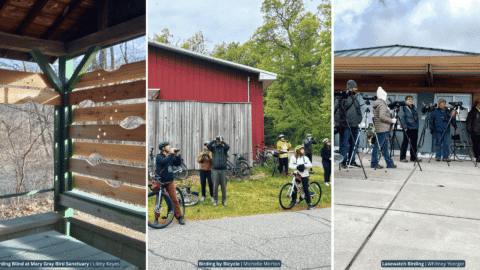
If you’re ready to see more than what visits your feeder, join one of Indiana Audubon’s late fall or winter field trips. Our informed and welcoming guides lead outings across the state to spot Sandhill Cranes, Bald Eagles, migrant hawks, and waterfowl, and to share the conservation stories behind them. It’s a good way to keep birding through the cold and to connect your love of backyard birds to the wider world of birding in Indiana.
Tags: birding insights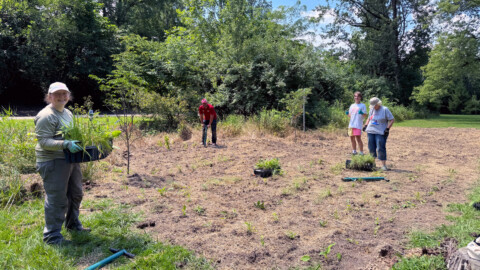




)