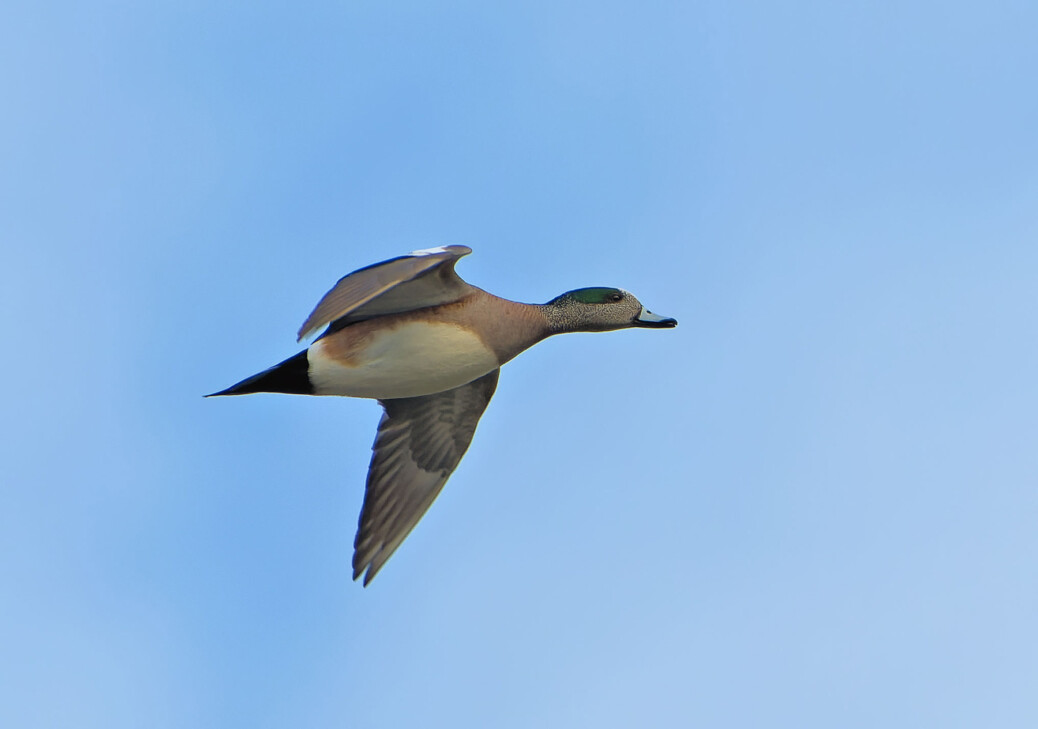
Photo: American Wigeon by Mark Welter.
BY MARK WELTER
I frequently see “ID help” posts on the various Indiana birding social media pages, and it always gets me to thinking about the importance of teaching new birders “how to fish,” metaphorically speaking. Many of my early lifers are on my list because someone who knew more than I did pointed to a bird and said “that’s an (insert species here).” While that was good to know, simply giving the answer did nothing to enable me as a beginning birder to correctly identify that bird the next time I encountered it.
Learning HOW to bird is an aspect of our hobby that I think is very under-emphasized. Many new birders find identification to be a daunting task because they don’t know where to start, other than by flipping through a field guide or scrolling through an app trying to find a matching picture. This is an exercise in frustration, since many bird families and species share generally similar characteristics, and because NO individual bird seen in the field is going to look exactly like its field guide illustration.
Do you know the difference between an experienced and a beginning birder? An experienced birder has misidentified more birds. —Source unknown
Here, I have compiled some pieces of advice I have been given over the years, that new birders may find helpful.
Observe first, identify later! When the bird is in front of you is not the time to be flipping through a field guide or scrolling through a phone app! Watch the bird. Take detailed mental notes on plumage, size, physical characteristics, behavior and environment. Then once the bird is gone, work on your ID. Photographing can be extremely helpful, but is NOT a substitute for firsthand observation of the living bird.
Knowing the broad characteristics of various bird families can make the task of ID’ing a bird less intimidating (“There’s just so many of them I don’t know where to start!”) as well as greatly speeding the ID process itself. Conical bill? Blackbird. Broad, triangular bill? Flycatcher. Soaring raptor with broad wings and short, fanned tail? Buteo. The GISS (General Impression of Size and Shape) principle also comes into play here. Once you get in the ballpark, more specific details can be used to narrow your bird to species.
Don’t rely on plumage. Lighting and distance can often obscure plumage details, and molting birds may look significantly different from their textbook appearance. Learn silhouettes—both perched and in flight—as well as patterns of light and dark (“where’s the white” is a great tool for identifying waterfowl in particular) to help with ID under challenging visual conditions.
Get a field guide. Yes, a real one printed on actual paper. Actually, get several, since they all present information slightly differently and you might find a certain style to be particularly useful. These are for studying at home. For use in the field, you can’t beat the convenience of a phone app. Sibley’s is the gold standard for both printed and electronic guides. Spend the money. The wildly popular Merlin app can be useful for confirming a suspected ID, but should not be your primary ID tool, because it’s wrong. A LOT. I regard it as the electronic version of a someone just blurting out an answer, while an actual field guide will give you tools to make your own IDs.
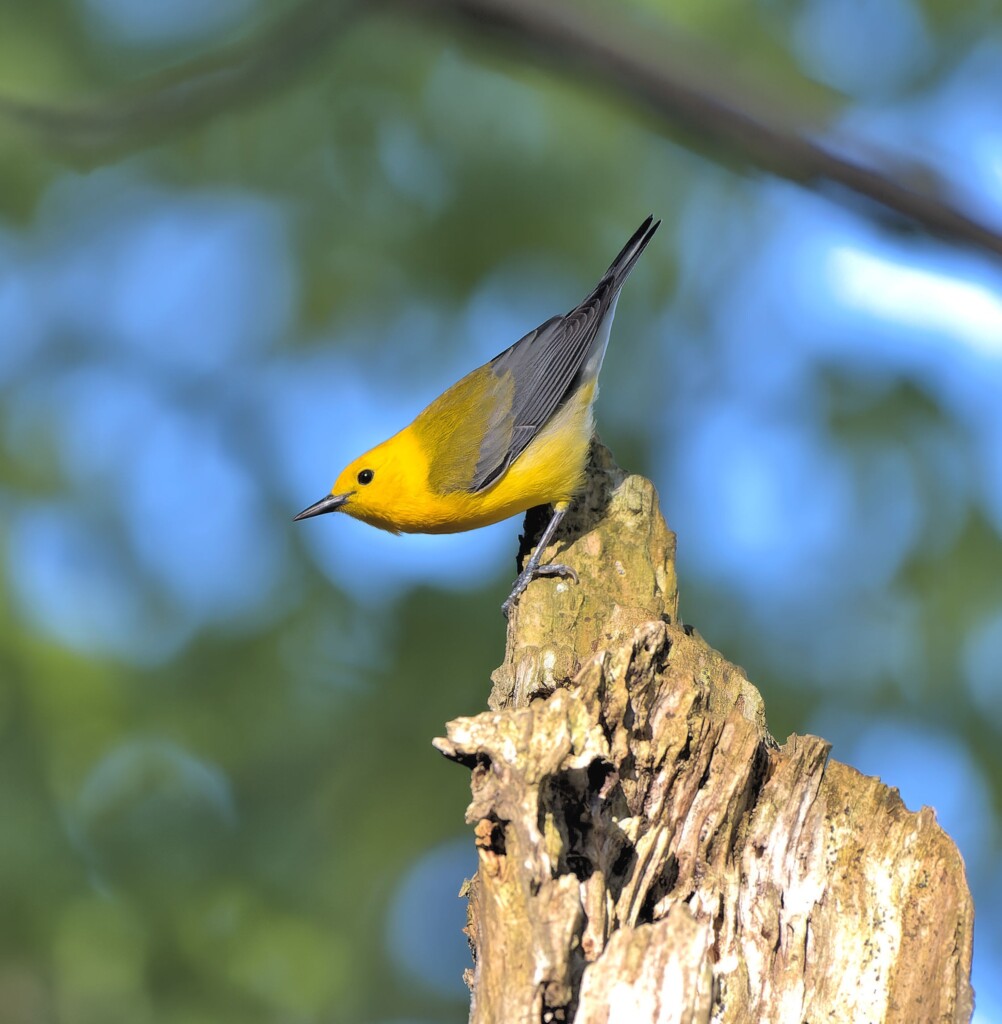
Photo: Prothonotary Warbler by Mark Welter.
Sound is very important; you can often hear far more birds than you can see, especially in late spring and summer when foliage is fully leafed out. Listening to “Birding by Ear” recordings can help you differentiate similar sounding birds (the Sibley app also has songs and calls). Start early in the year and learn the winter residents, then when the migrants start arriving you can pick them out. Learning mnemonic devices (or making up your own) for various bird songs can help you remember them from season to season.
Go on bird outings held by IAS or your local Audubon chapter. Hang out with birders who are better than you. Ask lots of questions!
Concentrate on the birds that you are most attracted to first, then branch out. If you are excited about raptors, become a “raptor guy” (or gal) first, then add another family that interests you. Save the ones that don’t thrill you as much for last – or just don’t worry about them. Nobody knows it all!
Everybody loves seeing rare birds. ID’ing rarities starts with ruling out common species, and that requires knowing what’s common or expected in a given area, and being intimately familiar with those species. That helps the oddballs really stand out when you see them. Assume a bird is the more common species, then prove why it is not. Knowing WHEN to expect certain species can also be a valuable ID clue – struggling with the immature Red-shouldered Hawk vs. Broad-winged Hawk is no struggle if it’s January and you know all the Broad-wings are in Central America until May!
“Bird every bird!” Take the time to look at individuals in a group; you never know what might be hiding there! Sometimes that one Semipalmated Sandpiper will turn out to be a Western, that immature Bald Eagle will turn into a Golden, or that Hudsonian Godwit will be Indiana’s first Black-tailed!
You will not be able to definitively ID every bird you see, and that’s OK! Not to say you shouldn’t try, but don’t force the issue. Be honest with yourself! eBird has tags like “Greater/Lesser Yellowlegs” and “blackbird sp.” for just such occasions.
When birding with others, say aloud what you are seeing through your binoculars or scope (field marks, plumage, behaviors, etc). Help others get on the bird, and encourage them to do the same. That will allow you to compare notes in real time and arrive at an ID together.
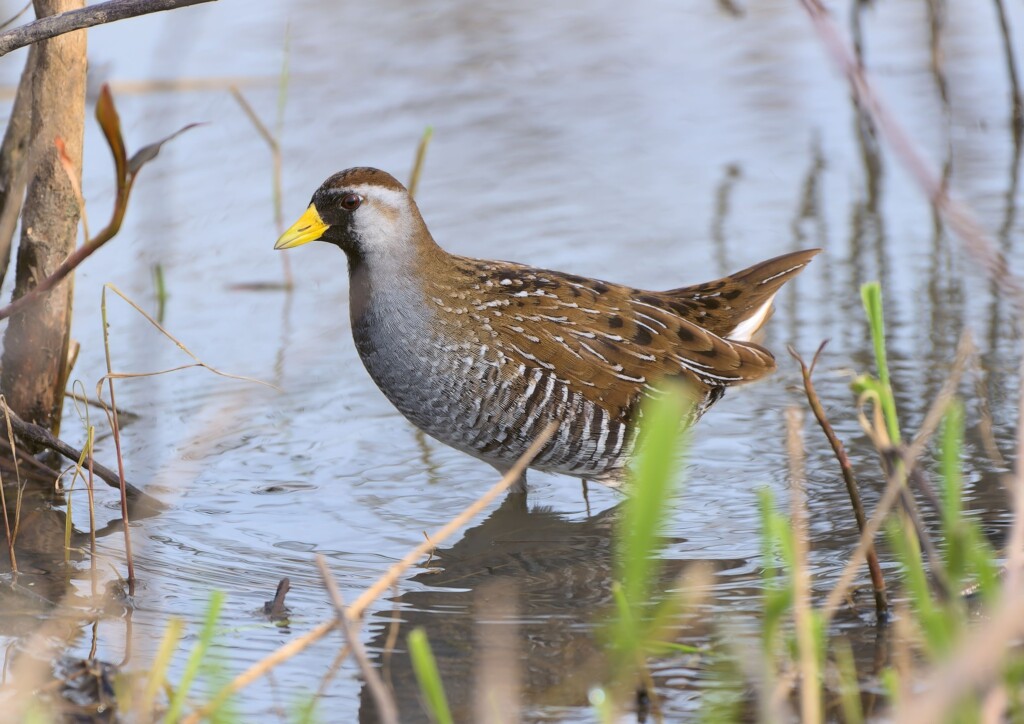
Photo: Sora by Mark Welter.
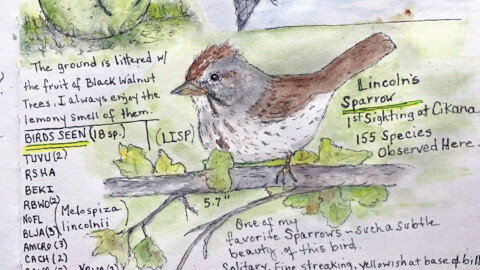
Keep a list, even if you’re not a “lister.” eBird does this automatically when you enter sightings, but I still keep an actual spreadsheet for my annuals, as well. Why? Because it shows patterns. For example, my FOY (First Of Year) Chimney Swift has been on April 21 for the past 3 years. A clue when to start looking for them. I can also see that I have “go to” spots for certain species, and that I have better luck with certain species as spring or fall birds. I can also include comments for specific sightings that will help me remember details when I look back on them down the road.
There is no alternative to experience; you pick up on a lot of things by just getting out in the field, birding and learning. Listen to what other birders say, and be open to suggesions and corrections. We all make mistakes, but if you stick with it and learn from those mistakes, they will happen a lot less frequently over time as your knowledge and experience base increases.
I hope these tips prove beneficial to you in your birding adventure. If you are already an experienced birder, what advice did you receive that had the most impact on your birding proficiency? What do you know now that you wish someone had told you when you were just starting out? What can YOU do to pass the benefit of your experience on to newer birders?
This article originally ran in the June–July 2023 print edition of The Cardinal.
Tags: birding 101 birding insights