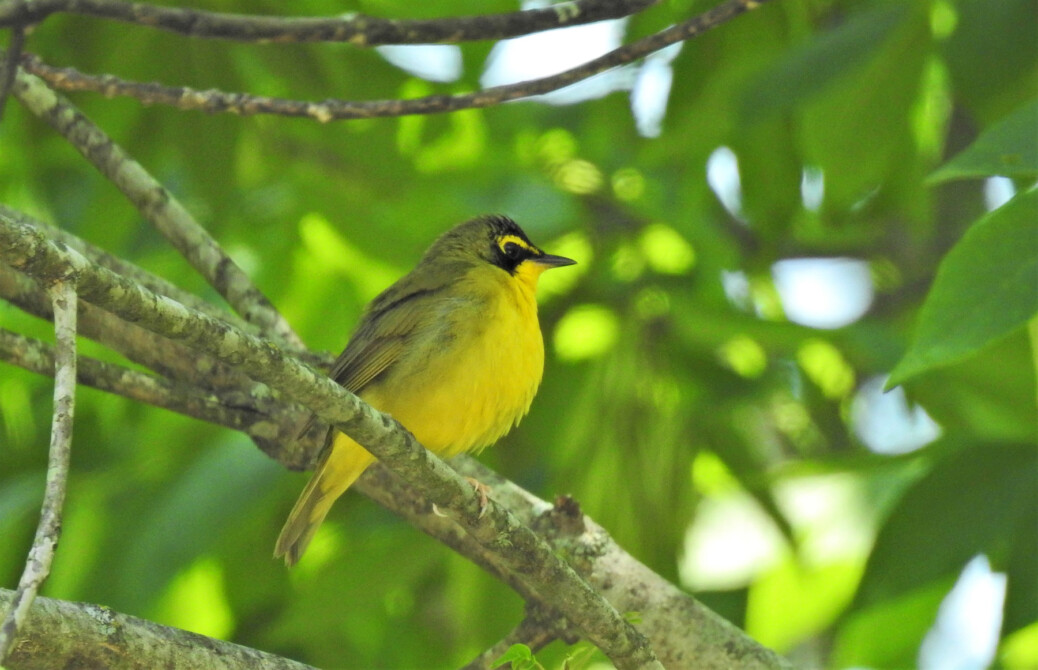
Photo: A Kentucky Warbler, photographed by Nick Kiehl. The bird is perched on a branch, surrounded by lush green foliage. It has a bright yellow throat and underparts, olive-green back, and bold black markings on its face.
BY NICK KIEHL
Like most people, birders are creatures of habit. We tend to visit the same places in search of birds again and again, whether for the sake of convenience or to look for a particular species, and in many ways that’s a good thing! Producing consistent data on species present, migrant arrival and departure times, and shifts in species’ range are all important reasons to bird your local haunts regularly.
However, a quick check of an eBird range map or county records will show that not all areas have equal coverage. You may be surprised to learn how few observations have been recorded at many of the state’s parks and nature preserves. This year, I challenged myself to break out of my usual pattern and visit locations that were new to me and had relatively few eBird checklists submitted. Along the way, I’ve found an extra level of joy and excitement in both ordinary and uncommon species that inhabit places I might have otherwise never visited.
In the grand scheme of things, few areas of Indiana would be considered “remote,” but you don’t need to go far to find a spot without much birding coverage. Places like Pipewort Pond Nature Preserve in Elkhart, Laura Hare Preserve at Blossom Hollow in Trafalgar, roadside birding in Owen County, and Tippecanoe River State Park in Pulaski County were some of the locations I chose. On recent visits to two less-traveled nature preserves in southern Indiana—Chelsea Flatwoods Preserve in Jefferson County and Calli Nature Preserve in Jennings County—I had no expectations of what I might find. This made close views of Kentucky Warbler, Yellow-throated Vireo, and Red-headed Woodpecker all the more exciting.
If you want to challenge yourself to explore new places, start by checking eBird for gaps in sightings or areas where no hotspots exist. I use Google Maps to locate habitat that appears interesting from a satellite view and then look for protected or public land nearby. A little competition never hurts either—a five-mile radius challenge (keeping track of all birds seen within five miles of your residence) or a county big year is a great way to uncover hidden gems that are overlooked by visiting birders. You can also use the list of resources at the end of this article as a jumping-off point for locating places with unfamiliar names. What discoveries will you make?
Why go birding somewhere new?
- Stretch your skills by recognizing familiar birds in an unfamiliar location.
- Improve your understanding of the status and distribution of birds locally.
- Find something unexpected!
- Contribute additional data points for a species on eBird.
- Explore a new part of the state or natural community (a native ecosystem shaped by environment and species) to broaden your perspective on what Indiana has to offer.