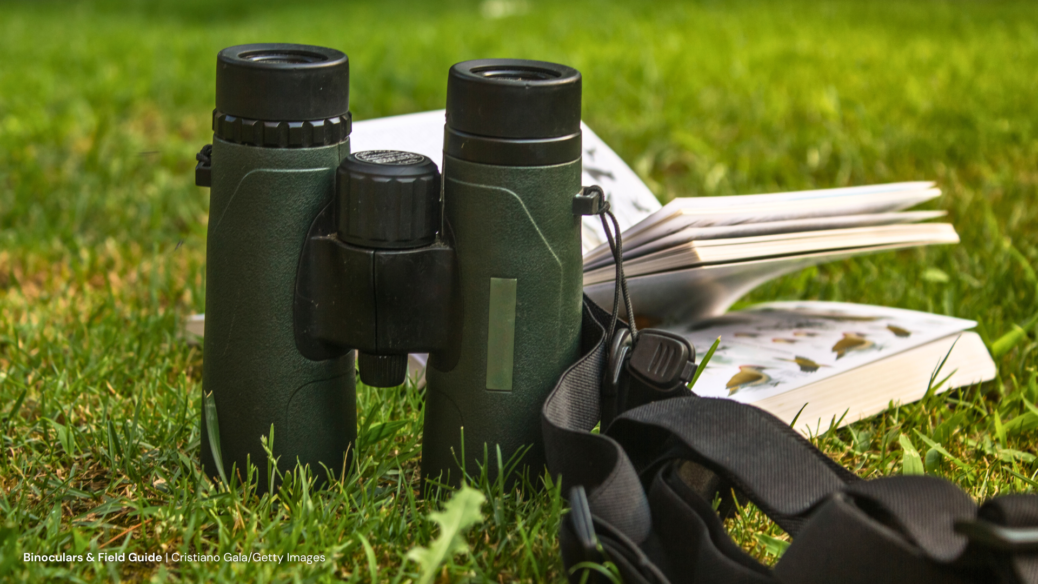
Photo: Binoculars and a bird field guide rest in the grass, ready for use in the field. Cristiano Gala/Getty Images
BY OLIVIA BAUTCH
Spend any time around a group of birders and you will notice they love their gear. Some station their spotting scopes at a reservoir to measure wingtips and bill curvatures on little brown shorebirds. Others take photographs or sound recordings and identify later. Some even strap on multiple accessories at once. For birders who observe birds by sight, the most indispensable of their tools is indisputably the binocular (or monocular). Taking time to invest in a quality pair for your needs can pay out over the next decade of birding adventures or more!
This Birding 101 article tackles the basics of this optics essential with tips to get comfortable with them in the field.
Anatomy of Binoculars
Before you shell out hundreds of dollars at a specialty optics retailer, it’s beneficial to narrow down your specific needs. You’d be surprised just how many fits, sizes, and magnifications exist on the market—and not all binoculars are created equal. To determine your best fit, you’ll need to understand binocular anatomy and specifications. Let’s first break down the main parts of a pair of binoculars.

Photo: Labeled diagram of binoculars showing the main parts, including the ocular lens, eye piece, focus knob, diopter dial, lens barrels, hinge, and objective lens. Courtesy of Olivia Bautch.
- Ocular Lens – These are the glass eyepiece you look through.
- Eye Pieces – The rubber casing over the ocular lenses is called the eye piece, or eye cup. These adjust to accommodate eyeglasses. When you look through binoculars, the image in both “circles” is meant to form one image, or one “circle.” Eyeglass wearers have a little extra distance between their eyes and the ocular lenses, called eye relief, which breaks up that “circle” image. Twisting the eye pieces down brings those circles back into one picture by removing some of the distance from the ocular lenses.
- Diopter Dial – Most binoculars have a single ring located beneath the right eyepiece. This dial adjusts the focus of that eyepiece independently to compensate for any differences in vision between your eyes. Once set, you’ll use the central focus knob for general viewing.
- Lens Barrels – These cylinders house the magic of binoculars. Inside each “barrel” are lenses and prisms, and a neck strap connects to the outside. Binoculars have two lens barrels, while a monocular consists of one.
- Hinge – To fit both narrow- and wider-spaced eyes, most lens barrels bend on a hinge. Smaller “compact” binocular models might have a rectangular piece of metal or rubber between the lens barrels that holds two hinges.
- Focus Knob/Focus Wheel – Since birds are notorious for disappearing into shrubbery as soon as you get them in focus, this is the one feature you’ll adjust actively and continuously. On most binoculars, the knob, found between the two lens barrels, turns right to focus in on closer objects and left for objects farther away. Depending on the model or prior use, this can be loose or it may stick. Make sure you choose binoculars that you can quickly adjust for speedy species.
- Objective Lenses – These are the lenses opposite the ocular lens. The more light they take in, the brighter and clearer the image you see.
Binocular “Specs”
Did you know that binoculars aren’t only used for birding? Nikon’s Complete Binocular Handbook lists four other uses: nature watching, spectator events, stargazing, and viewing at museums. Naturally, chasing a tiny moving warbler requires different capabilities from optics than viewing a distant, stationary planet.
There are two numbers (specs) you’ll want to want zero in on: magnification and field of view. These numbers are listed online and on packaging, and are usually embossed into the binoculars’ focus knob as well.
Typically, magnification comes in 7x, 8x, 10x, and 12x. That interacts with objective lens field of view (ranging from 25-50mm) to create the image you see. Binoculars with larger fields of view and higher magnification seemlike the obvious choice, but these measurements often work against each other and come with the trade-off of being clunkier, heavier, and less stable. If you’re seeking higher birding magnification than 8x or 10x, consider a spotting scope instead.
Other Considerations
Birders might spend five minutes at a time with their binoculars, or they might spend nearly an entire day in the elements. Additional options center on ease of use and intended purpose. Ask yourself these questions:
- Are they comfortable to hold up over long periods of time?
- Is the strap comfortable for prolonged use?
- Would you prefer the streamlined, straight-barrel of roof prism binoculars, or the wider, angled-barred look of vintage porro prism models?
- How often do you foresee taking your binoculars out in extreme weather?
- Is aesthetics important to you?
Luckily, advances in technology have made their way to birding optics, allowing a diversity of features to be found in affordable binocular models, both compact and full-size. Weatherproofing, waterproofing (think seabird trips), and color choices are available, as well as accessories to support your hobby.
All binoculars come with a lens cloth, and most models include rubber covers for the lenses. Eye shields can be purchased that slip over the ocular lenses and block excess light from distorting your view.
To steady a shaky view, look for a model with a built-in tripod adapter screw near the objective lenses. You can mount binoculars to tripods or other equipment such as that specialized for wheelchairs. Another way to maximize comfort is swapping a traditional neck strap for a harness, where Instead of straining your neck, the weight is distributed around your shoulders and chest.
There are several features on the market, however, that are hit-or-miss when it comes to usage in the field. Digiscoping adapters, zoom and photographing binoculars, and even Swarovski’s new AI-powered identifying binoculars are much more likely to compromise either image clarity or consistency. Many may get better over time.
Beginner Models and Trying Them Out
Currently, a solid pair of beginner or “low-range” binoculars costs between $100 and $225. Vortex, Nikon, Opticron, Celestron, and Hawke are repeatedly rated highly as best-value beginner binoculars (and beyond). Many young birders start with a compact pair of Bushnells. And the up-and-coming brand Nocs Provisions offers colorful binoculars and monoculars trending with birding influencers.
You can always visit your local nature center, bird-feeding store, or big-box retailers like Cabela’s or REI to discuss and compare models. Just like a pair of jeans, everyone has their own fit, and there is no substitute for trying out optics yourself. When you find your perfect match, you’ve got your very own trusty piece of birding gear to take along for years of adventures.
Tags: binoculars birding 101