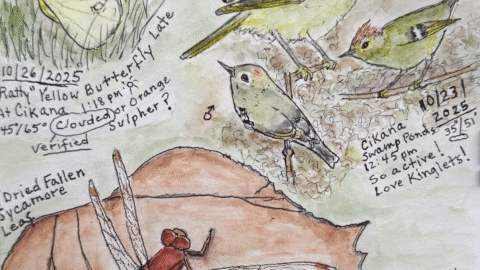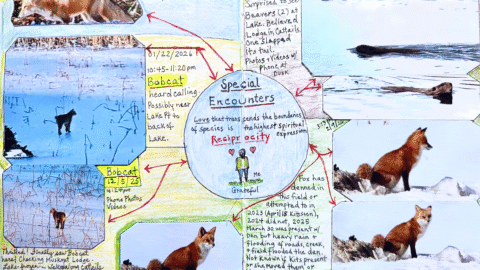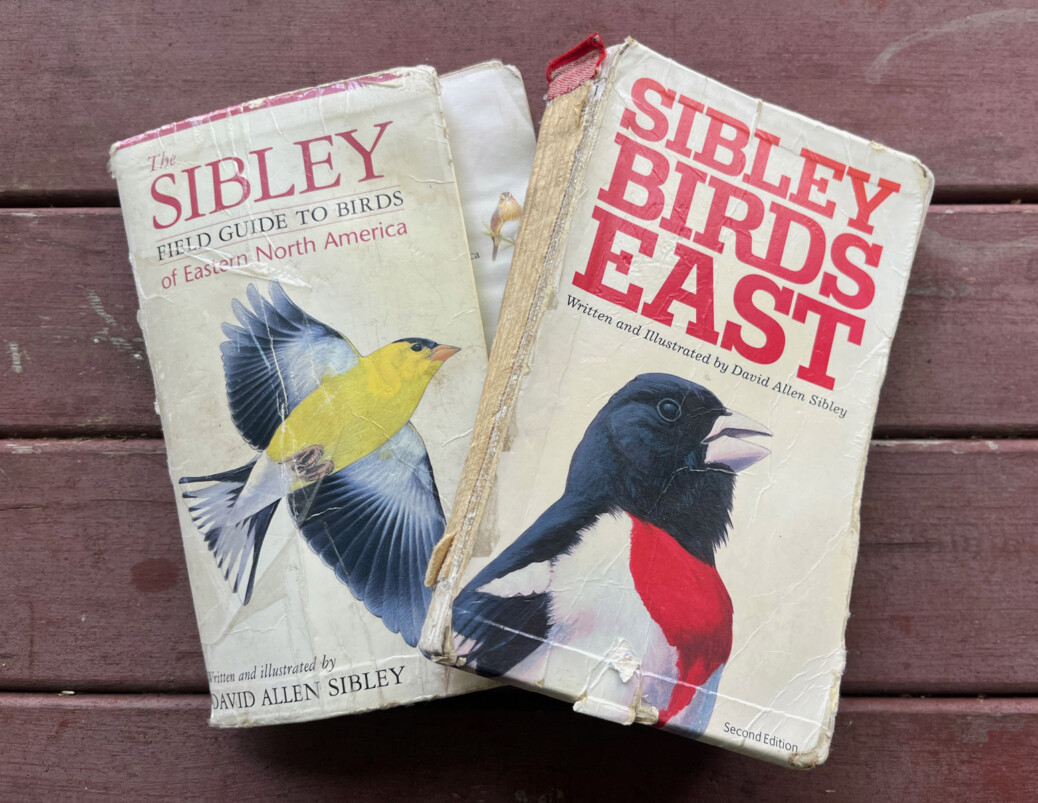
Photo: Field guides like these helped shape generations of birders, including Brad Bumgardner. But in a changing world, even trusted tools have to evolve.
BY BRAD BUMGARDNER
There was a time when the mark of a serious birder was the weight of their backpack. Not because of extra optics or snacks. It was the field guides—plural. Like many birders of a certain age, my shelves bend under the weight of them. Peterson. Sibley. Kaufman. National Geographic. Some volumes are mud-stained, their pages stiff from wet mornings and steady use. My original Sibley literally falls apart at the spine today.
Time after time, I’ve spoken to groups in person and virtually and professed that, like I, you’d end up buying them all anyway—so go get that guide. But here’s the truth: I probably will not buy another printed field guide in my lifetime.
The Game Has Changed
We live in a time where the free app on your phone is smarter than any book you could carry. The Cornell Lab of Ornithology’s Merlin ID app is a marvel. It puts field marks, range maps, audio, photos, and yes—even AI-powered ID—in your pocket. And it keeps getting better.
Field guides taught us birds in a certain way, one species at a time, often posed in classic profiles. But birding is about experience: he sounds, movements, and fleeting glimpses that no two pages can truly capture. Merlin’s Sound ID feature alone has changed how many of us approach a dawn chorus in our local patch of woods. I can stand at Mary Gray Bird Sanctuary, phone in pocket, and have a running tally of species around me without openinga book.
It’s also worth noting that many of the apps supported by the Cornell Lab (Merlin, eBird, and others) run counter to the typical app model of today. These tools are free, with no paywall to use core features. This is not just generous, it is intentional. For citizen science to work at scale, and for the data to remain robust and representative, access has to be open. The moment you start filtering who can contribute based on who can afford the tool, you introduce bias. Cornell Lab knows that. They prioritize scientific integrity over revenue, which is a refreshing approach in a time when many apps want to charge you to identify a female Red-winged Blackbird.
The Pros of Print
Physical field guides absolutely have their strengths. They do not require batteries. They encourage slower, more mindful study of bird ID. They’re excellent for building foundational knowledge, especially for beginners and kids. And when you find yourself off-grid, they’re often the only reliable option.
Also, it is somehow more socially acceptable for me to be sitting on the toilet flipping through a field guide than scrolling through the same guide on my phone. Go figure. One makes me a dedicated naturalist. The other makes me look like I am wasting time watching cat videos.
Why I’m Letting Go
I love books. I run an organization steeped in the tradition of field study and birding literature. There will always be a place for beautiful, printed guides—especially as reference works at home.
But as a tool for field ID, they can no longer compete. I don’t say this lightly. I still have my trusted Sibley on the shelf. I still open it from time to time, but it rarely leaves the house anymore. Let me correct that: it never leaves the house anymore. When I travel, it’s my phone I grab, not a book.
And let’s be honest: updating a printed field guide is a five-to-ten-year affair, if you’re lucky. Digital tools update overnight. New vagrant records, taxonomic changes, new bird names coming down the pipeline—these now flow through the ether to my device faster than any publisher can react.
What We Gain
Digital guides help lower the barrier to entry. They allow anyone with a smartphone (and nearly everyone has one) to tap into a global wealth of knowledge. They foster curiosity. They invite exploration.
For us as an organization, this is an opportunity. It allows us to engage with a bunch of new birders in ways we could not have a decade ago. It levels the playing field between beginners and experts. And it reinforces a simple truth we strive to uphold in our programs and partnerships: birding should be accessible, welcoming, and evolving.
The Final Chapter?
I will always treasure the printed guides I own. I’ll keep them, and in quiet moments, I’ll revisit them. But the next time I consider buying one, I’ll ask myself: what will this offer that Merlin, electronic access to Birds of the World, or similar tools do not? If the answer is nostalgia, I’ll save my dollars for conservation work instead. I’ll toss $25 to support a Loggerhead Shrike when the next Sibley comes out.
The field guide, in its printed form, is entering its twilight. That’s not a loss. It’s a transformation. And honestly, that is a good thing. Anything that gets more people looking at birds, however they get there, is a win in my book.
Tags: op-ed