Photo: Brad Bumgardner visited Wyalusing State Park in early July and found Steve’s Yellow-throated Warbler singing. “[It] sang distantly and at first wasn’t being picked up by Merlin. But on the return trip, it was calling more frequently and closer,” he noted.
BY STEVE BETCHKAL
For today’s birder, the Merlin Bird ID app is the hottest thing since the invention of the printed field guide. It’s all the rage. Everywhere I go, people are using it, talking about it, and singing its song identification praises.
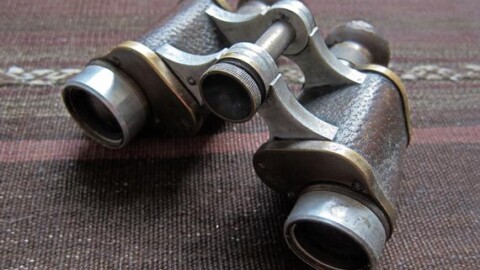
The technology seems brand new, but it’s not. In 2004, the Boston-based corporation Wildlife Acoustics was “perfecting” Song Sleuth, a rather clunky hand-held device designed to identify wild bird sounds. It was a rather crude point-and-shoot computer, bigger than binoculars but smaller than a breadbox, with a microphone in front and a read-out screen. For it to work, you had to insert the right bird card for your region. But that didn’t mean it succeeded.
I field-tested the Song Sleuth for Wildlife Acoustics in the Eau Claire area of Wisconsin. For the first trial, I walked it into my backyard and pointed it at a singing American Robin, and voila! The Song Sleuth correctly matched the song to the bird. Heady with success, I then pointed it at a Gray Catbird. The machine told me I was listening to a Canada Goose.
Song Sleuth was a marvelously fun toy. For its next field test, I brought it to a high school science class in Colfax, Wisconsin, where the students had a gas pointing it at any bird that opened its mouth. We discovered that the device’s success was limited by the species included on the inserted card. Also, ambient noise confounded it. Wind and traffic noise often garbled the results. But when it correctly matched the song to the bird, it was magical. What a delightful and wondrous trick!


Photos: Campsite (left) by Steve Betchkal and Wyalusing State Park by Brad Bumgardner.
I feel somewhat the same about Merlin today. I have now been field-testing the Merlin app for months across the U.S. While the app is generally accurate, it regularly makes both positive and negative errors. That is, it identifies birds that aren’t there, and it misses birds that are there. Here’s a classic example. This spring, I camped at the Green River Campground in Dinosaur National Monument in extreme northeastern Utah two days after Earth Day and played a favorite game I call “Birds in the Bag.” I try to identify as many birds as I can by sight or sound each camping morning before I shed my sleeping bag. My record is 43 species, set at Straight Lake State Park. My REI two-person tent has a built-in birder-friendly feature: the top is made of screen, so in arid landscapes I can camp without the fly and watch the birds moving about above me.
As I lolled in the bag, taking inventory of the bird sounds and sights, I opened my cell phone and switched on the Merlin Bird ID’s Sound ID feature, just to see how we “matched up.” Since the app not only records in real time, but then preserves the track record, it’s easy to go back in and review the results. The app and I both agreed upon Spotted Towhee, American Robin, Canada Goose, European Starling, House Wren, and Black-billed Magpie. However, the app also identified Lesser Goldfinch and Red-tailed Hawk (I neither heard nor later confirmed these species in the campground), House Sparrow (which I could not detect from the tent but later found singing about 100 yards from my campsite), and House Finch (present 75 yards from my tent, but a brash and easily detectable song). The app failed to register a nearby Eurasian Collared-dove clearly and persistently calling “Blue-MOON-poop” and a flyover Wood Duck calling “oooh-WHEAT!” If you’re scoring along at home, that’s 50% accurate, which is downright embarrassing.
I had better luck at a high mountain pass in central Wyoming. There, the app did well, successfully logging Dark-eyed Junco, Red Crossbill, American Robin, Pine Siskin, Canada Jay, Mountain Chickadee, Red-breasted Nuthatch, Mountain Chickadee, Red-naped Sapsucker, and Cassin’s Finch. The only error was a Clark’s Nutcracker, so the app scored a 91% match with reality.
Since then, I’ve had the AI tell me I had White-eyed Vireos, where I wished there were, and ignore goldfinches, warblers, sparrows, and catbirds. It missed a Mourning Warbler 10 feet away from me at Lion’s Den. At Bong Recreation Area in Wisconsin, it completely whiffed on American Crow, Tree Swallow, and Bobolink. Strike three, you’re out!
But then, there are the times when there truly is Merlin Magic. Over Memorial Day weekend, I was birding Wyalusing State Park. I hadn’t seen or heard a Yellow-throated Warbler at the top of Long Valley Road for many years, so I stopped to listen. It was still early, not even 5:30 a.m., I had the place to myself, and the woods were noisy with birds. A number of birds were present: American Redstart, Cerulean Warbler, Kentucky Warbler, Wood Thrush, gnatcatchers, woodpeckers, pewees, titmice, grosbeaks, cardinals, and vireos. Alas, there was no Yellow-throated Warbler. I thought to myself, “Hmmm.” This would be a good time to see what Merlin says, so I switched it on. The species list immediately started to populate on screen. Imagine my surprise when a Yellow-throated Warbler appeared. I stopped what I was doing and listened harder, and there it was. High-pitched, faint, and way up in the White Pines. I’d missed it in the cacophony. It’s my informed opinion that the human ear and brain combined are still better than Merlin, but the app had done one thing it does best; it registered everything it thought it heard, and in this case, it had caught the bird I had glossed over.
Bird song identification is always challenging. In fact, it scares most people who find it overwhelming. While Merlin is not 100% accurate, what it does with 100% efficacy is boost confidence. Beginning birders find the tool liberating and revelatory. It reveals an unknown world, full of educational possibilities. As a backup, it can assist as a safety net in detecting possible species present, and for birders with hearing loss, it can augment visual assessment. Merlin Bird ID will only get better with time.
My advice? For now, don’t believe everything it says it hears.
Steve Betchkal is an ornithologist, author, master birder, and Emmy-winning journalist from Eau Claire, Wisconsin, who speaks fluent bird.
This review originally ran in the August–September 2023 print edition of The Cardinal.
Tags: birding insights identification