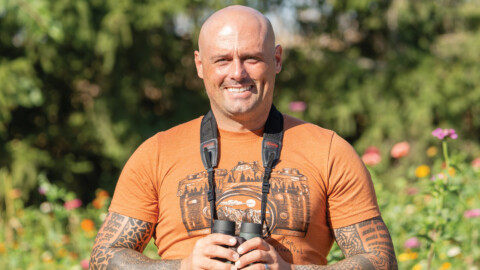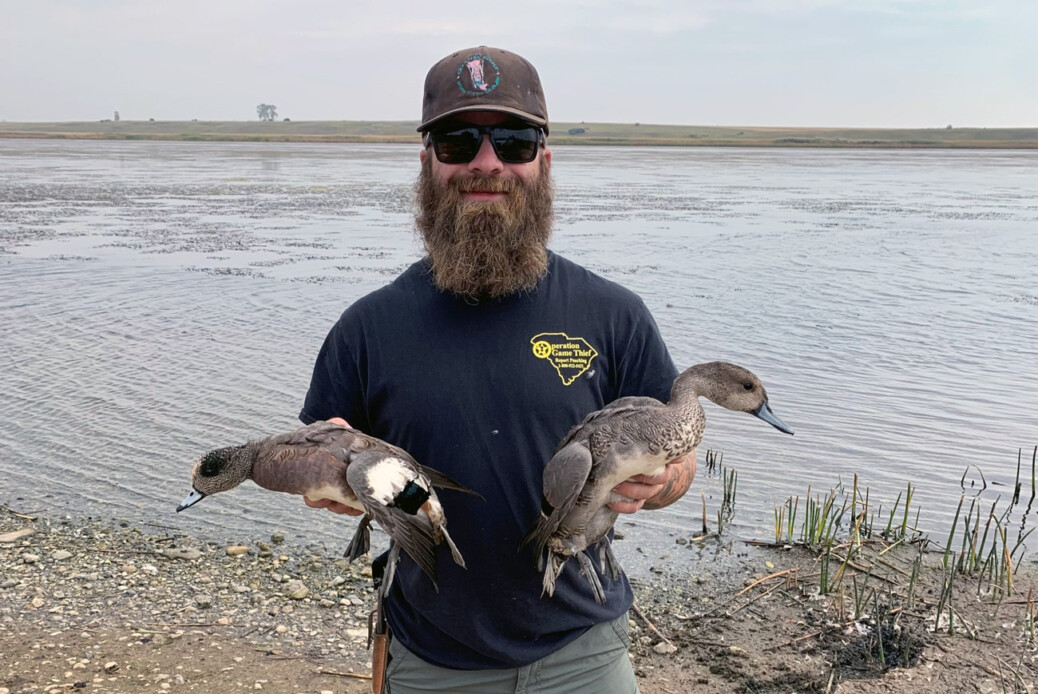
Photo: Jared Emmack stands at the edge of a marsh holding two freshly banded ducks (American Wigeon and Northern Pintail) at J. Clark Salyer National Wildlife Refuge in North Dakota. Courtesy of Jared Emmack.
BY JARED EMMACK
Tell us a little about yourself. Family? Where do you live and work?
I grew up in Elkhart, Indiana, but after bouncing around to a few places, I’ve called Mount Vernon, Indiana, home for the last five years. I am currently the assistant property manager at Hovey Lake Fish and Wildlife Area (FWA), arguably one of the most unique ecosystems in Indiana, with many southern species rarely found elsewhere in the state.
What got you interested in birds and birding?
I’ve always loved being outdoors from a young age, hunting and fishing, but never had any interest in birding until I was in college at Lake Superior State University in Michigan’s Upper Peninsula. Being at a small school with limited class sizes, I couldn’t get into the ornithology class one semester, so I decided to just learn the birds for myself. With Whitefish Point’s massive waterfowl migrations nearby, along with the annual inundations of Snowy Owls, Great Gray Owls and the occasional Northern Hawk Owl, it was easy to get hooked on birding.
Do you have a favorite way to bird, i.e., casual walks, focused listing, sound ID, seasonal specialties?
It depends on the time of year and what year it is. I’ve been known to be a shameless lister some years, while most other years I’m content even if I don’t find a new bird for my life list. Recently, I’ve been birding local hotspots in the hopes of increasing eBird coverage in under-birded areas, as well as getting into recording songs and calls of hard-to-record birds like waterfowl. But if I had to bird one way for the rest of my life, I would prefer sitting in one place with a raft of waterfowl in front of me, trying to pick out the odd rarity or hybrid mixed in.
How does birding influence how you do your job day to day?
Birding has become a great tool for identifying species, their needs and habitats on the property. In order to identify habitat needs and what certain species prefer, we must be able to first identify the ducks and migratory shorebirds we are seeing, and then be able to cater the habitat to their liking. With such a unique environment in this corner of Indiana, bird diversity and population numbers are very important to us, especially migratory waterfowl and shorebirds.
Here at Hovey Lake FWA, one of our main focuses is managing for waterfowl habitat through the construction of wetlands, water-level management and promoting moist-soil vegetation. In the last several years, we have constructed roughly 250 acres of marshes to add to the already immense waterfowl habitat in the region. Since the construction of one wetland in the fall of 2023, we have observed county-first records of Whooping Crane, Black-bellied Plover and Black-necked Stilt in addition to attracting significantly more shorebirds and waterfowl. In addition to wetland species, we are constantly monitoring areas for indicator species such as Northern Bobwhite and Short-eared Owl to help inform us on the health of our grasslands.
I have also been fortunate to travel for work and band close to 20,000 ducks and geese. Having the birds in hand has helped my birding skills to ID tough field marks when often seen from hundreds of yards away.
What challenges do you face balancing habitat needs with public use?
Our main goal as a Fish and Wildlife Area is to provide high-quality recreation opportunities for hunting, fishing, wildlife viewing and more. To provide that for the public, we must maintain high-quality habitat for our wildlife populations to thrive. Most of the year, this is not an issue, but when we have thousands of visitors each month on the property, this sometimes means restricting access to sensitive areas or closing waterfowl resting areas off completely to minimize human disturbance.
To the public, it can often look like we are too restrictive with access to certain areas, even if it is a high-quality birding spot. But having undisturbed wildlife populations and intact habitats during certain times of the year takes priority to ensure that the birds come back year after year for nesting, migration and wintering.
As a birder and a property manager, I would encourage anyone that birds public property in Indiana to talk to the property managers and ask questions to gain a better understanding of why certain management practices are being implemented.
Tags: meet a member Q&A