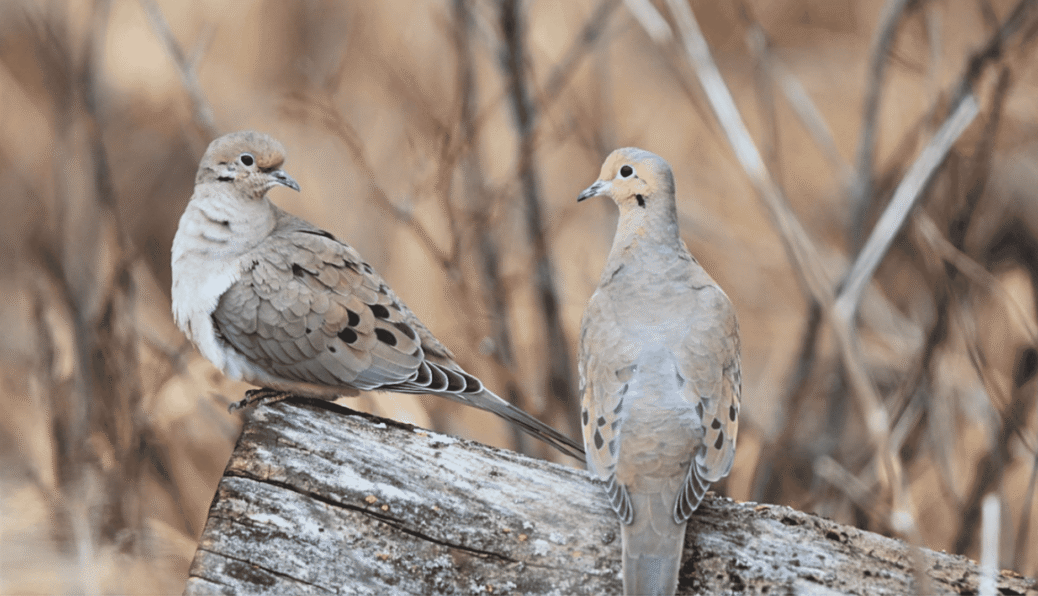
Image: Two Mourning Doves perched side by side on a weathered log, their soft gray-brown plumage and black wing spots visible against a warm, blurred woodland background. Photo by Lauren Wadas.
BY OLIVIA BAUTCH
Love is in the air.
And even if it’s not because your heart is as black as a goth cardinal (it’s not a phase, mom) you’re sure to be enamored with our round-up of romantic avian behaviors.
Except romance isn’t actually a concept for birds.
Recently, I shared some observations of birds engaging in play and even expressing enjoyment. Yes, the feathered creatures may also have a whole network of receptors and chemicals like dopamine, serotonin, and endorphins, but the emotions that result are a lot less complex than our own.
Birds may feel joy in a sense of simple gratification from socialization or food. They may mourn, but not over tissues and ice cream. Instead of angst toward an ex, birds may feel fear or defensiveness around competition and predators.
It’s been suggested that birds also feel affection for their partners, though the primary goal of pairing up is reproduction. That’s right: bird love is ultimately about hatching as many young as possible and passing on genes. In fact, the Cornell Lab of Ornithology says females are trying to “select a mate who is most likely to produce healthy young” to be worth the energy she’ll put out “producing eggs, incubating them, and raising the young.” I’m pretty sure that’s not why you’re sending roses on the dating app Hinge.
Love Languages, But Make It Birds
You may have heard of a book called The 5 Love Languages—originally written by Gary Chapman to strengthen marriages—that essentially narrows how humans give and receive love. Thirty years after publication, even my boss was using the method on coworkers to grow productivity. I figured, with a little alteration, we could categorize some of the lesser-known bird courtship behaviors the same way.
Words Vocalization
The full term for this is Words of Affirmation, which doesn’t make any sense for birds. Using vocalizations to attract an avian partner, though, is nearly universal. Birdsong ranges from simple to complex by species, but the National Wildlife Federation (NWF) adds that males also adjust their songs seasonally and to compete for female interest.
Oh, to be the American Goldfinch I watched in May, with four sun-kissed males perched against the sky-blue backdrop, practically singing over each other to impress her. As NWF explains, by tuning into intricacies between songs she’s sizing up “the degree of maturity and intelligence” of her serenade. It also suggests the male has higher-quality territory he’s defending. Within pairs, communication isn’t as showy; instead, they revert to shorter, practical notes for contact while nesting.
Which brings up a point I haven’t addressed yet: who’s doing all this courting? In most cases the pursuing bird is a male, though that doesn’t mean female birds don’t sing, too. In species where males and females look dissimilar (sexually dimorphic species), males dress up to get the girl, and ladies dress down to camouflage on the nest (unless you’re a phalarope). Maybe in another piece we’ll dive into nesting sex roles and the many forms of partnership, but we’re already slightly off-topic.
Physical Touch
We’re skipping the bad mating jokes and jumping into the either equally uncomfortable or cute-and-fluffy physical expressions of avian affection. The familiar example is lovey-dovey Mourning Doves cuddled on your porch—they’re communicating safety and lack of ill intention as a mate. So, the opposite of that guy standing a little too close to you.
While nestled close, doves, raptors, waterfowl, and other backyard species will groom each other’s feathers. Most birds preen to remove dirt and mites from their plumage anyways, but done between pairs (or social groups), it’s called allopreening. The act is not always purely functional but is equated with stronger bonds and better parenting.
Similarly, Cedar Waxwings play a choreographed dance passing items between partners. They’ve even been observed with flower petals. Oooh, how romantic.
Gifts
Money isn’t everything, but a couple stick nests, some shiny gum wrappers, juicy serviceberries… that’s the good life.
The most impressive gifter of the bird world is indisputably the bowerbird of Oceana. Making decoration of our plastic junk, they entice females to breed. Closer to home, male nestbox species like Northern House Wrens and Eastern Bluebirds build multiple nests for females to choose from. Male terns secure a mate by dodging their competing bros and gifting one flirty female a fish.
Across families, gifts of food are sometimes known as nuptial gifts. These presents are nutrient-packed for reproductive health. They’re for healthy eggs, babies, and parental bonding: the core of avian courtship.
I should mention that while it may sound like female birds are at the will of males, they usually aren’t. There is no feathered feminism, but the ladies have a decent amount of say in who they pass theirgenes on with. Photographer Rajan Desai described his experience with Least Terns: “Sometimes it works and sometimes it doesn’t.”
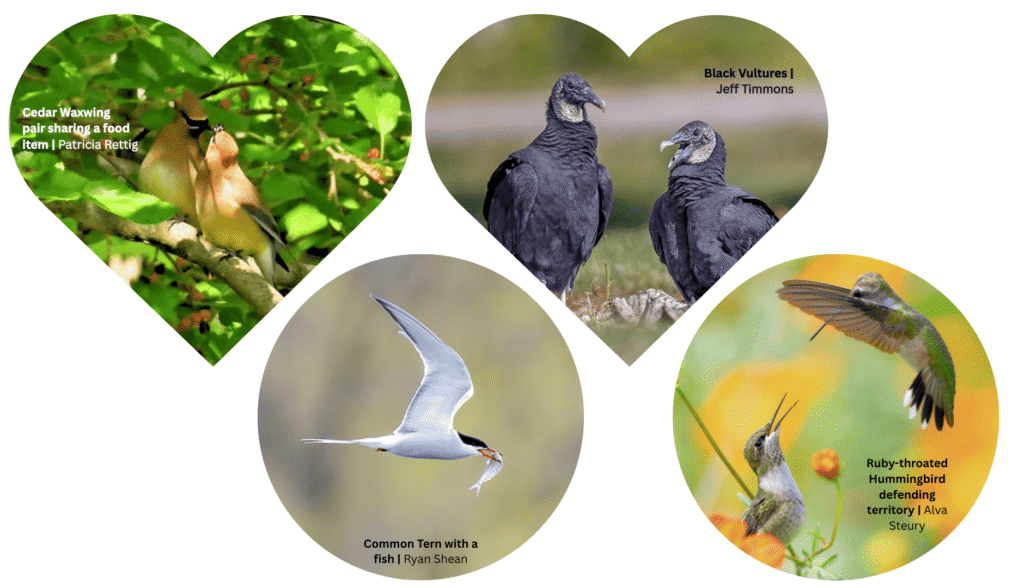
Image: Graphic featuring four bird photos arranged in heart and circle shapes on a light background: a heart-shaped image of a Cedar Waxwing pair sharing a food item (photo by Patricia Rettig); a heart-shaped image of two Black Vultures standing together (photo by Jeff Timmons); a circular image of a Common Tern in flight carrying a fish (photo by Ryan Shean); and a circular image of a Ruby-throated Hummingbird defending its territory, wings spread near flowers (photo by Alva Steury). Graphic created by Olivia Bautch.
Quality Time
I teased this a bit earlier, but not all birds literally pair up. Unfortunately for the hopeless romantics, even within the ~92% of species that form a pair bond for at least a breeding season, 75% of these “aren’t looking for something serious” outside that window. But remember, the goal of polyamorous, communal, or annual mates is to raise young, regardless of who is left to raise them.
Monogamous species are the traditional #relationshipgoals of nature. For instance, one of two vulture species in Indiana, the Black Vulture maintains their pairing outside of the breeding season. In these species, reliability increases the survival of healthy young and decreases energy output for securing a new mate and new territory every spring.
And like in human relationships, it’s both hard to find and maintain, though not necessarily for the same reasons. In migratory species like those in the blackbird family, males reach their destination weeks before females. Either mate could get impatient waiting to breed, be infertile, be a poor provider, or die. The benefits of monogamy aren’t enough for all species, but those that do keep our hopes for true love alive.
Acts of Service
I hope our examples have your heart fluttering like the wings of a violently chivalrous hummingbird (he’s not picking his friends over you). And that brings us to service.
Some species commit through proclamations that they would die for each other, or something like that. The famous death spirals of Bald Eagles and other raptors are an extreme example of this, serving as a trust fall to test strength and intention of potential partners. In many species, like waterfowl or the hummingbirds I mentioned, males often will fight for their favored female both in courtship and on the nest. Some even valiantly fight off car windows for their mate.
Other acts of selflessness might look like one parent taking on more parental duties or rearing young that aren’t their own. This isn’t as sweet as it sounds, though, since these cases typically arise when the other parent is promiscuously flying around with other mates, usually females with males. Spotted Sandpiper females strap males with the kids, and those same chivalrous hummingbird males bolt after babies are born. However, think like a bird here—if the situation adds to the genetic line, whatever works, right?
Instinct > Being in Love
This isn’t an exhaustive list of courtship categories. Plumage and display are two of the flashiest tactics, and consequently get all the press, but it’s our job to fill you in on some of the less obvious behaviors of birds.
You could try integrating these into your Valentine’s Day plans, but also… maybe not. As bird camera makers Birdfy explain, bird love is “driven by instinct and evolutionary advantage rather than romance.” So instead, you and your loved one might bond by observing the ducks, hawks, and other courting birds of February.
Tags: birding insights