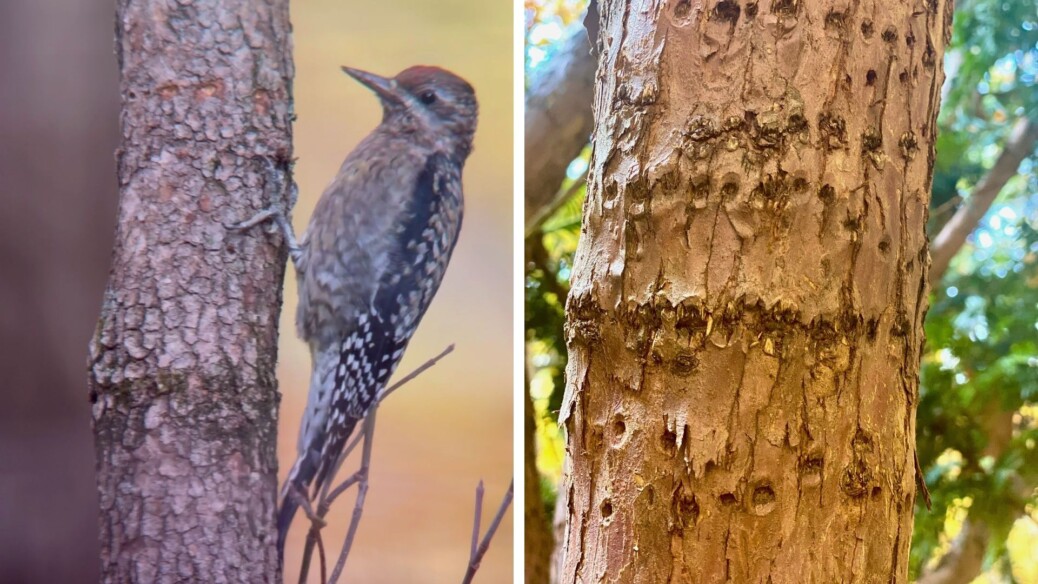
Image: A juvenile Yellow-bellied Sapsucker clings to the trunk of a small dogwood. The bird is black and white with soft brown tones and a pale yellow wash on its belly, and it lacks a bright red cap. Its pointed beak angles slightly upward as it braces against the bark with its stiff tail feathers. Photos by Mona Clayton.
BY MONA CLAYTON
I first noticed the evidence of a Yellow-bellied Sapsucker (Sphyrapicus varius) before spotting the actual bird.
As a member of the woodpecker family, the Yellow-bellied Sapsucker leaves small, shallow holes in tree bark arranged in neat rows. They are migratory visitors, typically seen in central Indiana from fall through spring. Their tapping is quiet and they’re less common in our woodlands than our year-round residents like the red-bellied, hairy, downy, and pileated woodpeckers.
In fall of 2025, I observed Yellow-bellied Sapsuckers on several outings in Marion and Hamilton counties. One morning, while walking through the bedroom, I caught a glimpse of one flying to a small dogwood near the house. I rushed to the living room to reposition my spotting scope, trying to do so stealthily to capture the bird drilling its precise holes. My husband started to walk through the room, and I quickly waved him back – any movement risked disrupting the bird’s behavior.
I put my phone in the PhoneSkope case, mounted to the scope, and pressed record. I watched the bird’s beak flick bits of bark with each tiny hole it drilled. Through the magnified view, it appeared grander than its modest size, every feather edged in morning light. Its pale yellow belly would occasionally glow like the faint light of a lantern as it circled the tree, continuing its methodical work. Each hole held the promise of sap – perhaps even a future buffet for other creatures.
I noticed the bird lacked the bright red cap and red or bright white neck, marking it as a juvenile. A few glorious minutes passed before the dogs began barking, and the bird flew off to another tree to resume tapping. Even the smallest visitor can turn a quiet morning into an unforgettable field experience.
This piece was originally published in published in Hoosier Outdoor Writers‘ newsletter, The Blade. Reprinted with permission.
Tags: birding insights identification