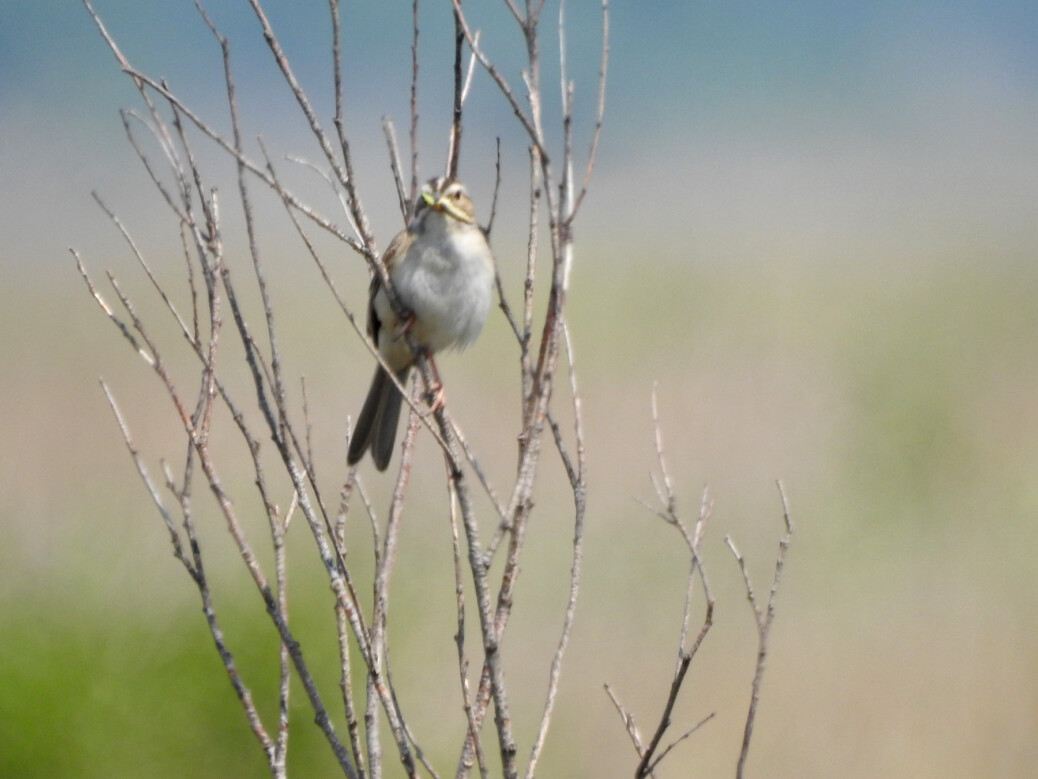
Photo: Kristin Stratton swiftly snapped this photo of the Clay-colored Sparrow carrying food, confirming the breeding sighting.
BY KRISTIN WALKER
On June 17, 2023, The Dunes-Calumet Audubon hosted a field trip led by Julie Bonnema, with experienced birders Angie Archer and me, among the fifteen participants. It was a beautiful day for birding, filled with old and new birding friends. The day at Kankakee Sands offered perfect weather, with clear skies, a slight breeze, and temperatures in the low 70s.
Julie had a few key locations in mind, each with target birds for the group to observe. Along the way, we encountered some little surprises—two of those being at the corner of where units F, D, G and the Beaver Lake Nature Preserve meet. We stopped there to look and listen for Blue Grosbeaks. I ventured away from the group to unit G to scan and listen while Julie stayed by units F and D to do the same. Upon scanning the restored grassland prairie habitat, managed by The Nature Conservancy, Julie came across a late Clay-colored Sparrow. She called me and Angie over to see it and confirm the identification, saying, “Kristin knows these well.” As I was walking over, I heard the raspy buzzzz buzzzz call and confirmed that it was indeed a Clay-colored Sparrow. I snapped one photo of the bird perched with food. Julie, Angie, and I all assisted in helping the field trip attendees see the bird. We were excited because it was mid-June and Clay-colored Sparrows are migrants in Indiana, and spring migration had been over for a few weeks. As we were observing the sparrow perched with a tiny inchworm in its bill, we heard a second buzzzz buzzzz call come from the west of unit F. Two Clay-colored Sparrows! That, in itself, is a treat.
We spent a considerable amount of time observing the birds and their behavior. The first bird was perched in the same spot with food, flying down to the same location four times. Julie also witnessed the bird carrying food to the same spot multiple times. Both birds were singing and doing their chip calls. At one point, Julie saw one fly away, and the other arrived with food at the same spot. Angie kept all our eBird checklists that day and logged the Clay-colored Sparrows as breeding birds. At this time, I don’t think any of us had realized that we had discovered the first breeding Clay-colored Sparrows in Indiana. We needed to get the trip moving along and also didn’t want to spend too much time at that spot as to disturb the sparrows. (By the way, we never heard or saw Blue Grosbeaks that day.) On our way to our next spot, we had to abruptly stop for a singing Connecticut Warbler, also a late migrant. That’s a whole different story for another time.
I consulted with Jeff McCoy about our observations of Connecticut Warbler and Clay-colored Sparrow, inquiring if either bird breeds in Indiana. Jeff confirmed that both species were considered late. He also indicated that breeding Clay-colored Sparrows had never been confirmed in Indiana. Upon sharing this information with Julie and Angie, we decided we had better do some more observations. The next morning, Julie and I returned to do a mini “big sit,” but strong south winds altered the weather, keeping all the birds hunkered down and quiet. Despite spending four hours watching and waiting for Clay-colored Sparrow activity, we only heard one buzzzz buzzzz song and observed a single sparrow popping up from unit D, flying over and perching in a tree along the road.
A few weeks later, Brad Bumgardner let us know that he had consulted with Allisyn-Marie Gillet and Ken Brock regarding our observations. He clarified that, according to the Breeding Bird Atlas protocol, a bird carrying food is considered a confirmed breeding record. Dr. Brock provided additional context, citing four other summer records in Indiana, including a pair in June 2016 at Kankakee Sands Unit D. Other records include a territorial Clay-colored Sparrow in St. Joseph County in July 1989, Pigeon River Fish and Wildlife Area in June 2011, and again in St. Joseph County in June 2013.
So, on June 17, 2023, Julie, Angie, and I collectively had a hand, eye, and ear in finding the first confirmed breeding Clay-colored Sparrow in Indiana. The Clay-colored Sparrow and Connecticut Warbler sightings came at a time when I lacked confidence, especially in birding. Some great memories happened on that field trip that I will always hold near and dear to my heart. The birds, fellow trip participants, and those we consulted with served as a reminder to stay positive, be mindful, have confidence in aspects of life. This experience reignited my passion for sharing my birding knowledge with others.
This story originally ran in the February–March 2024 print edition of The Cardinal.
Tags: birding insights birding story