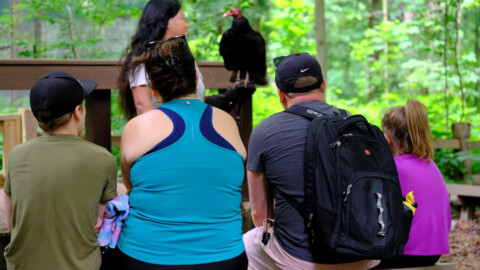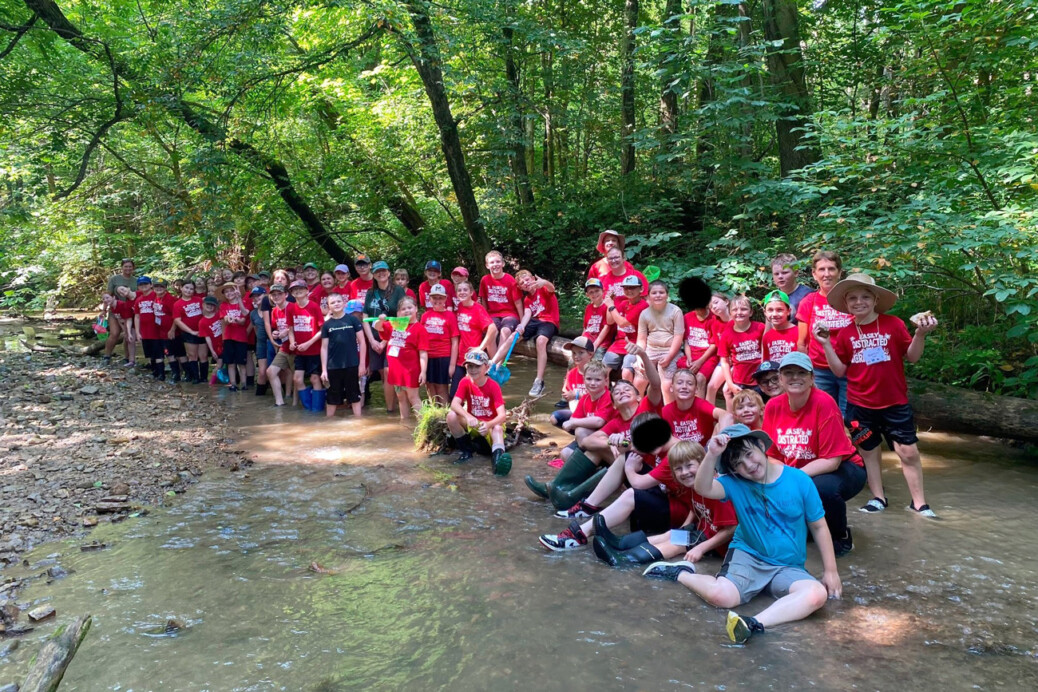
Image: Large group of Outdoor Education participants and leaders in red shirts gathered in a shallow creek during a hike at Mary Gray Bird Sanctuary in June 2025; the wooded stream setting reflects a day of exploring and finding crayfish and salamanders. Photo courtesy of Fayette County Community Voices.
BY ERIN FUTRELL
Fayette County Community Voices Outdoor Education at Mary Gray Bird Sanctuary provided its seventh year of programs in June of 2025 for elementary students from grades two through six. The program ran daily from 9:00 a.m. through 1:30 p.m. The purpose of Outdoor Education is to provide local youth with the opportunity to be outside in nature, learn about and build an appreciation for their natural environment, and have fun.
The themes for each of the one-week sessions for the 2025 program were Incredible Insects and Creepy Crawlies, with 55 students attending each week. Funds awarded by Indiana Audubon Society, Whitewater Valley REMC, Yaryan Eye Care Center, Roots Blower, USLA Bank, and FCN Bank were used to provide rent for facility use at Mary Gray Bird Sanctuary, scholarships for disadvantaged students, round-trip bus transportation from Connersville to Mary Gray Bird Sanctuary, a field trip experience to Hueston Woods State Park, supplies for hands-on science activities, pre-hike snacks for campers, ice cream and toppings for family night, and stipends for qualified and experienced staff. Each camper also received a camp shirt, field guide, and a nature journal.
Project Activities
The structure of each week’s sessions had a similar format. When students arrived, they signed up for one of four hikes offered that day, which were led by staff. They were then offered a choice of four pre-hike snacks. The morning hike began at 9:15 and ended at 9:55.
On Monday, Tuesday, and Thursday, participants rotated through four 30-minute stations in groups of 12-14. Lunch in Brooks Hall followed at 12:15. After lunch, participants again broke into their hiking groups for a read-aloud by the staff member who led their hike. The books reviewed or enriched each day’s topics. Next, everyone reconvened in Brooks Hall for theme-related songs, a tick check, announcements, and then departure at 1:30.
Each day’s rotation of stations for both weeks included a Bug Safari in various habitats within the sanctuary: the woods, the prairie, the pond, and a creek. Mary Gray Bird Sanctuary is an outdoor science lab, and our goal is to help students have a variety of learning experiences in it.
Other stations during the first week featured hands-on activities to teach about insect vocabulary, how insects produce sounds, the role bees and other insects play in pollination, compound eyes, the metamorphosis of butterflies and moths (which included observation of the life cycle stages and release of three monarchs and a luna moth), the comparison of human and insect strength and speed at an insect Olympics, and the strength of the hexagonal cells in a beehive.
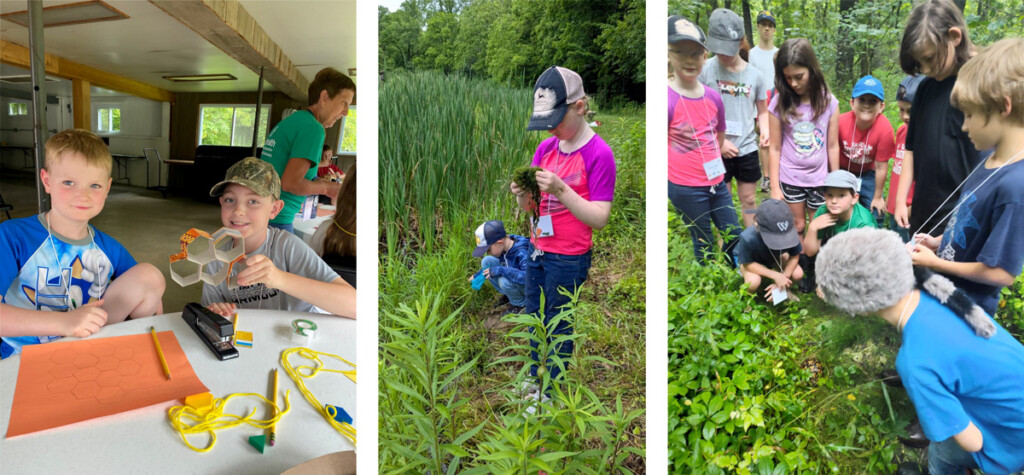
Images (left to right): Campers build behve to learn about why bees use hexagons; a camper examines moss from the pond, looking for insect larva; and campers examine an Eastern Box Turtle they found on their morning hike. Courtesy of Fayette County Community Voices.
During the second week, Creepy Crawlies, in addition to the Bug Safari stations, participants learned about the four main types of arthropods and how to identify them, as well as other invertebrates. They conducted two scientific experiments: one to determine which type of matter earthworms will choose to inhabit, and the other to determine whether pill bugs prefer light or dark and wet or dry habitats. Students observed crayfish to study their anatomy and the functions of body parts, learned about the types and functions of spiders’ webs through a photo hunt in the woods and crayon-resist paintings, studied camouflage and mimicry, and constructed “pooters” to safely capture and observe very small insects.
Special events or speakers were scheduled on the other two days of the week. During the first week, Incredible Insects, a special speaker, Bill Cummins, apiarist, taught the participants about bees on Wednesday. Students were divided into two groups, who alternately attended Bill’s hour-long presentation and two staff-led 30-minute activities: “Life in a Bee Colony/Bee Metamorphosis” and an art activity in which students used leaves in a printmaking process to create paintings of various butterfly species.
Two special events were included during the second week, Creepy Crawlies. Participants hiked Garrison Creek on the far side of the sanctuary on Wednesday. Then, on Friday, students used crayon-resist paintings of spider webs to write thank-you notes to staff, volunteers, and sponsors. Participants then enjoyed games, a cookout, and a sing-along of theme-related songs (such as “Going on a Bug Hunt”) until departure time. Students each received a net for catching bugs to take home to encourage them to continue their investigations as young entomologists.
A family night was held at the sanctuary on the last Friday of Outdoor Education. Families rotated through three activities: a shady hike, creek exploration, and an ice cream sundae bar in the barn.
Participation and Impact
All 55 spots were filled during both weeks of this year’s Outdoor Education camp. In addition to elementary-aged campers, there were also seven teen volunteers and 15 adult volunteers who assisted during camp. Family night had a great response as well, with approximately 90 people returning to Mary Gray Bird Sanctuary to experience what their kids had shared with them.
On the last day of camp, students responded to a survey about their experiences at Outdoor Education. Over 85 percent of campers surveyed rated camp at a 4-5, and nearly all said they would like to come back next year. Meeting new friends, morning hikes, and Garrison Creek were students’ favorite experiences from camp. Students were also given the opportunity to suggest themes for future camps. Campers expressed interest in learning about plants and trees, fossils, animals, and birds.
Parents were also given an opportunity to share about their child’s experience at Outdoor Education. One parent shared that the only negative thing for their child at camp was “having to wait a whole year for the next camp!” Another parent shared, “(I’m) just very grateful this program is available with all the volunteers and grants being sought out to use. Thank you so much! This program will have lasting memories and knowledge for the kids who attended.”
Due to families expressing interest in having a camp for kindergarten and first-grade students, an additional week for these younger students is planned for Outdoor Education 2026.
Indiana Audubon’s Mumford and Keller program funds natural resource research and projects focused on Indiana’s birdlife. This report highlights a project supported in the 2024-2025 grant cycle. Learn more at indianaaudubon.org/mumfordandkeller.
Tags: grant report mary gray bird sanctuary mumford and keller