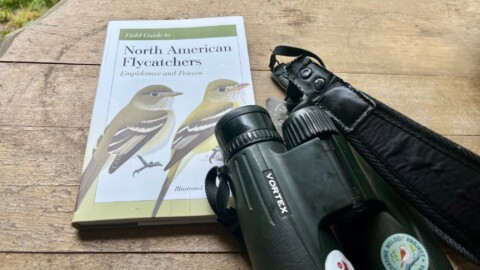
Photos: Kyle Wiktor’s paper checklist utilized during Longshore Tower migration surveys, incorporating banding codes. Both photos by Brad Bumgardner.
BY BRAD BUMGARDNER
Over the years, the realm of birding communication has undergone a remarkable transformation propelled by technological advancements and evolving social dynamics. From the early days of field guides and printed newsletters, birding communication has embraced the digital age with open wings. Today’s dedicated birding apps and social media groups share a wealth of information, reshaping the way we learn and connect across the Hoosier state. As citizen science and hobby birding intertwine online, the previously shunned four-letter bird code is now finding a new life.
For some, the adoption of bird banding four-letter codes represents a gateway to a deeper understanding of avian life, while for others it is a frustrating obstacle in understanding what more experienced birders are talking about, especially for beginning birders just figuring out how to interpret the codes and their use. So much so, that some online groups ban their entire use. Though often attributed to the Bird Banding Laboratory (BBL) for use by banders submitting data, their use is far beyond just bird banders, and with citizen science, there are more birders using the “banding codes” than banders today.
Truly embracing the four-letter codes (and six-letter code format for scientific names) offers an opportunity to streamline the birding experience if you’re one of the growing number of eBird and Merlin users. You may be using both eBird and Merlin already, but as an app with growing popularity, its integration with these codes is allowing for citizen science in the field without your head constantly looking at your phone.
Want to see how banding codes fit in? Visit Merlin and use the Explore function. If you want to search Black-and-white Warbler, you can type out the entire species name to narrow it down, or simply use it’s four-letter code, BAWW, and now you’re left with only one option to choose from.
You have more than likely used eBird already, as it’s become one of the world’s largest citizen science databases. Thus, it only makes sense that users have access to locating birds using the same banding codes. If you’re using the eBird app, you only need a partial banding code to start generating a list of possible birds, thus allowing you to quickly record five Black-and-white Warblers in as few as six quick taps of the screen.
How do you go about learning the four-letter banding codes? While the rules of conventions are for the most part logical, there are always a few interfering names that require some tweaks here and there. One-name birds are easy: KILL for Killdeer, BOBO for Bobolink. Two-word names take the first two letters from each word. Thus, Tufted Titmouse is TUTI and House Wren is HOWR. If the bird has a three-part name, use a 1-1-2 pattern. Great Blue Heron becomes GBHE; Black-capped Chickadee becomes BCCH. Rarely you might have a four-parted name, and you simply take one letter from each word. Hence our Black-and-white Warbler is a no-brainer: BAWW.
The confusing codes are often what makes birders hesitant to use the codes. Conflicting birds can’t have the same name, so our beautiful Barn Swallows and Bank Swallows can’t both be BASW. (Hint: go down the letters of the name to find the first until you find a unique letter). In which case, we have BARS and BANS instead. Same for HADU. Harlequin Ducks and Hawaiian Ducks would conflict, so we have HARD and HAWD.
Despite the obstacles, birders who challenge themselves to learn the banding codes will find benefits in their overall citizen science experience and find continued ways to bridge the gap between birders and researchers. You’ll be a faster eBirder and find enrichment along the way.
This story originally ran in the April–May 2024 print edition of The Cardinal.
Tags: birding insights