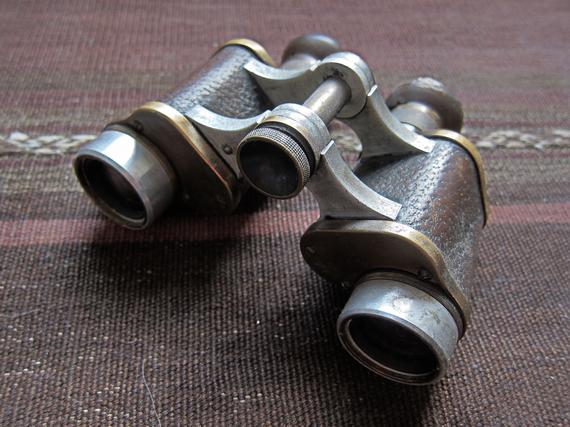
Photo: Vintage metal binoculars from the early 1900s resting on a woven fabric surface, showing worn leather grips and signs of age. Courtesy of Terri Gorney Lehman.
BY TERRI GORNEY LEHMAN

The Christmas Bird Counts (CBC) began on the east coast in 1900. The counts rely on volunteers both in the field and watching bird feeders to record the species of birds that are seen or heard as well as their numbers. It is the oldest citizen science project in the country and was created as an early winter census for the birds and as an alternative to shooting birds for sport at Christmas. This count gives an idea of bird populations. The counts take place every year between December 14 and January 5.
Archival records for the CBC annual summaries are available online in the National Audubon Society’s Bird Lore.
The first Indiana CBC was held in Richmond on December 25, 1908, at the White Water River Gorge. The winds were light from the southwest; the ground was bare’ temperature 28°F. Birds recorded included:
- Red-shouldered Hawk, 1
- Kingfisher, 4
- Hairy Woodpecker, 1
- Downy Woodpecker, 2
- Red-bellied Woodpecker, 1
- Blue Jay, 10
- Crow, 30
- Goldfinch, 6
- Tree Sparrow, 50
- Junco, 6
- Song Sparrow, 16
- Chewink (male) [towhee], 1
- Cardinal, 4
- Brown Creeper, 3
- White-breasted Nuthatch, 1
- Titmouse, 6
- Black-capped Chickadee, 8
- Golden-crowned Kinglet, 2
- Ruby-crowned Kinglet, 1
A total of 19 species and 147 individuals by Mr. & Mrs. Percival Brooks Coffin, M. Baxter, and Mrs. J. G. Sutton. It was noted that the were out for four hours.
In 1909, Richmond and Webster conducted the CBC. Richmond held the count at the Earlham Cemetery on December 25 in a snow-storm. Ground covered; brisk wind, northwest winds; temperature 22°F. Birds recorded:
- Blue Jay, 4
- Crow, 2
- Tree sparrow, 6
- Junco, 3
- Cardinal, 2
- Golden-crowned Kinglet, 2
A total of 6 species, 18 individuals. Counted by M. Baxter and Mr. & Mrs. P. B. Coffin. It was noted they out for two hours in the morning.
The Webster CBC was held on December 27 from 1-2:30 p.m. Cloudy; one foot of snow on ground; winds southwest; 17°F. Birds recorded:
- Mourning Dove, 2
- Red-shouldered Hawk, 1
- Sparrow hawk [kestrel],1
- Downy Woodpecker, 1
- Red-headed Woodpecker, 2
- Crow, 50
- Goldfinch, 5
- Tree sparrow, 13
- Junco, 45
- Song Sparrow, 20
- Cardinal, 2
- Carolina Wren, 1
- Tufted Titmouse, 6
- Chickadee, 4
A total of 14 species, 159 individuals. Counted by M. S. Markle and Loren C. Petry.
In 1910, there were four CBC held in Richmond, Indianapolis, Fort Wayne, and Dublin.
The first record that I found of taking a camera on a CBC was the 1920 Fort Wayne CBC, and the photographer was Amos Mehl. The group of men walked along the old canal path by the St. Joe River. The men looked like they were dressed for work or church and not birding.
The modern-day CBC is a 15-mile diameter circle created by the National Audubon Society in the 1950s. The traditional chili lunches appeared to start in the 1960s.
I hope that everyone can participate in at least one Christmas Bird Count. It is for a good cause, and it is a great way to meet other birders.
This blog post was written by Hoosier historian and naturalist Terri Gorney Lehman as part of her Flight Paths Through History series, exploring the people, places, and moments that have shaped Indiana birding.
Tags: flight paths through history