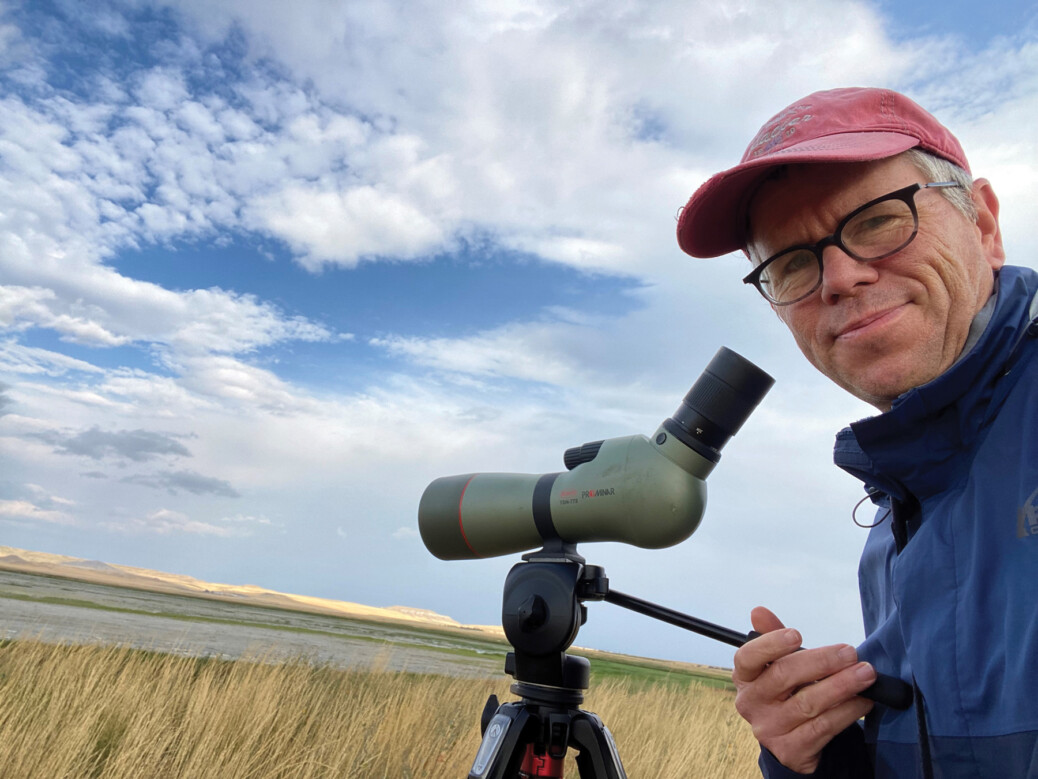
Photo: Dr. Benson takes a selfie in Montana.
BY DAVID BENSON
“There’s no way we are going to find this thing.” I was sure of it. The trails were packed with tourists, hiking noisily all over the mountain side, completely oblivious to the possibility of a Sooty Grouse—and that there was such a thing as a Sooty Grouse. “Let’s just keep scanning,” my friend, Maikel Wise, who joined me on this western trip to Rainier, Washington, and the Pacific coast, suggested.
So, we continued scanning the heath subshrubs. Even at a distance, I’ve got a decent shot at picking one out. I’ve been doing research on ptarmigan in Glacier National Park, Montana, for decades and have a pretty good search image for grouse. However, my internal clock was telling me that we needed to cut our losses and move on. We spent way too much time in Seattle traffic yesterday and needed to get to the coast where the majority of my target species were. Sooty was the only species I needed in Rainier. On the other hand, it would be a lifer – I can’t give up too easily! Keep searching…
“Got it!” Maikel exclaimed. “Wait, is that a grouse or a ptarmigan?” Maikel had found the bird in the deep willows, but not too far from the trail. Getting it in my binoculars, I said, “That’s no ptarmy! It’s a Sooty!” Yes! 468 for the year, and one that I was definitely not guaranteed to get.
I’m a biology professor at Marian University in Indianapolis. I decided to do this big year in early March 2023 when I was granted a sabbatical for the fall. This gave me freedom for a few more fall trips than I would be able to do with my typical class schedule. My travels fit the times I had available. Spring break I went to northern Florida and south Georgia, adding 80 species to the year. Then, in early May I went to Utah to watch my middle daughter graduate from Westminster College. I went a day early so I could bird, adding 32 species. From there, I flew straight to Arizona, primarily birding in the Madera Canyon and the Portal areas for a week. There, I added 90 species and had so much fun. Everyone there is a birder, so if you are missing a target, just ask. I asked about Spotted Owl and was told the exact tree it would be sitting in during the day, along with Red-faced and Olive Warblers and Mexican Chickadees singing nearby. Returning to Indiana during the peak of spring migration and doing my annual (carbon neutral) birdathon for the Amos Butler Audubon Society with Wesley Homoya resulted in an additional 50 new species.
During my Montana summer I was able to bird in Glacier, of course, but also take day trips a few times around Montana, seeing lots of amazing views, habitats, and birds, and adding 70 species. Because I was already close by, I decided to go straight from Montana to Washington state in mid-September, then take a week in California, mostly in the San Francisco and Los Angeles areas, where I took a second pelagic trip. The first was off Cape Hatteras in May, adding 8 species. This one was out of Half Moon Bay and was super productive. Even though I had spent a lot of effort trying to learn the species that were most common, brown and white birds zipping by the bouncing boat at great speed take practice to identify in the field. Thankfully, pelagic tours include expert spotters on board. All told, the Washington and California trip added 73 species.
In October, my wife Kara and I traveled to south Florida and the Keys, including Dry Tortugas National Park, to celebrate our 30th anniversary. Despite not being a birder, she enjoyed the thrill of adding to the burgeoning year list, bumping it from 542 to 560. Who wouldn’t enjoy joining the experts at the Florida Keys Hawkwatch, seeing hundreds of peregrine falcons along with my targets, Short-tailed Hawk and Mississippi Kite?
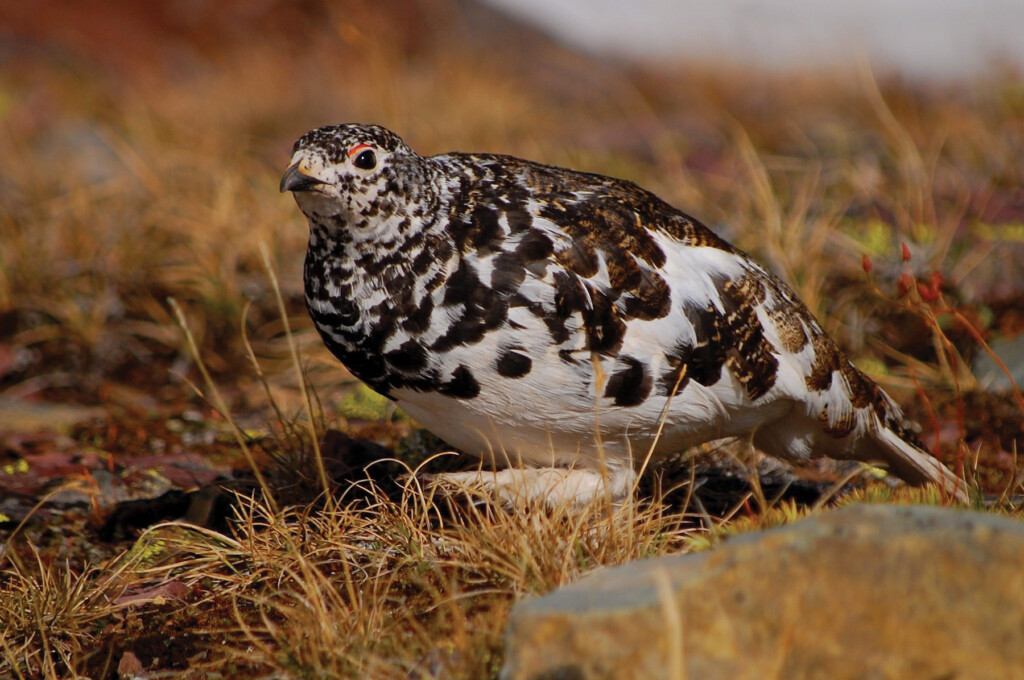
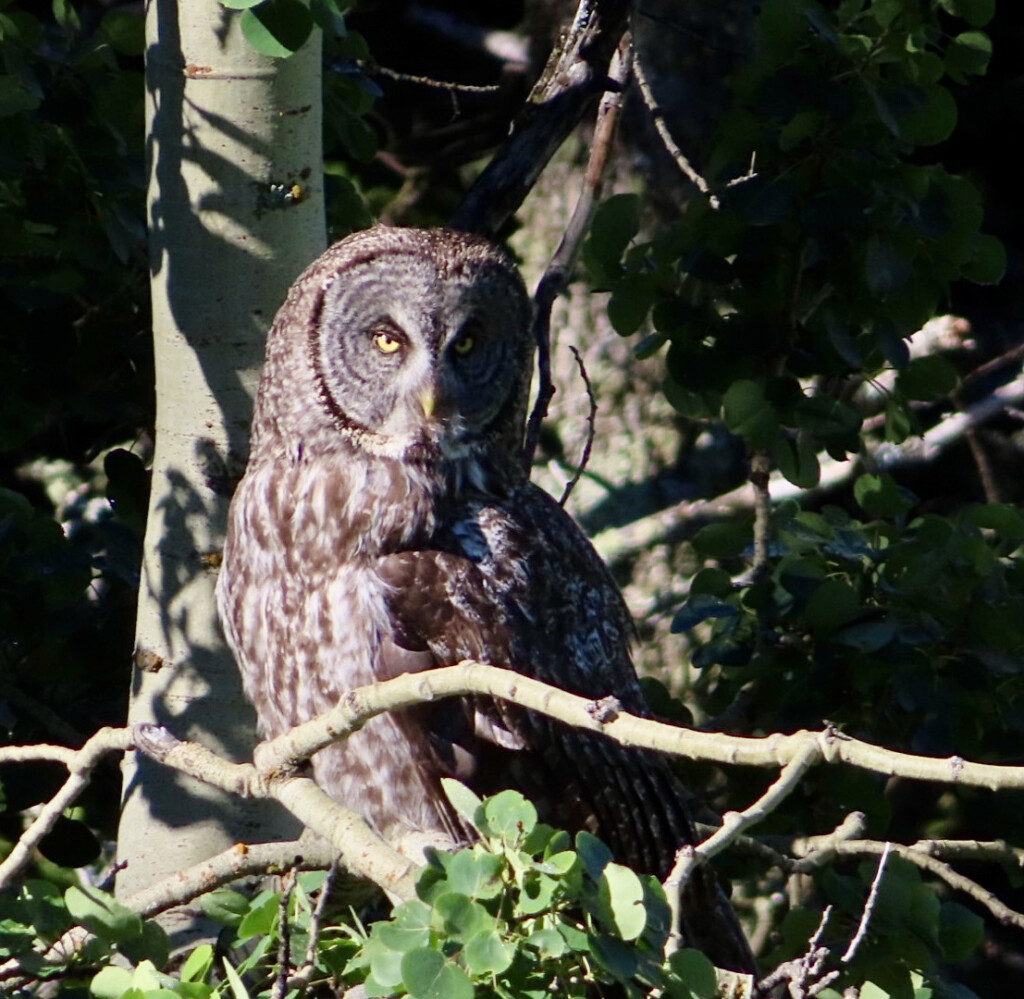
Photos: White-tailed Ptarmigan (left) and Great Gray Owl (right) by David Benson.
Thanksgiving found my family in North Carolina with friends. After that, I dropped off the rest of the family at the airport and drove overnight to Cape Cod, spending hours on cold, windy beaches looking, unsuccessfully, for Dovekie and Manx Shearwaters. I loved it, and I found Great Shearwater, Razorbills, and eiders, plus 10 other new species along the Massachusetts and southern Maine coasts.
The last best trip of the year was to Texas, where, thanks to Jeremiah Oden, the Bare-throated Tiger-Heron awaited. Jeremiah had already booked the required guide to go for the heron on private property south of the border wall, and he graciously invited me, along with Katey Powell and Kyle Wiktor. This was the highlight of the trip with fantastic views of some of the rarest of the rare, like the heron (#600 for the year), Brown Jays (so big that at first glance, I thought they were hawks), Morelet’s Seedeaters, Red-billed Pigeons, and Rose-throated Becards. Texas yielded 36 new birds for the year leaving me at 611 for the lower 48.
Among the 611 species I saw in 2023, 75 were entirely new to me. Which was my favorite? For me, often it’s the chase more than the bird itself that endears me to it. For example, the Black Rosy-Finch is a beautiful bird on its own. But, the fact that I had to search along the Beartooth Highway, a 11,000-foot high stretch of road in the spectacular mountains just outside of Yellowstone National Park, made this species my favorite of the year. I searched and searched with mind-blowing views in all directions, and when dusk was falling and I’d almost given up hope, I heard one calling outside the car window. A brief hunt located three individuals among the alpine rocks, species #446 for the year.
Over the course of the year, I learned an enormous amount, working hard on tricky identifications, better understanding birds’ movements, and simply grasping at a more visceral level bird ecology, which I will be able to pass on to my Marian University students. This crazy goal was the driving, fun force in my life last year, and I highly recommend it!
David Benson, Ph.D., is Marian University’s senior biology professor. He finished 2023 on a high note, ranking 12th for identifying an outstanding 611 bird species across America’s Lower 48 states during the 2023 calendar year.
This story originally ran in the February–March 2024 print edition of The Cardinal.
Tags: big year birding story birding travel