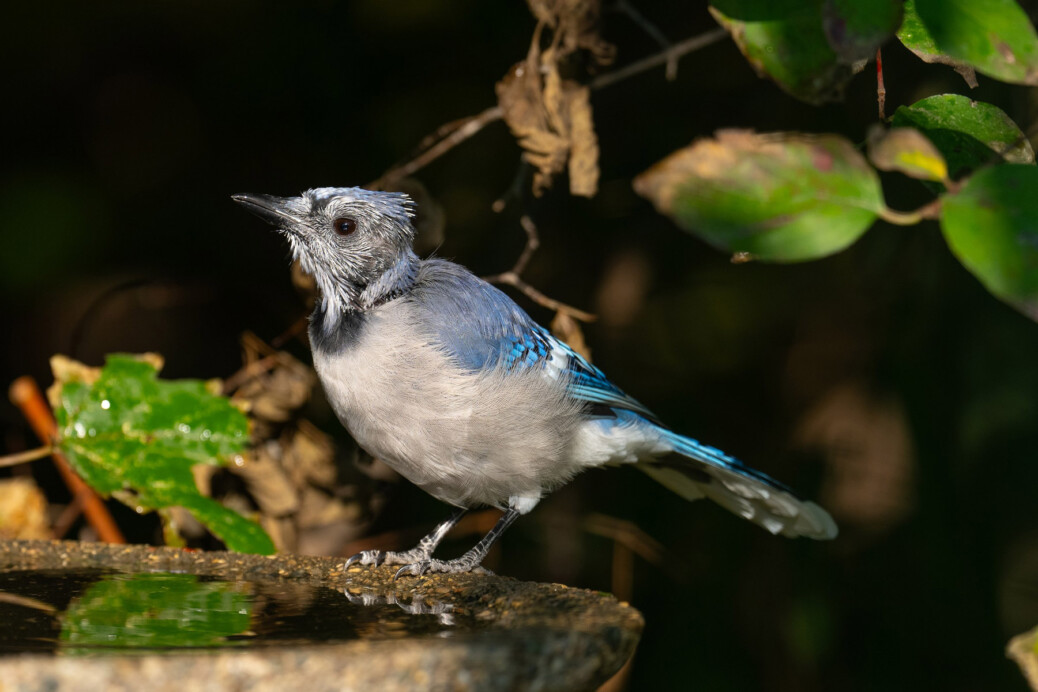
Photo: A molting Blue Jay with patchy head feathers stands at the edge of a birdbath. Photographed by Chandler Roberts on September 11, 2024.
BY OLIVIA BAUTCH
Your excitement grew as buds and fresh blossoms fed emergent insects who would make way for the birds of April and May. Alone or in the company of other bird enthusiasts—just as excited as yourself—you learned the sights and songs of more species than you knew existed. At the lake, at the neighborhood park, in the field, migrant birds and territorial locals created reason for celebration. You’d grown accustomed to the heightened sensory awareness that mentally pulled a Yellow Warbler’s song out of countless other warbles and tweets—even fine-tooth comb croaks of springtime’s chorus frogs.
But now it’s different. Both the muffled city soundscape and an excess of arboreal rustling each seem to magnify a sudden vacancy in the landscape. Spring has settled into summer, and with it, our birds have abandoned Indiana for northern territories.
Or so you assume. You may have heard that most American birds migrate north from South and Central America up to Canada or some snowy state adjacent the border. So, what if I told you over 150 species of birds spend their summers in our state—and in good numbers?
The Indiana Department of Natural Resources last ran a breeding bird atlas to collect and assess this data from 2005 to 2011 [1]. Their findings, published in 2023, named 155 species as “regular nesters” in at least one region of the state. Eighty-nine species had greater than 25% frequency for breeding in the state, meaning a bird such as American Robin, at 99.8% occurrence, was found to be likely breeding in 99.8% of survey blocks (scattered patches across the state). The specialized grassland songbird Prairie Warbler was only observed breeding in 24.9% of survey blocks.
Nevertheless, there are still birds nearby—and quite showy ones too. You might be wondering: if the birds are still around, why can’t we see or hear them anymore? Our first clue can be found in the last paragraph: the breeding season.
Being Quiet Around Baby
Remember the soundscape we mentioned earlier? Among other, more visual cues, birdsong is communication—to attract a mate and defend territory. But once mates are chosen, nests are secured, and young are born, those same birds won’t want to be so conspicuous.
Post-spring migration requires less of a hyper-focus on distinguishing songs, and more a tuning in to the subtle sounds known as bird calls, specifically “chip calls.” Shorter and more pointed, these vocalizations have a range of meanings within bird communication. For example, an adult Indigo Bunting may call to its young to deliver food, while a pair of Northern Cardinals might call to locate each other. You can listen to examples of both chip calls in the audio clips below.
Learning and following bird calls can expose you to the family life of nesting birds. Although they take more effort to seek out, the Cornell Lab of Ornithology suggests that there are more birds present during this summer baby boom than during migration [2].
Plus, it takes energy to sing and display for hours each day. Even we feel our voice wear out after an hour of road trip karaoke. For wild creatures like birds, conserving energy is vital to ensuring they can feed their voracious young, evade predators when necessary, and carry on with their uniquely designed biological functions. As soon as courtship goals have been reached, singing settles down and energy is put towards family life and other pursuits.
Losing Feathers on the Low
Birdsong isn’t the only thing that fades after May. As summer progresses, bold crimsons, neon oranges, contrasting hues, and even some patterns dull, making many species of songbirds unrecognizable. Your splotchy, ragged Mallards huddled on the shoreline? Molting. The bald Northern Cardinal and Blue Jay? Also molting. Perhaps the most famous of molt transformations belongs to our year-round resident, the American Goldfinch, whom many birders assume has migrated away after their sunny yellow plumage molts to faded olive.
Like song and display, producing extravagant feathers drains energy. Ornithologists joke that after wooing the ladies, male birds get lazy and quit their impressive attire. In reality, both males and females wear out their feathers, and at least once a year (depending on species) complete a molt. New feathers push old, frail ones out [3].
And since feathers are for more than just show—birds need certain feathers to fly—molt must be strategically scheduled during a lapse when birds can keep a low profile. Mallards, for example, lose their flight feathers and gather in a safe place near reeds or grasses. Blue Jays and Northern Cardinals may become comically bald, losing their head feathers all at once to speed up the process [4]. But a completely exposed head leaves them extra vulnerable to predators or the elements. In many cases, their entire body molts gradually instead.

Photo: A male American Goldfinch mid-molt, transitioning from its muted winter plumage to bright breeding colors. Photographed by Ryan Sanderson, April 4, 2016.
Binging Before Migration
Even after feeding and fledging a brood (or more) of baby birds, there is more foraging to be done. This time, it’s to increase a fat store for fall migration. Young have replaced their swaddling downy feathers with full-flight feathers, deeming them mature enough to travel, and adults have their own not-so-shiny new feathers to carry them afar.
The birds of late summer may not be so obviously foraging, with both sexes and all ages draped in duller hues, nearly silent, and a mixed bag of molt. Even when they do take off, migration is predominantly a nighttime occurrence. In this state, early morning fallouts may be less rambunctious than experiences from earlier in the year, and individuals are a monochromatic blur into the turning leaves. But if you have the patience, you might just come across one of the annual young-and-dumb hatch-year birds (or rarities), which birders reliably find sidetracked on their first trip away from home.
A Different Kind of Birding
Contrary to popular belief, summertime can present great birding opportunities! While the celebratory rush has passed, the calm that follows gives us room to focus on the behaviors and lives of individual birds. They’re still out there. What will you find?
References
- https://www.in.gov/dnr/fish-and-wildlife/files/fw-AtlasBreedingBirdsIndiana_2005-2011.pdf
- https://www.allaboutbirds.org/news/ive-been-hearing-beautiful-bird-songs-every-morning-since-spring-but-suddenly-im-not-hearing-birds-at-all-what-happened-to-them/
- https://www.audubon.org/magazine/understanding-basics-bird-molts
- https://blog.lauraerickson.com/2020/08/bald-blue-jays.html