Photo: American Woodcock by Ryan Sanderson.
BY DAN BARRIBALL
Whether you call it the timberdoodle, bogsucker, Labrador twister, night partridge, brush snipe, hokumpoke, twitterpate, or crazy straw, the American Woodcock has fascinated us for as long as people have lived here. That catalog of nicknames testifies to the hold that Scolopax minor has on our imagination. A friend calls them “nature’s lovable weirdos,” and truly I have been enchanted by them.
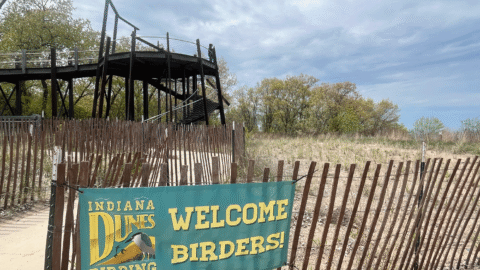
It all began in late March of 2019. I was just south of the bird observation tower on trail 3 in Pageant Blowout in Indiana Dunes State Park. Blowouts are a unique feature of the Indiana Dunes where wind and waves have broken through the foredunes, scouring out whatever was there before and leaving an open area of sand. That open area is first colonized by marram grass, sometimes called beach grass. On that March evening, I was standing in the marram grass when I heard that first peent. Soon, I was hearing peents from several birds in the area. My curiosity was piqued. A few minutes later, I heard the twittering sound of a flight display. First there was one, then another, then a third, all up in the air at the same time, dancing in the sky. I was enchanted. I found myself drawn back to the blowout, night after night, to watch this spectacle.
I began to log what I was seeing on the eBird app to help me learn more about the woodcocks. I noticed that the time when the males started peenting depended on how cloudy the skies were. If skies were cloudy, the peenting started earlier. Light levels seemed to drive their activity. There was a woodcock who nightly took his station right on the trail, about 30 feet down the trail from where I usually observed. I watched that bird arrive, peent, flight display, and challenge other woodcocks. The woodcocks would face each other with raised wings, aggression cackles sounding between them. The woodcock displays continued all through April and May, into the beginning of June. On June 4th, the displays suddenly ended as if they had run out of gas.
To my surprise, people saw my eBird checklists and began coming out to view the woodcocks. There was a couple that came out on a rainy night. Despite the rain, the birds put on a show. The couple had never seen woodcocks sky dancing, and they loved it. Another night, two women from Germany came to the blowout. They were in the area and wanted to see how American Woodcocks compared to Eurasian Woodcocks. They said that American Woodcock displays were considerably more dynamic than the Eurasian.
In 2020, I was determined to discover when the woodcocks would arrive back at the Indiana Dunes. I began my evening checks in mid-February. For a couple of weeks, I heard nothing. Then on March 1st, I heard one peent, then another, and then a flight display. They were back! More arrived over the next several days, and there were territorial disputes aplenty while they figured out who would be where.
There are still a few things I would like to learn about the woodcocks of the Indiana Dunes. Where do they go to feed when they are not displaying in the marram grass? How many females nest successfully? Where do the Dunes woodcocks go for the winter? I may never find the answers to these questions, but I’m going to have fun trying. The next time you are out in the evening from March to May, check out the grasslands and open forests. You may hear the woodcocks, begin watching them, and be fascinated by these birds as people have been for generations.
This story originally ran in the April–May 2024 print edition of The Cardinal.
Tags: birding story indiana birding trail