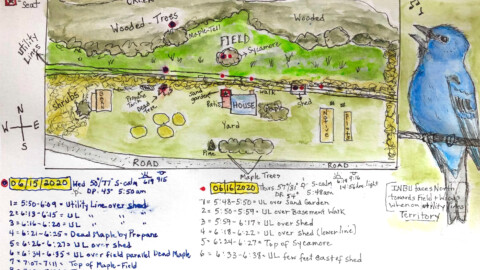
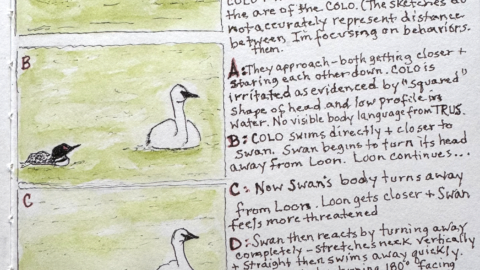
Photo: Here’s a look at nature journaling in action, as Joni James documents her observations with sketches, notes, and watercolors right from her backyard.
BY JONI JAMES
One evening recently, I presented a program to an organization. I had previously given a nature journaling program for them, and several members approached me afterward. Sheepishly, they admitted, “I was motivated by your nature journaling program, so I purchased a journal and a few pens with the intention to begin. I even have my journal sitting on a table to be used, but I just don’t know how to get started.”
I hear this quite often.
How Do I Begin?
Before you fill your journal pages, it is important to be aware of the personal thoughts, feelings, and beliefs that are likely preventing you from starting and sticking with your journaling practice.
Silence the inner critic. Fear of being judged—by others and yourself—or doubting your own abilities often stands in your way of beginning. The fear of the blank white page also affects many beginners and experienced journalers alike. The nemesis is the Inner Critic. The Inner Critic is the voice inside which is attempting to sabotage you. “That drawing looks funny.” “You can’t draw.” “Your writing is not good enough.” “Your penmanship is sloppy” “You should quit journaling. You do not know what you are doing.” You must learn to disregard that part of you that is self-critical. Once you recognize its intention, shut it down and proceed with your goals.
Adopt a growth mindset. We now know our brain development is not static. Our brains continue to grow and change throughout our lives. It is not about talent. We can learn new skills and ideas that create new neural pathways. A growth mindset means understanding that most basic abilities can be developed through perseverance and hard work. Learning a new skill is not easy, but when you work just outside your current skill level, new learning occurs. If you “put in the pencil miles,” you will be surprised at your improvement in a short time.
No rules. Nature journaling has no rules. There is no right or wrong way to journal. Your journal is for you! It does not need to include drawings, colored pencils, or watercolors. It can be primarily a written journal with no sketches or color. You can paste photographs in your journal, use magazine clippings, write poems, and include quotes. Write about your thoughts and feelings from your experiences. Brainstorm questions that come to mind concerning the experiences or observations and write these on the page. Design the page in any manner you wish. You can use any combination of these ideas or simply list the bird species you observed. Start slow by setting a goal of completing three journal pages a month.
What Nature Journaling Requires
Nature journaling is about attention, awareness, curiosity, and wonder during your experiences in nature. This is what is important. The goal is a connection to the natural world and documenting it in your own way.
Although I may carry my journal into the field, I usually prefer to remain totally engaged with my experiences and observations. I may take photos or write notes in a small field notebook, but I journal when I get home or as soon as my schedule allows it. I begin by writing the date, location, and weather data (metadata) on the page. Next, I plan what observations I want to include and the layout of my journal page. This works best for me.
Do whatever works best for you. Many nature journalers take their journal and tools into the field and do all their sketching, writing, and color work while there. Others may do half and half by sketching and writing in the field and finishing at home.
Be prepared. What will you need during your outing? Carry a shoulder bag large enough to hold your journal and tools. It should always be packed and ready in the same location. You do not want to repack it each time or risk forgetting something. Just prepare for where you are going and what you expect to need.
As you fill journal pages, you will acquire a journaling process that works best for you. There is no right or wrong way.
Situational Examples
The following scenarios provide examples of how you can document your observations once outdoors with your journal kit or when you return home.
- Just before sunrise, fog engulfs the pond on a late June morning. A Green Frog lies suspended near the shoreline. You stand motionless, watching the frog and noting its shape, textures, and colors. Using your phone, you take a photo of the frog. A flying insect flutters across the water a few inches from the surface, when suddenly the frog explodes forward and grabs it.
This is an event worth documenting in your journal. You may decide to sketch the frog waiting or striking the insect. Perhaps you print the photo you took and paste it on your page. You can write about the action, your thoughts, or information about Green Frogs. What questions can you brainstorm about this encounter?
- You arrive home from work with thirty minutes before you need to pick up your daughter from practice. You grab your journal bag and binoculars and walk into your yard. You notice an American Robin foraging in the grass. It gathers what appears to be insects and possibly a caterpillar, then flies to a nearby tree. You follow it with your binoculars and are surprised to discover a nest. Sitting on a chair, you watch for the next twenty minutes as it and its mate feed the nestlings.
This is another experience you can journal. You can simply document your observations, or you can count the number of trips they make to the nest in twenty minutes. What patterns do you notice from their activities? Where were they foraging? Did they leave your property? Could you hear nestlings begging, or are they too young? Will you draw the birds foraging, sketch the nest, or add researched information about robin nesting behaviors? Did you take a photo, or will paste in one from a magazine? What questions came to mind about this stage of the robin’s life cycle?
- It has been a busy week, and you have had no time to go birding or nature journaling. You have fifteen minutes before you need to fix dinner. You grab your binoculars and head outside. In that short time, you observe or hear twelve bird species and upload the data into the eBird app. You also spot a lovely Monarch butterfly larva feeding on a milkweed plant in the garden.
The next day you can create a journal page listing the birds seen and heard, then make a sketch of the caterpillar, adding in color.
Bottom Line
I hope you now have tips and examples to help you take the steps in your journaling adventure. Just go outdoors! Be attentive and curious. Document your experiences and shut down the inner critic. Most importantly, have fun.
If you would like more information, read my previous article, “Nature Journaling: A Deeper Connection with Nature” in The Cardinal’s February—March 2022 edition (Vol. 53 No. 1).
You will also find a wealth of information and links to video classes on numerous nature journaling topics on the John Muir Laws website. Search his name on YouTube for hundreds of educational videos. The Wild Wonder Foundation also offers classes, trips, and connections to the nature journaling community.
If you have any questions, contact me at [email protected].
Tags: journaling