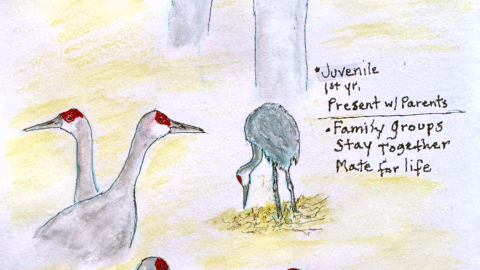
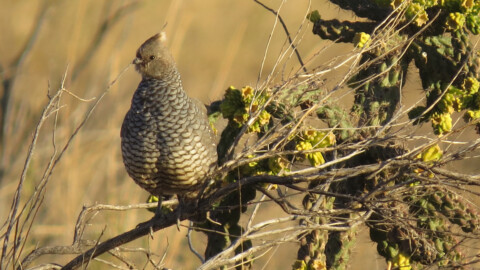
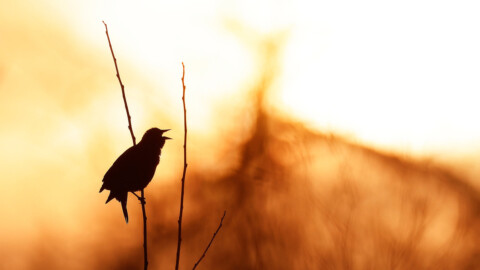
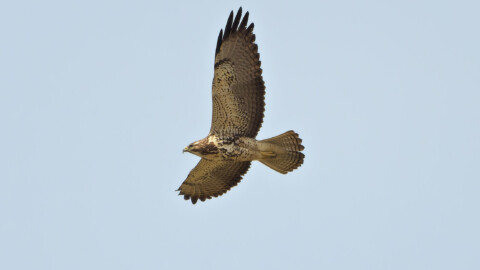
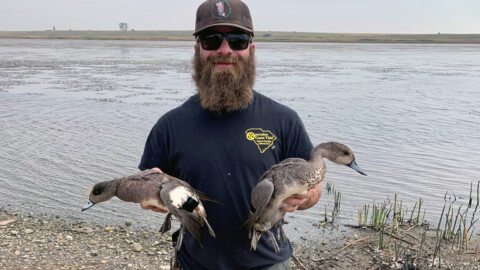
Photos: Sandhill Cranes at Jasper-Pulaski Fish and Wildlife Area and a covered bridge in Parke County by June Kohler.
BY JUNE KOHLER
Visiting all 68 sites on the Indiana Birding Trail was probably one of the most satisfying experiences I’ve had in years. I began on July 3, 2021. I had recently retired (well, semi-retired) and had just completed physical therapy following knee replacement surgery. It seemed like a good time for this self-proclaimed homebody to break out of her comfort zone for a little adventure. I love to bird, though I’ll never be mistaken for an expert. What better way to check out birding hotspots not just in northern Indiana, where I live, but throughout the entire state? As it turned out, the project also gave me a glimpse into a side of Indiana I’d not really thought of.
Indiana Audubon’s A Guide to the Indiana Birding Trail contained a wealth of the information needed to plan my travels. First and foremost, of course, were the locations along with best times of year to bird; hours; admission (if any); trail accessibility; nearby amenities and more. With more than 400 species of birds documented in Indiana, my goal was to find at least half that number at Indiana Birding Trail sites.
Birds, of course, are the primary focus of the Indiana Birding Trail. Stretching from the shores of Lake Michigan south to the Ohio River, Indiana is blessed with many diverse habitats. With its open farmland, marshes and wetlands, forests, lakes of all sizes, rivers, and rolling hills, you never know what you’ll find when birding in the Hoosier state. While it didn’t happen often enough, I was ecstatic anytime a friend accompanied me on this project. Their additional eyes, ears and expertise were invaluable in helping me identify more birds than I could hope to on my own.
It was inevitable that overnight travel would become necessary as I ventured farther from home. Since I’m not into camping, budget considerations meant reaching some sites after peak bird activity had subsided. It also meant I couldn’t spend as much time as I would have liked at some of the larger properties. My Indiana Birding Trail species list grew more slowly, sometimes not at all. Occasionally I questioned the wisdom of continuing my quest.
It was during one of those periods of introspection that I realized that the Indiana Birding Trail had, for me at least, become more than compiling a list of birds. It was also about getting to know Indiana, its habitats, even a little about its history. Most of all, it was about finishing what I’d set out to do, whether or not I succeeded in every aspect.
There are more than birds to be discovered on the Indiana Birding Trail. Kankakee Sands, for example, is home to a small herd of bison. I got to see several foxes and white-tailed deer fawns sporting spots. Whenever possible, I exchanged the well-traveled highways for the back roads to reach Indiana Birding Trail destinations. They took me through Amish communities, past limestone cliffs and among rolling hills with the type of sweeping vistas not seen in the north. My friend Kristen and I took a self-guided tour of covered bridges when visiting Turkey Run State Park and Raccoon State Recreation Area.
Small museums and historical displays can be found in or near many Indiana Birding Trail sites, particularly the state parks. I did not know that Corydon was Indiana’s first state capital. Or that O’Bannon Woods State Park (formerly Wyandotte Woods State Recreation Area) was named after the late Indiana governor Frank O’Bannon. I’d assumed that Brown County State Park’s Abe Martin Lodge was named to honor a community leader. To my surprise, Abe was actually a beloved cartoon character created by Kin Hubbard in the early 1900s. I came across pioneer cemeteries in several state parks on the Indiana Birding Trail, including the one containing the gravesite of Abraham Lincoln’s sister Sarah (Lincoln State Park). Someday I hope to return to Charles Town State Park and hike to what remains of the once-popular Rose Island Amusement Park, decimated in 1937 during the deadly Ohio River flood.
My quest to visit the entire Indiana Birding Trail concluded at Brown County State Park on September 10, 2024, three years, two months and seven days after it began. I fell short of my goal to identify 200 species at Indiana Birding Trail sites. However, I did celebrate 23 “lifers”, including the Limpkin (Kingsbury Fish & Wildlife Area) and the Brown Booby (Spring Mill State Park), arguably Indiana’s most celebrated avian visitor in recent memory.
I don’t know if anyone else has completed the Indiana Birding Trail, but I hope someone does. Whatever way you do the Indiana Birding Trail – whether all or in part – it’s well worth the time and effort.
Editor’s Note: The Indiana Birding Trail was established in early 2020 to highlight the state’s diverse birding habitats and opportunities. For more information, visit indianabirdingtrail.com, where you can access the trail online for free. A printed guidebook, updated every two years to include the newest additions to the trail, is available for purchase through our online store at inaudubon.square.site for $15.75 (plus shipping).
This story originally ran in the December 2024–January 2025 print edition of The Cardinal.
Tags: birding insights birding story indiana birding trail