Photo: Scaled Quail by Renée Wright.
BY RENÉE WRIGHT
“I’m taking you someplace special this morning,” grinned Ken Blankenship, our birding guide. “It’s a little bit…off the beaten path,” he added mysteriously, pointing his Subaru down a dusty gravel lane. Somewhat skeptically, we peered out the car windows at an auto salvage yard bordered by a parched, cactus-studded field.
Suddenly, Ken pointed and whispered, “Look, a Scaled Quail!” And there it was, a chubby bird with a fish-scale breast pattern basking in the sun atop a cholla cactus. Minutes later, we came across a family of Gambel’s Quails, then a Loggerhead Shrike, a Canyon Towhee, and a Pyrrhuloxia as we inched along the dusty road. Cha-ching – our life lists were expanding by the minute! Less than an hour into our first morning birding with Ken, we were completely sold on the value of an experienced local guide.
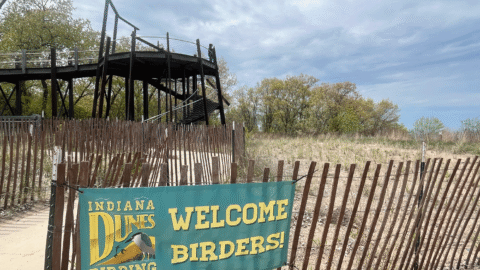
By no means expert birders, we landed in southeast Arizona by sheer coincidence. Among the auction items at the Indiana Dunes Birding Festival last May, we spotted a birding package in the area – two days of guided birding with East-West Birding Tours and two nights’ lodging at the Ramsey Canyon Inn. We have family in nearby Sierra Vista – could we visit them and have a birding adventure? Long story short: we bid, we won, we scheduled for late October.
It’s easy to understand why Ken and his partner Allee Forsberg based their company in the southeastern corner of Arizona, essentially an ecological crossroads. Here, the Sierra Madre Mountains of Mexico and the Rocky Mountains converge with the Sonoran and Chihuahuan deserts. Mountains rise abruptly from the surrounding grasslands, creating “sky islands” that offer habitat diversity found almost nowhere else.
From the moment we arrived in the area, spotting worthy birds was easy. (At times, they were impossible to ignore!) The first morning we stepped outside our Sierra Vista hotel, we found a Cactus Wren and Crissal Thrasher making a chirpy racket in the parking lot. That evening, we were entertained by a bright red-and-black Painted Redstart repeatedly attacking his own reflection in the side mirror of a Tesla.
Birding with an experienced guide paid off in many ways. Ken took us places we would never have visited on our own—like that junkyard lane or the Sierra Vista water treatment facility, alive with meadowlarks, kingbirds, kestrels and Yellow-headed Blackbirds. We nailed our quail trifecta when he helped us find a Montezuma Quail in out-of-the-way Hunter Canyon in the Huachuca Mountains.
Ken took us to traditional birding hotspots, too. We watched Canyon Wrens scaling the steep, rocky walls of the Nature Conservancy’s Ramsey Canyon Preserve, a moist, cool canyon area skirting a spring-fed stream. Acorn Woodpeckers, who jam acorns into holes they drill into the bark of “stash” trees, nattered overhead. Along the San Pedro River and its adjacent grasslands, we scored our first Vermilion Flycatcher, along with Gila and Ladder-backed Woodpeckers, Mexican Jays and Abert’s and Green-tailed Towhees. The small, tranquil Ash Canyon Bird Sanctuary teemed with avian life.
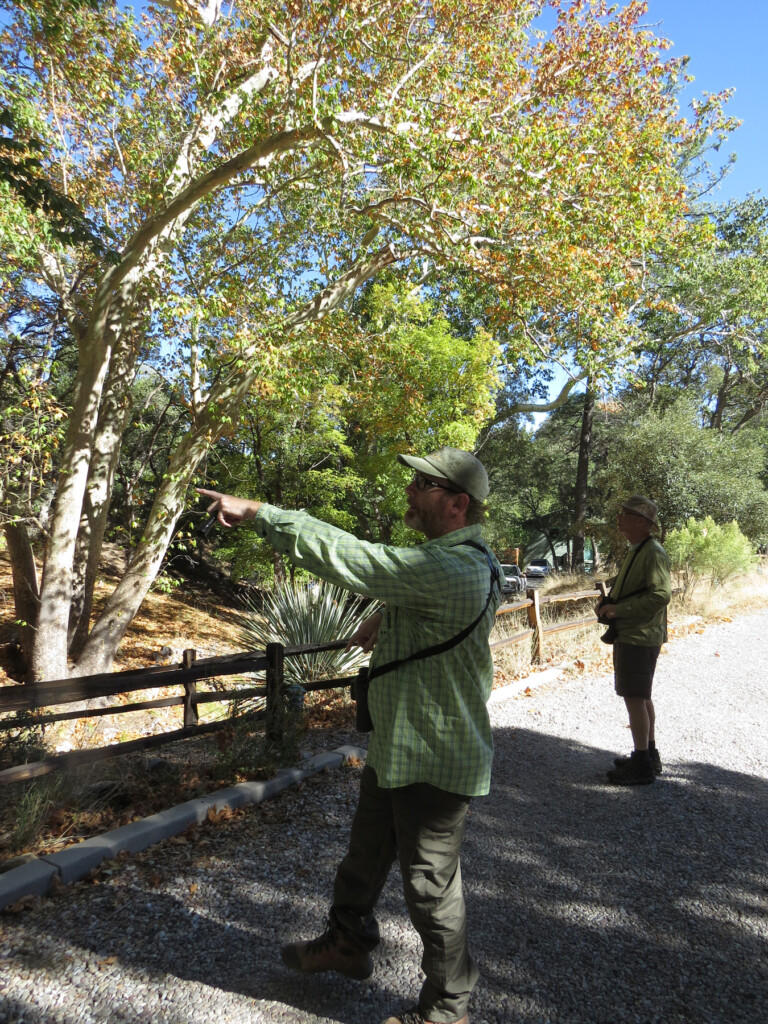
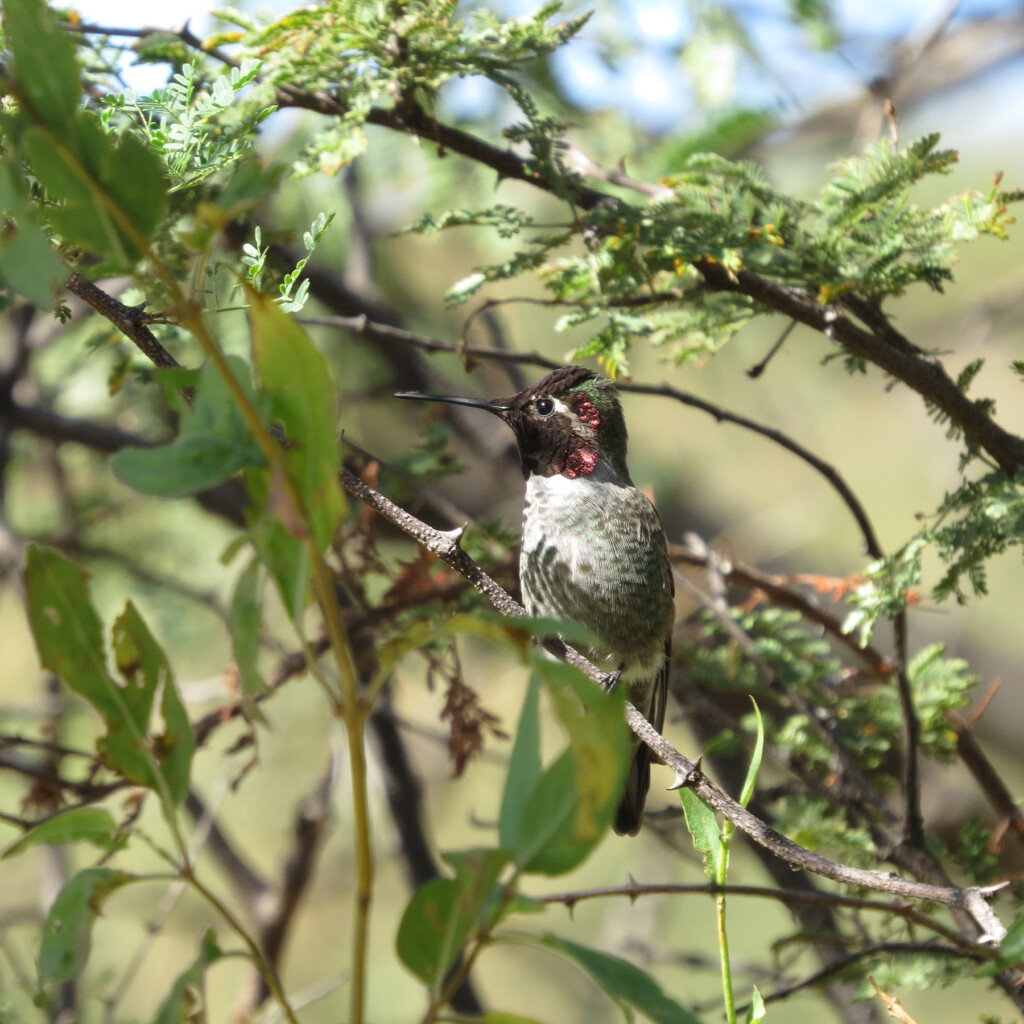
Photos: Ken Blankenship and John Shire at Ramsey Canyon (left), Casa de San Pedro (middle), and Anna’s Hummingbird by Renée Wright.
Hiking with a “broad spectrum” bird guide, whose knowledge stretches to include botany, geology, history and smatterings of local culture, makes the experience infinitely richer. The tidbits of information Ken doled out deepened our understanding of this unique region. Both of us are plant nerds, and Ken could typically ID an interesting forb or tree long before we could find it on our phone app.
In addition to the Ramsey Canyon Inn, we also stayed several nights at the Casa de San Pedro, a modern hacienda-style inn nestled in the grasslands along the San Pedro Riparian Corridor. Although the surroundings of the two B&Bs were markedly different – shady canyon vs. sun-drenched fields – both places planted us amid abundant bird and wildlife populations.
What about iconic Arizona birds, like the roadrunner? We checked that species off our list on our first day, when a roadrunner zoomed across the highway right in front of our car and darted into the scrub. (Surprisingly, there was no coyote chasing him.) And hummingbirds? It was off-season for hummers, but we spent many a happy hour (and yes, a Happy Hour) watching hummingbirds dodge and weave at the extensive bird feeder set-up at both inns.
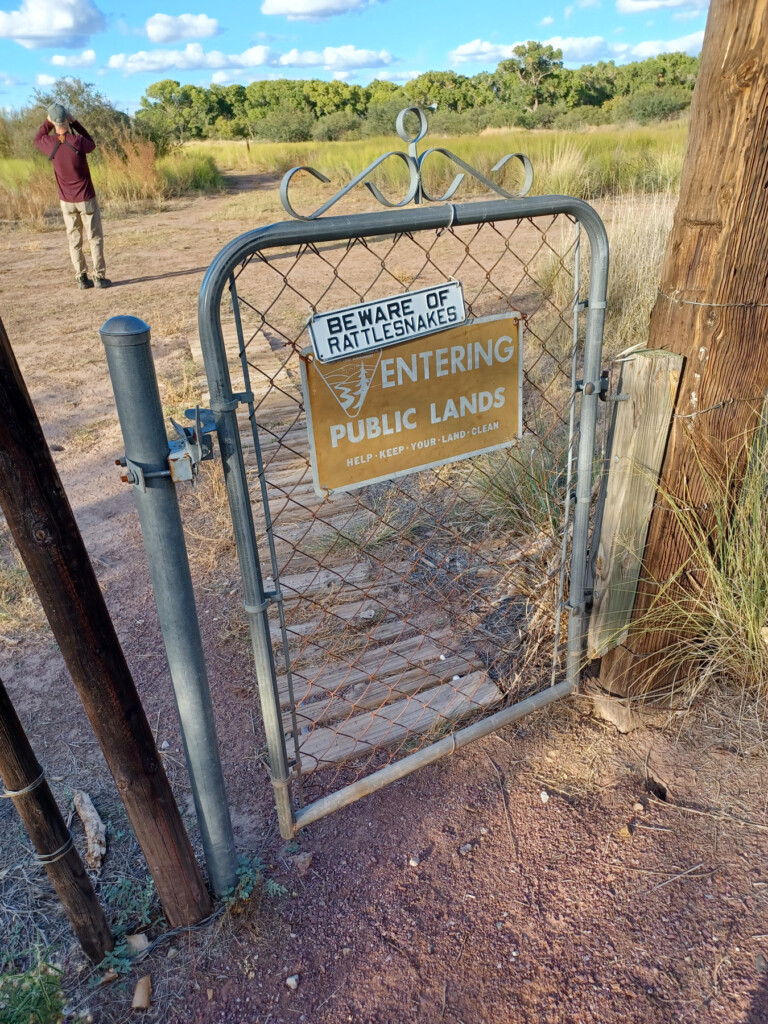
Birding in Arizona often brings you into contact with unfamiliar wildlife, too. A sign beside the trail into Ramsey Canyon warned of recent bear sightings. “Beware of rattlesnakes,” cautioned another sign near the San Pedro Riparian Corridor. There, furry brown tarantulas ambled leisurely across our path. Javelinas and Coues white-tailed deer could be seen along several trails we hiked.
After our week adventuring in the Sky Islands, one conclusion seemed inescapable. We had left too many canyon trails unhiked, botanical gardens unvisited, and historic sites unexplored. Besides, elegant trogons and elf owls remained elusive. We would simply have to come back.
Any guesses where we’re headed in April?
John Shire and Renée Wright are a pair of corporate escapees who have leapt into retirement with unabashed enthusiasm. They can be found volunteering for conservation groups, gardening, kayaking, scuba diving and often with their noses in books.
This story originally ran in the April–May 2024 print edition of The Cardinal.
Tags: birding story birding travel indiana dunes birding festival