Photo: Karla visiting Grand Teton National Park in Wyoming.
BY KARLA SIMPSON
Tell us a little about yourself. Family? Where do you live and work?
I retired in October 2021 as an Educational Technology Leader (Global Technical Education, R&D) for Corteva Agriscience, located on the northwest side of Indianapolis. I reside on the northeast side of Indianapolis, conveniently located four minutes from Geist Dam, five minutes from Fall Creek Trail at Geist, and eight minutes from Fort Harrison State Park.
What got you interested in birds and birding?
I grew up on a family farm in East-Central Indiana, spending more time outdoors than indoors. That balance shifted when my career required me to spend much of my time inside, frequently using technology. Fortunately, my upbringing had instilled in me a deep appreciation for nature, particularly birds. I vividly remember imitating bird calls, like the Northern Bobwhite, and credit my mom with fostering this interest.
Upon retirement, I sought to rediscover my connection with the outdoors. I’ve found that birding offers a unique combination of challenges, such as species identification, which engage multiple senses and encourage a sense of awareness beyond self. Moreover, the camaraderie among birding enthusiasts has been a significant contributor to my mental and physical well-being. Having transitioned from avid runner to hiker, I’ve now happily settled into birding as my primary outdoor pursuit.
What’s your favorite birding destination, both in Indiana and outside the state?
I feel like the answer to this question is always the last place I have been birding. There are so many bird species that are still new to me, as well as species I am still learning to identify better.
Within the state, I would say that Bloomington, Lafayette, East-Central, and the Indy area regions appeal to me because I can quickly drive to a variety of habitats and several hotspots within a 1.5-hour time frame. However, when I rounded the corner to Goose Pond Fish and Wildlife Area on U.S. 59 for the first time—and every time since—it has stood out as my top birding destination in Indiana.
Outside the state, the Indiana Audubon trip to Ecuador’s Amazon region checked all the boxes as my favorite, with so many highlights, including the fun group experience, the guides, the habitat, the wildlife, the Ecuadorian people, trip health, and, last but not least, the incredible variety and number of bird species!
How have you been engaged with Indiana Audubon (IAS), and what experiences have you most enjoyed?
I joined IAS close to retirement and immediately immersed myself in group trips—local, state, U.S., and international. Shortly after joining, I signed up for an international trip to Costa Rica in February-March 2022. (At the time, I didn’t even own a camera.) I would love to hear a recording of some of the questions I asked or the things I said on that trip—I’m sure they made the more experienced birders sigh.
What I enjoy most about IAS are the group trips. As anyone will tell you, I love the camaraderie and the funny mishaps that seem to happen wherever we go. The sheer number and variety of species is always a WOW moment! IAS trips are an incredible value, and the guides are always outstanding.
For those new to birding, what tips or advice would you share?
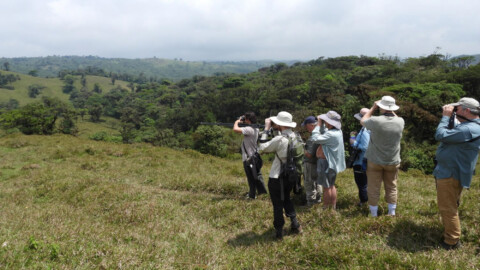
First, join a community bird-walking group and a couple of Audubon societies—both a local one for your area and Indiana Audubon. This will connect you with like-minded people who can offer tips and guidance on birding gear like binoculars, scopes, and cameras. Group trips are a great way to learn, and some of the people you meet may even become lifelong friends.
Also, practice birding on your own. Once you’ve gone on a few group trips and know you want to make birding a hobby, invest in the best optics you can afford to avoid frustration. You’ll notice your progress much faster with regular solo practice. (I personally birded for almost a year before I started reporting birds on eBird.) Avoid the urge to report a species unless you’re confident in your identification—eBird data supports science, so accuracy is important. Making mistakes is part of the learning process, whether they’re caught by experienced birders or flagged by an eBird reviewer. Birding is often a humbling experience, so take corrections as a positive and don’t let mistakes discourage you.
Find a few birding spots within minutes of your home so that you can go birding at least a couple times a week. These don’t have to be hotspots—just places where you can regularly observe and improve. Focus on what makes birding enjoyable for you. Don’t be concerned about keeping up with goals, photography skills, or the lists of other birders.
Keep educating yourself by reading articles and books about birds whenever you find something that interests you. I recommend going to the library and checking out a few different styles of field guides before purchasing them. (I still do this when considering a new guide.) I have found the Cornell Lab of Ornithology’s Bird Academy to be very helpful. Once you purchase a course, you can reference it anytime as long as it’s available. Keep an eye out for their sales on different topics.
Tags: meet a member Q&A