BY BRAD BUMGARDNER
I grew up camping in Michigan’s Upper Peninsula, leaning against boreal trunks of spruce and hemlock, and that unmistakable nasal, yank‑yank echoing through the pines. Those tiny tin-horn calls of Red‑breasted Nuthatches have long been my magic cue that I’m home. My wife still laughs when I slip outside with a glove sprinkled with seed, hoping one’ll land on my hand. And some years, especially the ones that knock my hot cocoa out cold, these little acrobats flood down to Indiana in numbers that feel almost cinematic.
Early season eBird alerts have been lighting up with early sightings of this seasonal favorite. But, what’s behind this early season invasion? Red‑breasted Nuthatch irruptions usually trace back to bad cone crops in their northern boreal breeding grounds. When spruces and firs fail to produce enough seed, these birds are forced to push south in search of food, sometimes reaching as far as the Gulf Coast or even northern Mexico.
Patterns show these invasions tend to happen every two or three years. After a winter irruption, breeding populations can be up to 50% lower the following year, though long-term population levels don’t seem to take a hit. Citizen science plays a big role here, datasets from eBird, FeederWatch, and others let researchers track these boom-and-bust rhythms over decades.
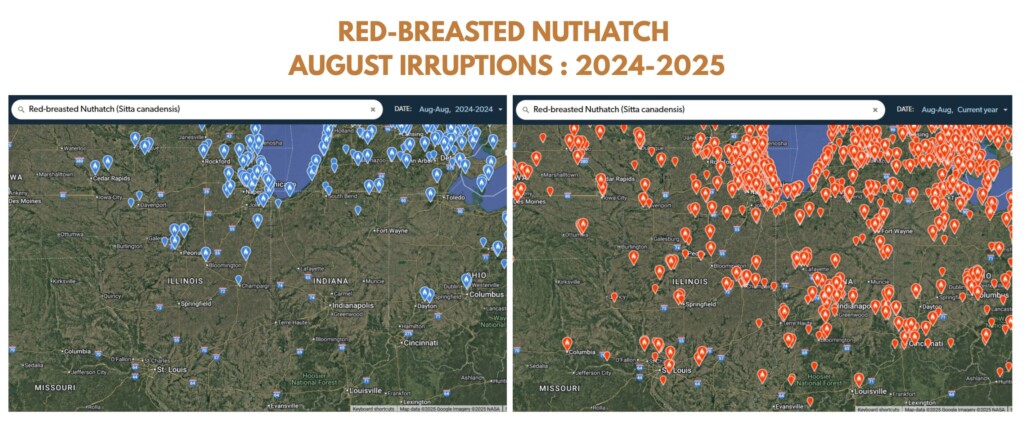
Why now in Indiana? The shores of Lake Michigan are already showing strong signs of an invasion, and this year looks like it could be one of the bigger ones we have seen in a while. Local birders are backing it up too, with over 100 tallied at the Indiana Dunes State Park Longshore Tower, the boreal forest suddenly seems to be emptying out, and even early sightings this weekend as far south as the Mary Gray Bird Sanctuary accessible birding blind, all pointing to a big movement underway. For many birders who have joined since COVID, this may well be your first real-deal fall Red-breasted Nutty invasion!
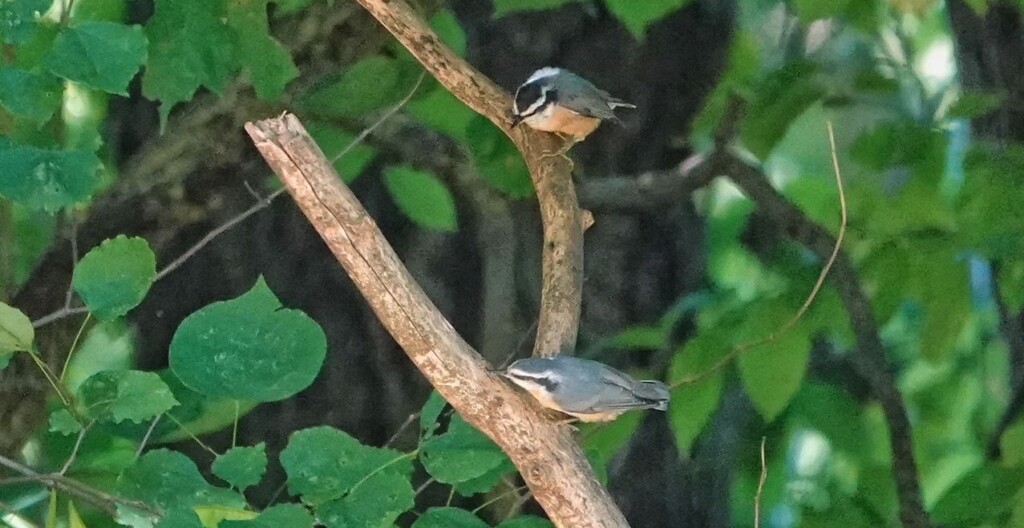
If you want to invite them, they’re not picky. They love conifer seed, but they’ll feast at your feeders too. You can attract them with suet cakes, sunflower seeds, and peanut pieces or chips. When they come, they often cache food in bark crevices and may return to the same feeder repeatedly.
Red-breasted Nuthatches are part of a broader group of irruptive birds such as siskins, crossbills, and redpolls that fluctuate wildly based on the cone and berry crops in northern forests. In years when food is in short supply across the boreal zone, these species often surge south in search of sustenance. Look back to fall 2020 and you will see how those invasions rolled in, starting in late summer, peaking through autumn, and tapering off by spring. This year’s invasion follows a similar rhythm, and it comes still a few weeks before Tyler Hoar’s 2025-2026 Winter Finch Forecast comes out. Here in Indiana, the data already back it up, sightings during the last week of August are up more than 1,450% compared to last year, and even about 31% higher than the strongest early movement in the past five years.
Header Photo by Shari McCollough.
Tags: birding insights red-breasted nuthatch