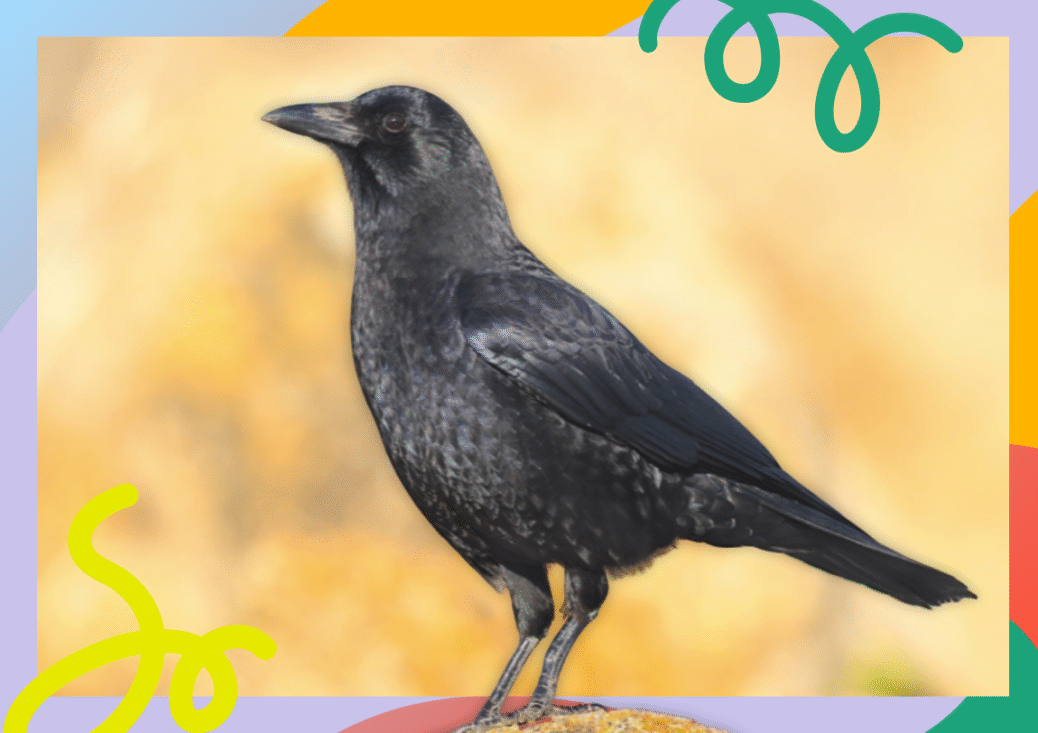
Image: American Crow perched in profile against a soft yellow background, showing glossy black feathers and stout bill. Crows (and other corvids) are famously intelligent problem-solvers and tool users. Photo by Ryan Sanderson; graphic by Olivia Bautch.
BY OLIVIA BAUTCH
When I was in college, one of my classmates was set on studying birdsong for his doctorate program. His question addressed a theory considered unconventional among ornithologists (a.k.a. bird scientists), but one that most of us who love birds already hope is true: Do birds sing simply because they are happy?
For those unfamiliar with the concept, the consensus among ornithologists views birdsong as a method of communication, but to say very specific things.
A Carolina Wren’s chatter or Blue Jay’s caw might communicate, “Get out of here, this is my territory!” while American Goldfinches twitter from treetops, “Choose me, I’m a strong mate with good genes!” Quiet chips, chirps, and squawks tend to serve as contact calls and information sharing.
But growing bodies of research are finding avian behaviors that don’t have quite as much of a direct purpose. In fact, birds play.
The Purpose of Play
When we think of human play, we might picture mindless games and phone apps, not activities that contribute to skill development (although many children’s games do that as well). The Cornell Lab of Ornithology describes the difference as activities that “enhance learning of motor and sensory skills and social behaviors but otherwise serve no immediate purpose.” The key word here is “immediate.”
You may have seen forms of avian play grace your TV or phone screens without realizing it. The stories that make headlines usually come from one family of birds: the corvids. The ravens, crows, and jays of the world are virtually synonymous with intellect—solving puzzles, unlocking hidden objects, even sledding. Dr. Kaeli Swift, a Corvid researcher, lists on her blog seven forms of play scientists have found in crows:
- Object play (manipulating things for no reason)
- Play caching (hiding inedible objects)
- Flight play (random aerial acrobatics)
- Bath play (more activity in water than necessary to get clean)
- Sliding down inclines (snowboarding, sledding, body sliding)
- Hanging (hanging off branches but not to obtain food)
- Vocal play (you know how kids go through that phase when they talk to themselves a lot? This is the crow version of that.) (Swift, 2015)
Though Dr. Swift references crows, several of these categories can sum up play behaviors in the broader avian community. Let’s read through that list again, thinking about parallel survival strategies.
Object Play: Tools, Caching, and Puzzles
Play with objects is done for no immediate reason, like a pair playing tug-of-war with a leaf or dropping rocks from high in flight, picking them up to drop them again, reminiscent of a tiresome toddler. American Herring Gulls are one of several species who have learned to hunt with this method. Drop one mussel onto the rocky lakeshore, and it cracks open under the force of gravity.
Author Laura Erikson speculates: Was this an accidental discovery? “Or did gulls start out simply playing, as [the] crow was doing, and thereby learned a cool trick?”
Aside from crows and gulls, accounts of species utilizing tools are a bit more random. Nuthatches pry under bark with twigs, and American Robins have used the same tool to “sweep” leaves away. Perhaps most amazing, Green Herons bait underwater prey with natural materials, similar to fishing lures.
Scientists have taken the most intelligent families into the lab, where cousins of our local crows formed a hook to reach food in a tube. And a Eurasian corvid species, the Rook, even acted out scenarios once only found in fairytales, piling up rocks in a glass to access water.
Problem solving through objects and puzzles comes naturally to many birds, and licensed wildlife rehabbers recognize that without these exercises, the well-being of the birds in their care would decline. If you have a wild bird center near you, ask the staff about enrichment and how puzzles keep their birds healthy.
Locomotive Play: Fight, Flight, and Sliding Down Inclines
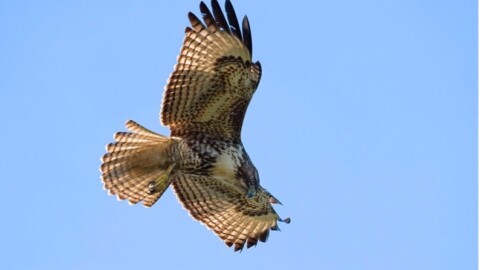
Have you ever gazed at the sky on a blustery day to find a hawk swerving and swooping in currents of wind and thought, “That looks like fun”? You might be right! Birds of prey like eagles, hawks, and vultures have been known to become birds of play, making extra aerial maneuvers, thought to be for the enjoyment of it. Mallards and some species of sea ducks intentionally whitewater raft down rushing river currents. Like we hinted earlier, some birds even sled down snowy inclines. Watch this crow—yes, another crow—making a recycled snowboard for itself out of trash.
Bird cameras over raptor nests document the day-by-day of growing babies, which includes learning to be a bird. This offers a peek into lots of play in action. Raptors in particular take longer to develop, so courtship and nesting begin long before the spring and may last into May.
If you ever tussled with your siblings as a child, it probably wasn’t to prepare you for a life hunting chipmunks with your bare hands (or talons) and physically squaring off with your neighbors. That’s where raptor fledgling play differs from children’s. Short hops and jumps, faltering flaps, and balancing acts may look silly, especially within a nest that barely outsizes a bird’s wingspan. But all behaviors are later used by adults in hunting, just on a larger scale.
Vocal Play: Happiness, Mimicry, and Context
The study my classmate contributed to helped monitor chemicals in European Starling brains, finding that song correlated with an increase of what we humans think of as “happy” hormones. Biology professor and lead researcher Lauren Riters said in a UW-Madison article, “It seemed like they were singing for no reason. There aren’t too many things that animals do for no good reason. The exception to that is playful behavior.”
From the case of Riters’ starlings, birdsong accompanied a “happy” chemical response to flocking, feeding, and their preferred environments. So while this study does not tell us that birds sing because it’s enjoyable, it does suggest that singing is one way a bird expresses an enjoyable experience.
This vocalizing “for no good reason” that Riters’ team witnessed has also been heard from a group of birds that defy familial bounds: the mimics. The mimics are the cat meowing from within the trailside bushes that was on second glance a Gray Catbird, or the “Keer, keer!” of a Red-shouldered Hawk that turned out to be a Blue Jay.
Starlings themselves are quite impressive mimics, notoriously calling as Eastern Wood Pewees in springtime before the species has even arrived back from migration. They have around 20 songs in their repertoire. Is that an Eastern Meadowlark in the front yard? Or a goose on the roof? Not in this video. Instead, the culprit is three European Starlings.
Sometimes vocally faking out seems logical. If you’re a songbird, pretending to be a predator will scare off or warn the animals in your patch. “But some of the most impressive mimics don’t appear to be trying to trick other species,” Ivan Phillipsen writes for his podcast, The Science of Birds. “A male Northern Mockingbird can have a repertoire of over 150 songs that he cycles through. Many of these songs are borrowed from other species. It’s hypothesized that birds like this are mimicking to increase the diversity of their repertoires, because knowing lots of songs is impressive to the ladies.”
Mimics hone their songs for hours on end, even outside of regularly scheduled courtship hours. Do these virtuosos’ practice constitute as play? I’d say so.
Make New Discoveries
From the American Crow and Blue Jay to gulls, mimics, and chickadees, Indiana is home to dozens of playful species. Late winter into spring is the perfect season to find large flocks and young raptors training for the wild. It’s the birders who take their time who will make new discoveries. Have you observed a bird at play?
Tags: birding insights