Photo: Juvenile Western Red-tailed Hawk (Buteo jamaicensis calurus). Note large translucent inner primary window and finely barred tail feathers. Red-shouldered also shows light, translucent inner primaries, but in the shape of a crescent. Photo by Jessica Weinberg.
BY LUCAS GREGORY WILSON
Red-tailed Hawks are ever-present overhead across the entirety of North America. Due to their prevalence, they can give birders of any experience level a great opportunity to practice their skills identifying the age of a bird. With careful examination, a birder can tell approximately how old many species of birds are just from the condition and patterns on certain feathers on the body. But, it is easiest in larger birds such as raptors, including the Red-tailed Hawk.
All Red-tailed Hawks have ten primaries (the feathers of the wingtip), fourteen to sixteen secondaries (the feathers of the inner wing), and twelve rectrices (tail feathers). The leading five primaries at the tip of the wing are emarginated (narrowed towards the tip). This creates a finger-like appearance at the wingtip.
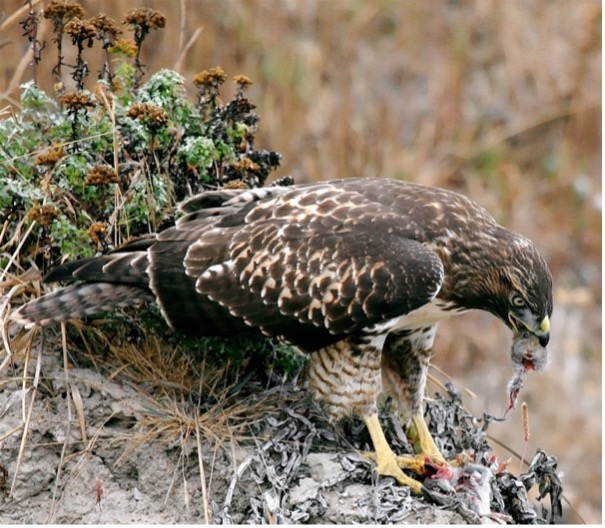
Photo: Juvenile Western Red-tailed Hawk (Buteo jamaicensis calurus). Note the pale tan edges to feathers on the face, the nape and upperwing coverts. The eye is light. Most Red-tailed Hawks acquire dark rufous edging here as adults. Photo by Steve Jurvetson.
Juvenile Red-tailed Hawks possess markers which differ from those in adults. In general, juveniles show
the following traits:
- Longer, narrower, more pointed tail feathers with thin barring (not all individuals show barred tails as adults, but all will show barred tails as juveniles).
- Shorter, more narrow secondaries, creating a narrower wing shape lacking the “secondary bulge” of an adult.
- A pale, poorly defined back edge of the wing, as opposed to the thick black band on the wing of an adult.
- A translucent, rectangular “panel” is seen when the wing is illuminated, as seen in some immature gulls.
- In light morph, the body and covert feathers have pale tan bases and edges.
- A pale eye, though some older birds have a light eye as well.
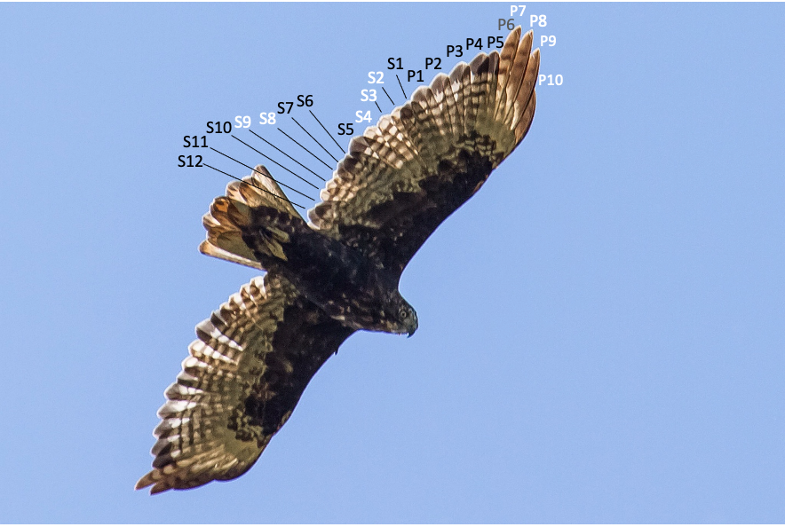
Photo: A second cycle young adult Harlan’s Redtailed Hawk (Buteo jamaicensis harlani) showing old juvenile leading primaries (P8-10, in white). P7 and some juvenile secondaries, S2-4, 8-9 are also juvenile (in white), and P6 (grey) is missing. The feathers that have been replaced, meanwhile (P5-1, S1, S5-7, and S10-12, in black) are adult and have a thick band band at the tip. This bird is approximately 1 year old and still has a light eye. Photo by Mike Borlé.
Red-tailed Hawks entering their second cycle (during a molt which occurs from spring until early fall at 1 to 1.5 years old) will show a mix of adult and juvenile feathers in the wings, body, and tail. This is because most large raptors only molt some of their feathers each year and keep the rest from the previous year. Despite this, they are already considered adults. These younger birds can be obvious in flight, as the juvenile and adult feathers in the wings and tail contrast due to their differing shapes, lengths, and coloration, making the bird look like a patchwork. Additionally, juvenile feathers will often appear more faded with a pale brownish cast.
Juvenile body feathers on these birds are often worn and bleached by mid- to late-summer and can appear whitish, which may cause confusion in the field with leucism or the Krider’s subspecies. Many adults in the second cycle will keep juvenile feathers in the wings and tail until the third cycle.
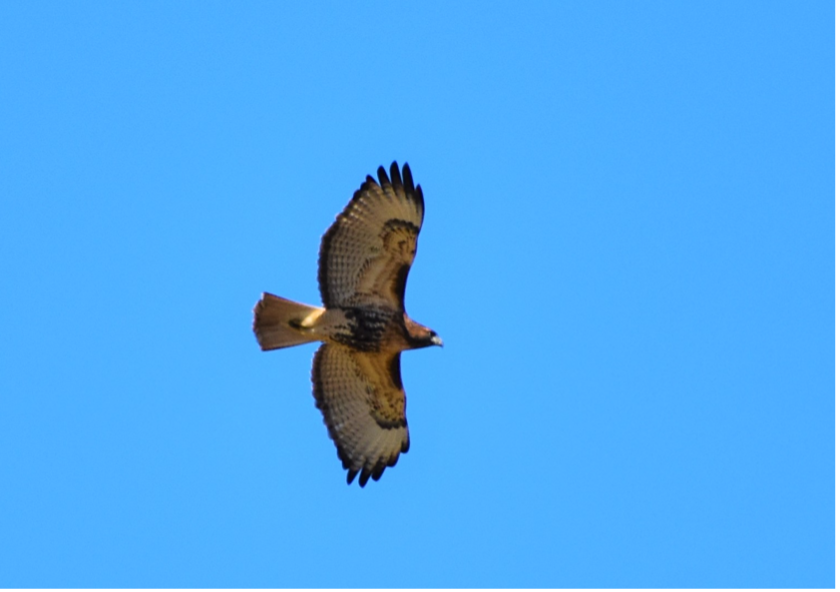
Photo: Adult Northern Red-tailed Hawk (Buteo jamaicensis abieticola). Note how rounded (“bulging”) the inner portion of the wing is, as well as the dark band at the tip of the wing feathers, telling us this bird is an adult. This bird is at least 2.5 years old. Photo by Mark Greene.
Adult Red-tailed Hawks in the third cycle and onwards (2.5+ years old) generally show the following
traits:
- A shorter, broader, more squared-off tail feathers with a dark band near the tip (may be broken or absent on some birds).
- Longer, more squared-off secondaries, creating the “secondary bulge” of an adult.
- A dark, well-defined trailing edge of the wing, on the tips of the secondaries and primaries.
- In light morphs, upperparts fringed in warm light brown, darker than that in juveniles.
- A dark eye.
A common misconception is that a red tail always indicates an adult hawk, but rarely, a juvenile may also show a red tail. So, it is important to note the points made above. Due to fade and abrasion, adult wing feathers from the previous year may appear paler and slightly shorter than surrounding fresh adult feathers, but the difference in older adults will not be as striking as between juvenile and adult feathers in second cycles. Next time you see a Red-tailed Hawk on the side of the road, I challenge you to age it!
This article originally ran in the June–July 2023 print edition of The Cardinal.
Tags: birding insights identification