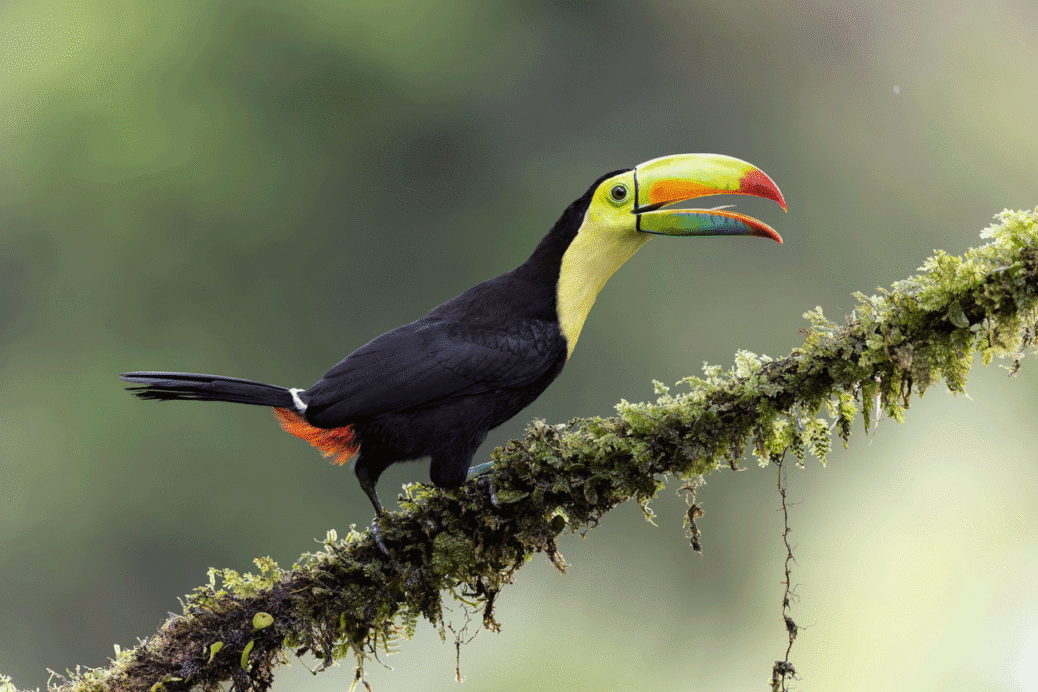
Image: Keel-billed Toucan perched on a moss-covered branch, showing its bright multicolored bill and yellow throat; photo by Juan Diego Vargas, taken at The Nest Nature Center in Costa Rica.
BY BRAD BUMGARDNER
It wasn’t long ago that I used to love bundling up and heading out for a brisk winter hike and a little birding. My wardrobe was well stocked with hats, gloves, long underwear, and thick boots. But in recent years, maybe due to aging, I find the cold less charming, and standing in 15-degree air to watch a handful of winter-plumaged goldfinches feels more like endurance practice than joy.
My winter ritual has quietly shifted. I’ll get my sunrise exercise at the gym, come home warm, heat up some hot cider, and connect with friends and field guides on a tropical livestream. I’m now more into swapping snowy trails for Snowcaps (a tiny hummingbird in Central American cloud forests) as my favorite way to spend a winter morning.
If you feel the same way, you’re not alone. Winter is often a time when field trip participation is down. Trails are frozen, maybe dangerous, and winter exposure can be a real threat some mornings. Our post-pandemic world has opened up a wonderful variety of virtual and remote birding experiences from places around the world. Wi-Fi connections continue to expand, making it possible to become fully immersed in a distant birding site without ever leaving your couch. Remote birding from places like Costa Rica or Ecuador fills that winter pause with something warm and bright. The perks are numerous.
Keeping People Engaged
Virtual birding opportunities create shared moments. These moments matter. People who feel connected are more likely to support, volunteer, or give. For many places in remote countries, today’s virtual birding provides new opportunities that never existed in these often rural, developing communities. If you’re an educator like me, these virtuals are ready-made curricula and a gateway to discovery in the birding world in another location.
A Life Cycle of Conservation
Winter virtual birding helps us connect the fact that Indiana’s birds do not stay in Indiana. Our warblers, thrushes, and tanagers spend a critical part of their lives in Central America. Among the shade-grown coffee farms and reforestation projects are real stories that connect our birds to these locations, and connect us to them as well. That is full life-cycle conservation in practice. Seeing a Tennessee Warbler hop along a Costa Rican bird feeder in January shows the mighty bird’s intent on completing that migration promise… the promise to return.
Expanding Access
Not everyone can travel. Not everyone can hike steep trails or tolerate a February wind. Virtual birding opens the field to people who are homebound, caregivers, newcomers to birding, teachers, and anyone who dreads winter weather. Remote programs also lower the financial and carbon cost of participation, while still directing resources to grassroots conservation efforts through ticket proceeds, donations, or direct support of local partners.
As part of this approach, Indiana Audubon is offering several high-definition streams from Costa Rica this winter, each paired with live commentary, a look at conservation taking place, and, of course, bright, tropical birds to enjoy live. A few are coming up still this winter, including:
- Birding Remotely: Costa Rica at The Nest Nature Center (Feb. 7, 9-10 a.m. ET): Canopy views, hummingbirds, manakins, and close-up audio.
- Birding Remotely: Live from Arenal Volcano (Feb. 27, 9-10 a.m. ET): Foothill forests and edges, toucans, tanagers, and habitat stories from the volcano’s slopes.
Both sessions run about 60 to 75 minutes, require registration for the Zoom link, and include recordings for registered participants. Tickets support local conservation partners and the guides in Northern Costa Rica.
Winter should be a season of planning and quiet energy, not of shrinking attention to birds. Virtual birding gives us a practical and fun way to connect with birds and to broaden access without lowering standards. From a warm chair with a hot cider or coffee, we can watch a canopy sing and a community work, and in doing so, we also help the birds that come back to Indiana each spring.
Tags: birding insights