Photo: This Wood Thrush decoy was used to help lure Wood Thrush near an avian mist-net to capture birds for banding and Motus-tagging. Photo by Amy Tegeler/South Carolina Department of Natural Resources.
BY SARAH KENDRICK
In 2024, a multi-national group of bird conservation partners across the hemisphere initiated a massive research project to track the survival and migration of Wood Thrush across its breeding and non-breeding ranges over the next two years to target conservation efforts for this important forest-breeding bird.
Between May and July, over 60 partners led by our agency deployed 589 Motus Wildlife Tracking System tags on Wood Thrush in 24 U.S. states and Ontario, across the species’ breeding range. Project co-lead SELVA, a Colombian bird conservation organization, is deploying over 100 more Motus tags in five countries of the species’ non-breeding range this winter, making this the largest Motus project to date.
The Motus Wildlife Tracking System (Motus) is an international collaborative research network that uses coordinated automated radio telemetry to facilitate research and education on the ecology and conservation of migratory animals. Motus is a program of Birds Canada in partnership with collaborating researchers and organizations. Learn more at motus.org.
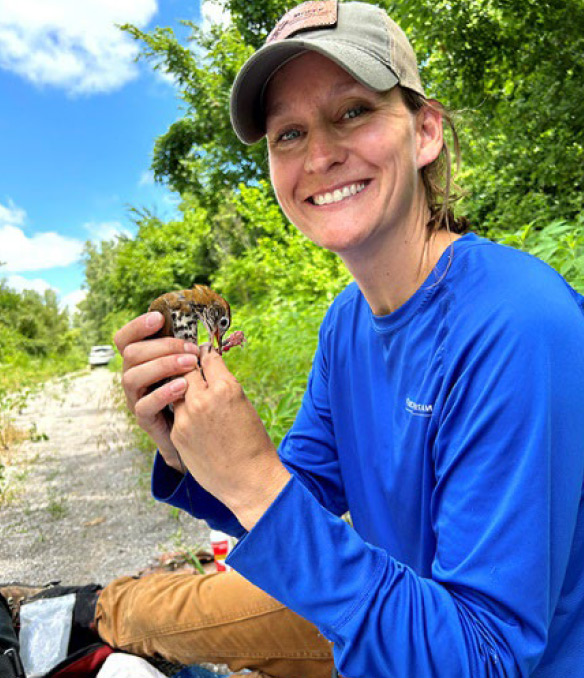
Thrush ready for release. Photo by
Andrew Dreas/USFWS.
With hundreds of tags deployed on the species over its full range, we will better understand Wood Thrush migratory connections, routes, timing and survival across the full annual cycle to inform conservation action. 2025 is expected to be just as exciting with a second breeding season tagging effort. The Wood Thrush is a priority species for conservation in 25 states and holds threatened status in Canada. Improving our understanding of the ecology of this species’ full annual cycle is essential to better understand conservation needs throughout its range and to improve the design of targeted habitat management actions. With all these factors in mind, an international group of bird-conservation partners have initiated a hemispheric Motus-tagging research and conservation project to better understand migratory connections, routes, timing and survival across their full annual cycle.
In spring of 2023, I approached state wildlife agencies via the Nongame Bird Technical Sections of the Mississippi and Atlantic Flyway Councils and asked if they were interested in being part of a large-scale research study on Wood Thrush. The project goals were to tag the species with Motus Wildlife Tracking System tags across their breeding range in the eastern U.S., in partnership with SELVA, who would coordinate Motus-tagging on the non-breeding grounds.
The pitch was that, if states or organizations could raise the funds for 25 tags and help coordinate the deployment of those tags on Wood Thrush in their state, I would handle the coordination and logistics of the project, and we could do something really big and unprecedented to learn a lot about this species together. To my surprise, many states and the province of Ontario signed onto the project to participate! Mass planning commenced.
Our partner SELVA and I wrote a common and required project protocol to ensure that all project partners were using the same field methods, Motus tags, attachment harnesses and bird-handling permitting process.
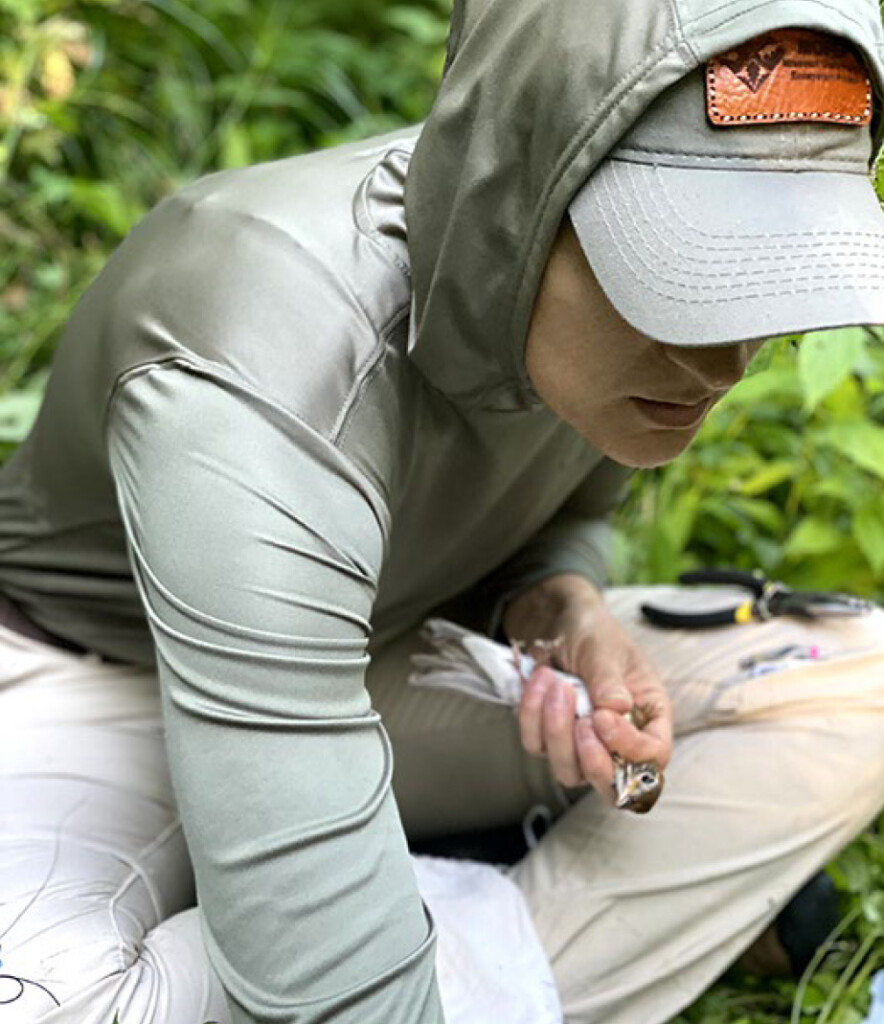
Our Midwest U.S. Fish and Wildlife Service Migratory Birds Program hosted a Wood Thrush Motus-tagging training for project participants in Kentucky. Participants learned how to tag birds from trainers from Willistown Conservation Trust in Pennsylvania and BirdsCaribbean, in partnership with Kentucky Department of Game and Fish staff. Biologists and researchers from state agencies and organizations gathered from seven states to learn how to safely fit birds with Motus tags.
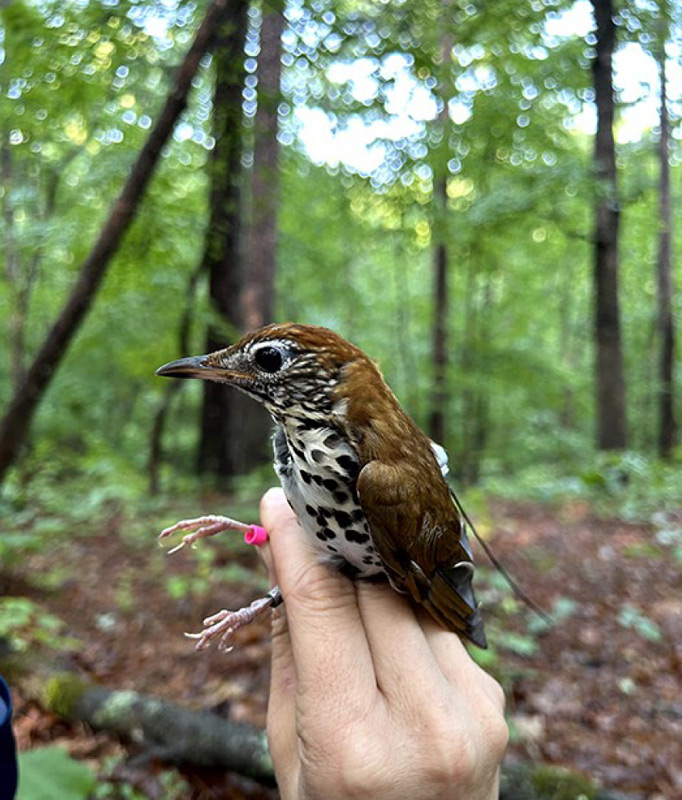
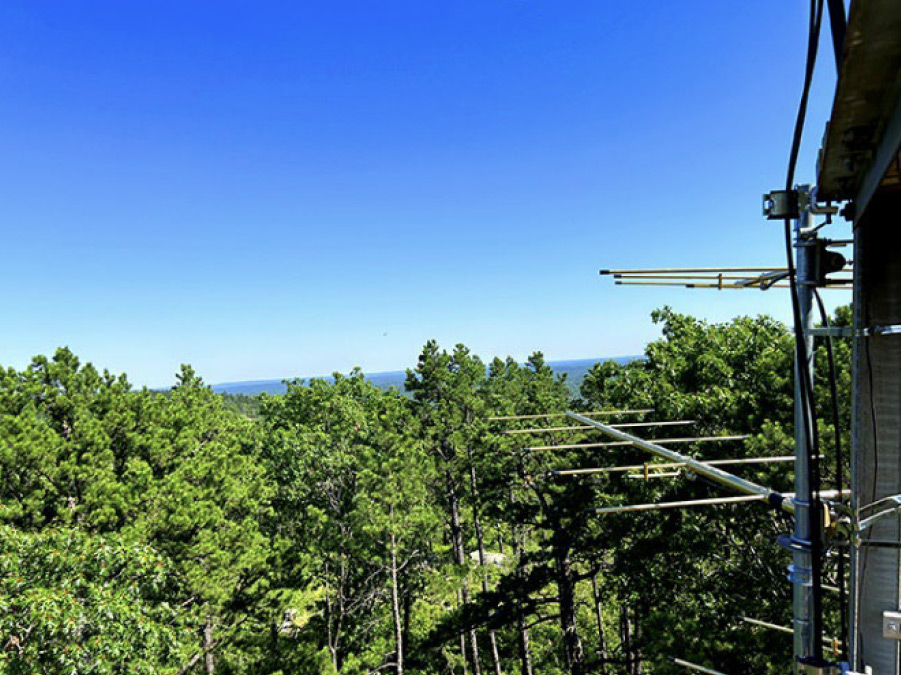
Photos from Left to Right: A Wood Thrush wears a Motus tag (Sarah Kendrick/USFWS); Motus stations at Stegall Mountain Natural Area in Missouri detects the signals emitted from Motus tags (Sarah Kendrick/USFWS); Taking measurements of a Wood Thrush during tagging (Robin Hirsch-Jacobson/William Woods University).
In summer of 2024, project partners across the eastern U.S. and Ontario deployed 589 tags on Wood Thrush across 24 states and Ontario, making it the biggest Motus project to date, and it’s only just begun. Partner SELVA is currently coordinating the deployment of over 100 Motus tags in Mexico, Belize, Guatemala, Honduras, Nicaragua and Costa Rica this winter. A second year of breeding-season tagging will occur in 2025.
Another exciting aspect of the project is that we asked partners to deploy their tags on Wood Thrush within range of an active Motus station on breeding and non-breeding ranges. This allows us to test detection ranges and gather data on breeding and non-breeding within-season movements prior to migration. Wood Thrush Motus tags last over a year, so we are hoping to also gather return detections as the birds arrive back in spring of 2025. Site fidelity or returning to the same breeding territory year after year, can be high in this species for adult birds. We hope that return detections can give us more information on inter-annual survival, which can be difficult to study in migratory species.
Many aspects of this project are providing us a positive proof of concept, including unique funding streams. A number of private, in-state funding streams are helping numerous states fund their project’s Motus tags or field work. One example includes birding groups in Missouri, including the Missouri Birding Society, Burroughs Audubon Society, Columbia Audubon Society in Missouri and other private donors that funded Missouri’s portion of the wood thrush tags.
Keep your eyes peeled when you encounter Wood Thrush this spring – you may just see it carrying a Motus tag.
Sarah Kendrick is a Migratory Bird Biologist with the U.S. Fish and Wildlife Service, where she works to conserve and protect migratory bird populations across the region. This article originally appeared in an internal U.S. Fish and Wildlife Service newsletter and is republished here with permission. It is part of a larger partnership effort connected to Indiana Audubon’s Chasing Melody Project.
Tags: chasing melody program updates research