Photos: State Historical Markers for Jane Hine and Gene Stratton-Porter, photographed by Terri Gorney-Lehman.
This is the first installment of Flight Paths Through History, a series of articles highlighting Indiana’s bird and birding history.
BY TERRI GORNEY LEHMAN

Indiana is fortunate to have not one, but two outstanding women who were self-taught in ornithology and excelled in the field, speaking on behalf of our birds.
Jane Brooks Hine was born in 1831 in Lake County, Ohio. She attended Oberlin College in 1852/3. Her parents believed in educating their daughters as well as their sons, and Ohio was a state that “allowed” women to attend college. She taught school for a short while, then left to marry Horatio Hine. At that time, women could not be married and teach. They moved their growing family to DeKalb County, Indiana, in 1861, where in 1836, Horatio’s father, Sheldon, had purchased land. Jane called her home “Birdlawn.”
Jane was a generation before the other bird woman, Gene Stratton-Porter. Gene was born Geneva Grace Stratton on her parents’ farm in 1863 outside of Lagro in Wabash County. Gene met her future husband, Charles Porter, at a Chautauqua gathering in Rome City. They were married in 1886 and moved to his hometown of Decatur. In 1888, they moved to Geneva in southern Adams County, where they were surrounded by the Limberlost Swamp. It would become Gene’s outdoor classroom for the study of birds and nature, a place she would later make famous in her novels and non-fiction works.
Both women, at a young age, were aware and appreciated birds on their family farms. Jane remembered being about 6 years old when her father lifted her up to see a bluebird’s nest. Gene’s father called her the “Little Bird Woman,” and as a child, she entertained herself and learned about the birds around her.
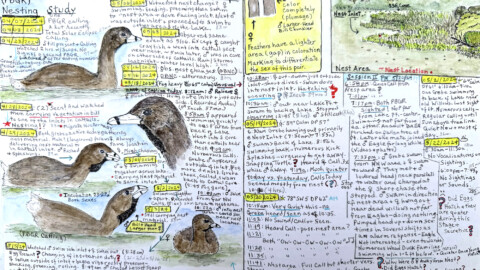
Jane served at the Indiana Academy of Science with Amos Butler. She was one of the contributors to his Birds of Indiana (1898) publication. She was a member of the Indiana Audubon Society (IAS) and spoke to many farmers about the value of birds on their farms. Jane was credited for 400 bird sightings for the USGS’ North American Bird Phenology Program. She was a member of the National Ornithology Society, which published a booklet in her honor after her death.
Both women believed in educating the next generation. Jane taught children about birds and the value of having them, while Gene also reached out to young people, speaking at local schools during an IAS conference in Fort Wayne in 1908.
At that same conference, Gene was one of the keynote speakers, stepping in for Amos Butler, who was ill and could not attend. She and T. Gilbert Nelson, who would later become head of the National Audubon Society, were the featured lecturers. It was at this conference that Gene was made an IAS officer.
During Woodrow Wilson’s administration, Jane was invited by the First Lady to attend a costume event, called the Bird Masque, at the Wilson family’s summer home in Cornish, New Hampshire. This event, which featured a theatrical performance, aimed to raise awareness about the plight of bird populations being decimated for their feathers, which were used in women’s hats. Unfortunately, poor health and age (she was in her 80s) prevented Jane from attending.
Gene was both a non-fiction and fiction writer, and she used her own bird photography in her books, featuring live, unmounted birds. She wrote herself into her novels as the ‘Birdwoman.’ Gene learned the patience required to photograph bird nests and young birds. She wrote, “the greatest thing possible to do with a bird is to win its confidence.”
In 1908, Gene was asked to write an article in the Biennial Report of the Commissioner of Fisheries and Game of Indiana (1908). Her piece, titled “Character Sketches of Twelve Birds,” contained her photographs, including: a King Rail on its nest, Great Blue Heron, young Mourning Doves, American Barn Owl, Purple Martin, American Robins, and Blue Jay.
Jane’s best birding articles were written when she was in her 60s and 70s. Some ideas for articles came directly from her journals. Her best-known work was in the Biennial Report of the Commissioner of Fisheries and Game of Indiana (1911). Jane’s long article on “Game and Land Birds of an Indiana Farm” made up about a third of the book. This book was released early so it could be placed in the time capsule in the cornerstone of the DeKalb County Courthouse.
Both women have Indiana Historical Bureau markers in their honor. Gene’s is located at the Gene Stratton-Porter State Historic Site in Rome City. It was placed there in 2013 for the 150th anniversary of her birth. Gene has two historic state sites in her honor: Limberlost State Historic Site and her home in Rome City. Jane’s marker was dedicated in November 2023 and is in front of the Waterloo Grant Township Public Library in DeKalb County.
Both women were ahead of their time and had careers separate from being wives and mothers. Through their contributions, these two outstanding women left a lasting impact on Indiana’s field of ornithology.
Terri Gorney Lehman is an Advanced Indiana Master Naturalist with 20+ years of volunteering with the DNR. She is a member of Indiana Audubon, Three Rivers Birding, and the Robert Cooper Audubon Society. Terri compiles the Southern Adams Northern Jay Ouabache (SANJO) Christmas Bird Count and Berne’s Breeding Bird Survey, and serves as secretary for Friends of the Limberlost. She is also president of the Society of Indiana Pioneers. A historian and naturalist, Terri met her husband, Randy, while volunteering for the DNR.
Tags: flight paths through history