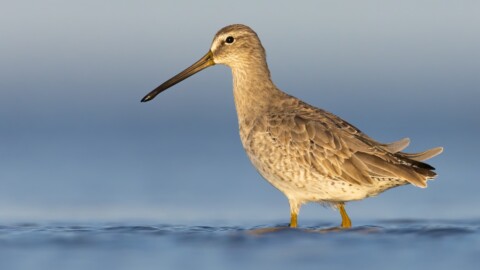
Collage: Upland Sandpiper by Ryan Sanderson, night sky by AlxeyPnferov/Getty Images Pro, and moon by Amelia from Rimela Studio.
BY ROBIN JANSON & CHRIS NEWBOLD
This spring, seven curious Indiana Audubon members ventured into the dark world of birding: nocturnal flight call recording of migratory birds for the pilot launch of the organization’s Echoes of the Night Sky Project. While we slept (and passively birded), our recorders captured the ebb and flow of migratory birds’ nocturnal flight calls (NFCs) from March 15 through May 31. Some nights yielded only a few NFCs, while on peak migration nights, we recorded over 2,500 calls! By the project’s end, our group submitted over 260 eBird NFC checklists, documenting 80 species—most migratory, with a few locals.
We had an exciting start on April 17, just after midnight, when Chris reported Marion County’s first of year Upland Sandpiper:
For more details, check out our eBird trip reports for March, April, and May at indianaaudubon.org/nfcs.
We placed Wildlife Acoustics Song Meter SM4 recorders, loaned from Indiana Audubon, into elevated buckets on ladders or rooftops to minimize ground noise for overnight recording. In addition to recording NFCs, our recordings captured other night sounds: planes, trains, automobiles, barking dogs, snarling cats, bats, wind chimes, human voices, crickets, music from neighborhood parties, sirens, and more.
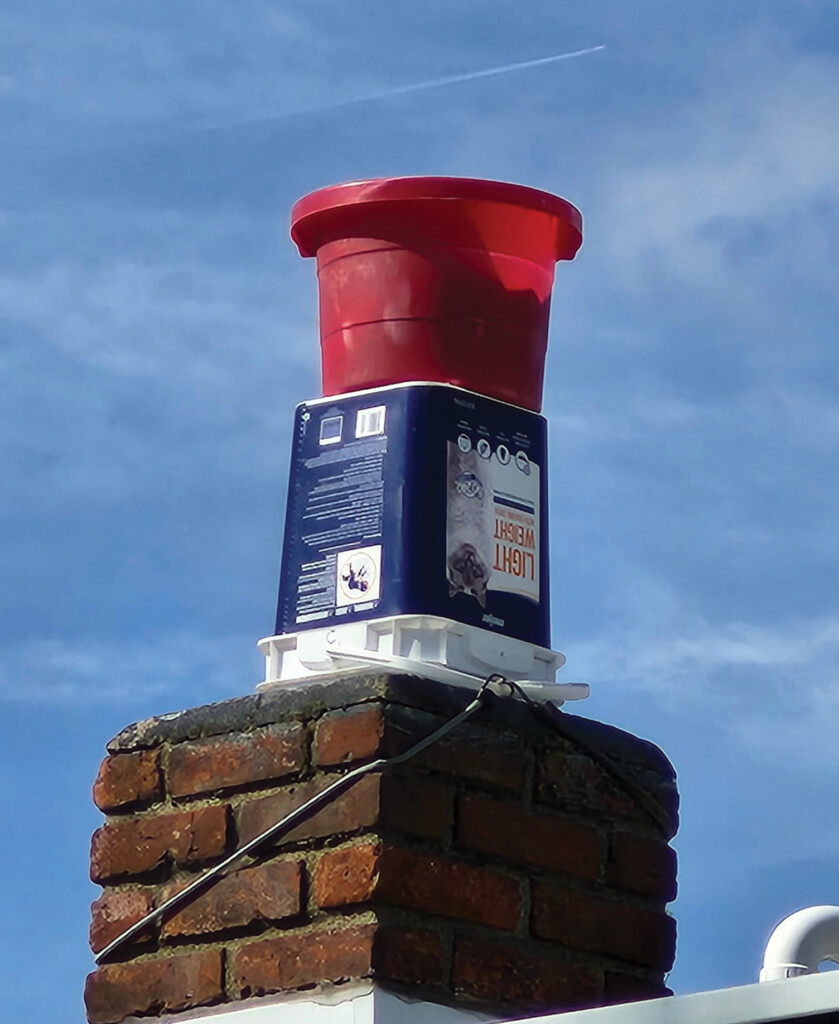
Photo: Chris Newbold’s recorder placement on her chimney.
In the morning or whenever convenient, we retrieved the recorders, removed the SD card containing the night’s recordings comprising six to seven hour-long audio files, and transferred them to our computers. As a tool to help us get started with the NFC identification process, we used a free program called Nighthawk.
After processing our recording files, Nighthawk generated Excel spreadsheets for each hour-long recording, detailing detected NFCs, detection times, and some preliminary identification information such as order, and possibly family, group, and species, with probability statistics. It was always exciting to open and review these files to see what birds may have migrated over our homes at night.
Our next step involved confirming or determining the species identification for each NFC detection reported by Nighthawk. As we listened and analyzed NFCs signatures on a spectrogram in Audacity, a free recording and audio editor app, we sometimes discovered NFCs that were undetected by Nighthawk. This was challenging, but rewarding when we confirmed the species that made the NFCs.
One of our most valuable resources for NFC identification was Cornell Lab of Ornithology’s Macaulay Library of audio recordings, specifically the “flight call” filter. We compared our NFC audio clips with confirmed species from the audio library to aid in accurate identification.
For NFCs we couldn’t identify on our own, we posted audio clips of the unidentified calls to the Echoes of the Night Sky and/or the Nocturnal Flight Calls Facebook group to seek help. We made every effort to identify as many NFCs as possible, acknowledging that some NFCs remained unidentified.
Once we confirmed the species, species counts, and total number of NFCs made by each species, we entered this data into an eBird checklist. We uploaded NFC audio clips edited from the recordings in Audacity. Unlike traditional diurnal eBird checklists, these NFC checklists are specifically for reporting migratory birds’ nighttime contact calls. For best practices when submitting NFC data, refer to eBird’s Nocturnal Flight Call Count Protocol.
This project was a tough endeavor at first, but as we learned the technologies and utilized our resources to identify the NFCs, it became quite fascinating—and addictive! Witnessing the timing and variety of migratory bird species flying overhead at night was eye-opening. What we learned from this project has enhanced our overall birding skills by improving our call recognition. (Many of the NFCs are same as or similar to calls made during the day.)
Additionally, learning to edit NFC audio recordings in Audacity for NFC checklists has streamlined the process of preparing and uploading quality audio clips to include with our diurnal eBird checklists.
As we strive to make birding accessible to all, NFC recording offers another way to bird that requires minimal physical effort, doesn’t require transportation, and can be done from the comfort of one’s home.
Interested in giving it a try? Contact Indiana Audubon to participate in the fall 2024 Echoes of the Night Sky Project! While limited recorders are available on loan, you can consider learning independently by purchasing a recording unit, downloading the free software, and joining an NFC group online.
This article originally ran in the August–September 2024 print edition of The Cardinal.
Tags: birding story program updates