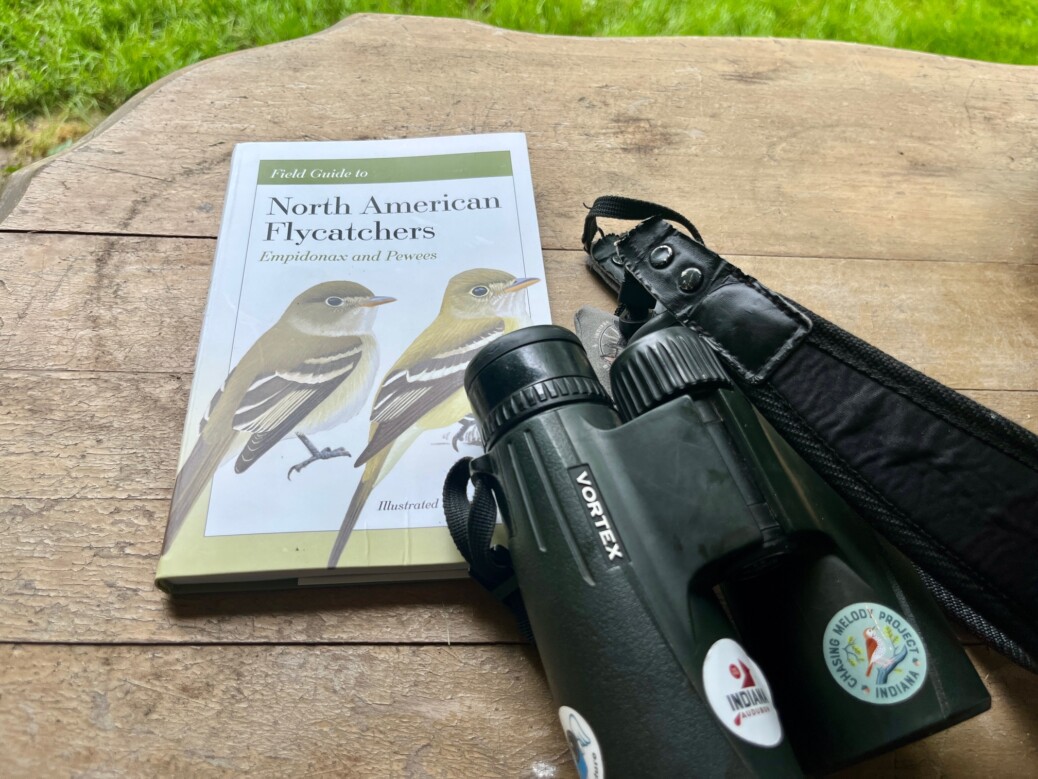
Photo: Field Guide to North American Flycatchers with binoculars by Brad Bumgardner.
BY BRAD BUMGARDNER
Nothing defines ‘Birding 201’ like flycatcher identification. Despite the issues that come with warbler, thrush, and sparrow ID, none compare to identifying Empidonax flycatchers. This unique genus within the tyrant flycatcher family is widely regarded as one of North America’s toughest challenges for birders. So, I was thrilled to see the first teaser images from Cin-Ty Lee’s Field Guide to North American Flycatchers, illustrated by Andrew Birch.
The first thing you notice is the amazing illustrations that show the subtle differences between these incredibly similar species. The holistic approach resonates with me, drawing on my past bird banding experiences where no single trait or field mark is used for species identification. Here, 12 different species traits are explored in depth, including bill length comparisons, eye-ring shape, wing-bar contrast, and of course, the dreaded primary projection.
Observing these birds in real life is much harder than studying illustrations in a book, but learning these combinations of traits should boost your confidence in teasing out brief views of silent flycatchers. To aid with lookalikes, they have also added the Contopus pewees for comparison. I found the Olive-sided Flycatcher drawings my favorite.
The species range maps have significantly improved, featuring migration advancement as dotted lines and location histograms. It’s even more fascinating to understand their southbound migration to the wintering grounds, connecting the entire year of natural history for each flycatcher and pewee species.
Some bird species may not have clear, distinguishable field marks, which adds to the challenge and excitement of birding. As the author suggests, sometimes you must accept that you might not always get the ID right or identify the bird beyond its family. Marking an entry as Empidonax sp. or Contopus sp. on your bird list or in your notebook is perfectly fine—and you certainly won’t be alone in doing so.
For those that want to seek out more knowledge on this fascinating, but frustrating group of birds, look no further.
This review originally ran in the August–September 2024 print edition of The Cardinal.
Tags: book review