Image: A dark gray background with a green, blue, white, yellow and red stripe cutting diagonally across it representing the disability pride flag. A photo of a Ruby–throated Hummingbird is overlaid on the red stripe, a woman with binoculars is overlaid on the yellow stripe, a White-collared Manakin is overlaid over the white stripe, an Eastern Screech-Owl is overlaid on the blue stripe, and a flock of pigeons is overlaid on the green stripe. Bird photos courtesy of Jason Jablonski (hummingbird), Canva (woman birding, flock of birds), Ryan Shean (Manakin), and Olivia Bautch (owl).
BY OLIVIA BAUTCH
Think back to your first time joining a bird walk, which, we know for some of you, may have been several decades ago. You may remember the joyful anticipation of growing your new (or established) hobby in the wild among others who share your enthusiasm. Meeting your people. Arriving at a new location, you encountered new scents and sounds, new trails, new faces, and new terminology. Depending on your field trip leader, you may have been guided patiently through each part of the experience, or expected to keep up with well-meaning but unspoken expectations.
Follow as the leader turns onto the narrow, eroding, creek-side trail. Hold up both your head and your binoculars for two hours, at least. Locate the high-pitched “bzeee” of Cedar Waxwings masked by treetop leaves and similarly pitched insect sounds. Maneuver under this vine and over that fallen tree. Engage in the small talk of already-acquainted strangers during the hours that were scheduled for watching birds, mind you.
Any of these situations could easily inconvenience a first-timer. But for someone with a disability, unexpectedly facing one or more of these situations could not only inconvenience one’s birding experience, it might make it impossible to go birding with the group.
Why July?
In the same way bird lovers celebrate Global Big Day or World Migratory Bird Day as the day that the Migratory Bird Treaty Act of 1918 was signed into law, July is Disability Pride Month, observing the signing of the Americans with Disabilities Act (ADA) in 1990. The Arc, national advocates for people living with intellectual or developmental disabilities, explain the month’s designation as “a time to recognize the history, achievements, experiences, and struggles of people with disabilities. It affirms that disability is a natural and valuable part of human diversity—not a deficit or condition to be fixed.”
Whether visible or not, 1 in 4 Americans has a disability. These conditions come in many forms and can affect any system of the body. They do not discriminate between young or old, new birder or longtime world traveler. In fact, this is the one minority group that anyone can become a part of at any time.
The Face of Disability
During July you may see a gray flag with five stripes landing on your social media feed: this is the Disability Pride flag. Thoughtfully designed to represent the wide spectrum of experiences people with disabilities might face, it also serves as an informative graphic.
In brief, the dark grey background remembers those who have passed away from their illness or condition. Each of the five stripes represent a category of disabling conditions:
- Green: Sensory, blind, deaf, and deaf-blind communities
- Blue: Emotional and psychiatric disabilities
- White: Invisible or undiagnosed disabilities
- Gold: Cognitive and intellectual disabilities
- Red: Physical disabilities
The band of colored stripes is diagonal, said to cut across walls, barriers, and stigmas. In the birding community—and in greater society—perceptions of disability tend to fall into one of two camps: resist ableism, breeding bitterness and self-pity, or exist as the novelty, under the cloud of shame and others’ pity.
In reality, we’re fully human too. We’re students, coworkers, parents, hobbyists, thinkers, birders, travelers, and scientists. We know how to take care of ourselves, or we’re working toward it. Like the able-bodied population, we each have different skills both in and out of the field. A birder who is blind may be amazing at birding by ear because they do not practice sight identification. Someone who can only travel short distances at a time due to fatigue or an autoimmune disorder may be highly attuned to minute ecological patterns others may miss.
No one should let their struggles define them, including disabilities. We are asking, though, that the diverse and very real barriers we may face in the outdoors be better understood and reduced, just as we would do for any member of our birding community.
The natural world, in its ubiquitous and nonjudgemental presence, has long been known to serve as a calm to anxious conditions, a light for depressive conditions, focus for intellectual conditions, and more. Readers have been fascinated by tales of avian companionship and its support in the hold of depression and grief, such as in Helen Macdonald’s H is for Hawk memoir, or the illnesses of birds themselves, like Julie Zickefoose’s Saving Jemima: Life and Love with a Hard-luck Jay. In this way, I want to introduce you to several Indiana birders who wanted to share a bit of their story with Indiana Audubon readers, starting with myself.
A Little Birdsong Goes a Long Way
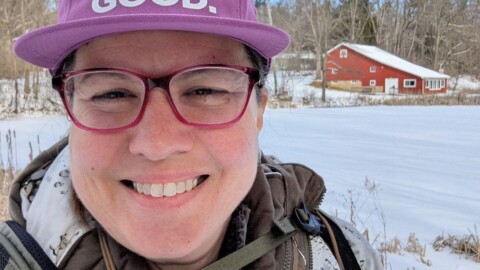
Olivia Bautch | Carmel, Indiana
Some of you may have already heard me discuss my chronic illness and why I support accessible birding. One condition I don’t often mention is Tourette’s Syndrome, a neuropsychological condition—and it’s not just tics. While I have mostly grown out of my tics, the sensory aspects aren’t going anywhere. In birding, this looks like being overwhelmed and sometimes shutting down with too much birdsong at one time. Who knew there could be too much birdsong? Cold weather layering and high humidity can be terribly uncomfortable, and walks with spontaneity can equally shut my brain down.
Birds are one of my life’s passions, so I’ve made changes for my enjoyment: I use “deer ears” (or “owl ears”) to funnel specific sounds on the trail while filtering out the rest. I take sit spots for calm and focus, choose looser clothes, car-bird more in winter, and go birding with people I know will understand my pace.
My disabilities are invisible, just like those of a little ambassador Eastern Screech-Owl I knew. She sang her quiet, calming “coo” sound with me when she ate and took her daily meds. She was (and still is) a feathered friend who shared her strength and joy with me.
On a Mission for Birds and Wheelchair-Friendly Locations
Angie Parelius | Indianapolis, Indiana
I have a neurological disease that requires me to use a wheelchair. This presents the major challenge of finding a location where I can both hear and see birds. I rarely find activities that offer wheelchair accessibility. I was so excited when Eagle Creek Park did just that. My husband and I had never been out specifically on a mission to hear, see, and identify birds. It was a fantastic experience. Because of our guide and other experienced birders, we located an Eastern Bluebird, a Summer Tanager, and a Red-headed Woodpecker. They were all beautiful and bird species that we had not observed before. I was grateful for the opportunity to experience our first birding outing.
Even though I love seeing a beautiful cardinal and hearing its distinctive whistled song, my favorite bird is a hummingbird. These tiny beauties are thought of as symbols of joy, hope, and resilience. I agree. No matter what is going on, seeing them makes me smile. On multiple occasions, I’ve had one stop and hover in front of my face, as if to say “Hi!” Awesome.
Gratitude for Awareness, and Passing it On
Rookie Birdher | Central Indiana
As part of Disability Awareness Month, I was asked to write a short profile. I love birding. In 2022, I recorded over 300 bird species in Indiana. Now, I am recovering from a motor vehicle accident, which has resulted in ongoing health issues, including post-concussion syndrome. I experience multiple symptoms daily, which gives me some firsthand knowledge of the increased challenges of birding with disabilities. Living with my health issues motivated me to complete the Certified Access Birding Outing Leader course. The course expanded my understanding and my awareness of the many challenges faced by others.
Regrettably, since the accident, some friendships have lapsed. However, I organized a birding trip with other friends, which was successful. That success was thanks to my diligence in gathering information ahead of the trip and our thoughtful birding guide. He got to know each of us and our needs, prioritized accessibility, set a pace that was good for everyone, made room for extra breaks, and facilitated special dietary needs. During the trip, we found creative ways to recall birds. A White-collared Manakin became a White-collared Mannequin. Joy and laughter ensued!
I suggest modifying outings to include brief introductions, guide contact details, and information on parking, restrooms, and maps to facilitate better knowledge up front which will make events more inclusive and successful for all.
A Shared Responsibility
There are great resources for anyone who wants to learn more about reducing and removing barriers for your birding friends who live with disabilities. And for those of us who know these struggles firsthand, I want to share this reminder: everyone is dealing with or will deal with something, even if their struggles look different than yours. Birds, nature, kindness, and life are for everyone. As bird lovers, we should all do our part, in July and every month, to make sure all have access and ease in enjoying the bird life around us.
Tags: birding insights disability pride month