The see-saw of spring continued this week. When the winds weren’t coming off the lake, we actually saw spring migration surge, with two standout count days delivering strong passerine and raptor movement, including an excellent sapsucker flight and one of the season’s better showings for buteo hawks.
Woodpecker Winds and Sapsucker Surge
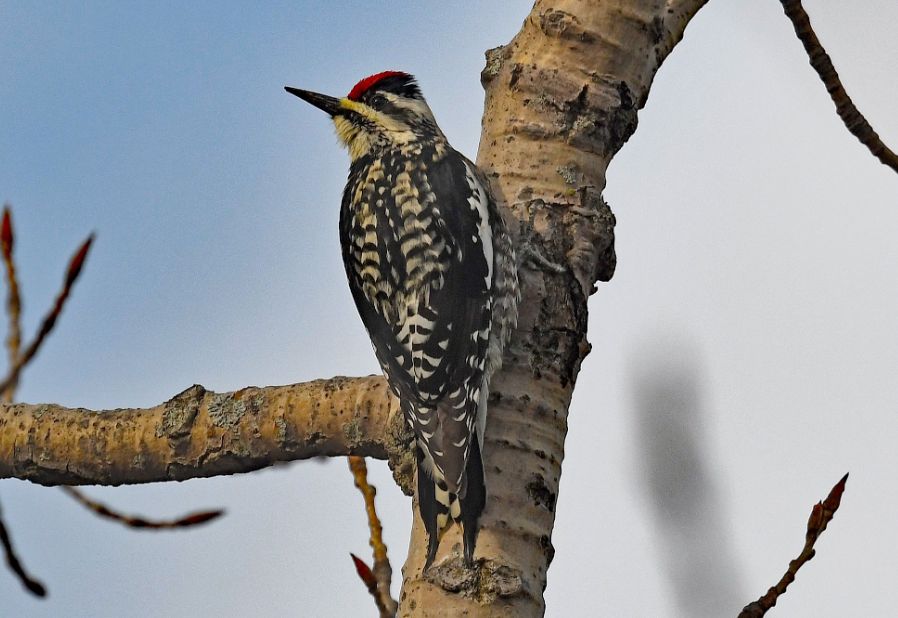
A sharp pulse of Yellow-bellied Sapsuckers kicked off Monday, April 14, with an impressive 139 tallied, many moving low over the tower and briefly pausing in nearby cottonwoods before continuing northward. It marked not only one of the best single flights of the year, but was the highest in over 13 years, when over 340 were logged, marking one of the highest spring flights anywhere in the country (4/7/2013). Woodpecker migration overall was solid, with 488 Northern Flickers also logged that day, which is typical this time of year. They tend to migrate in perfect timing.
Raptors: Buteo Primer & Highlights
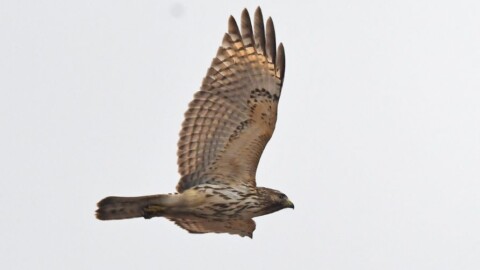
The tail end of the week brought welcome diversity in buteo hawks. On April 18, all three expected species—Red-tailed, Red-shouldered, and Broad-winged Hawks—made appearances. For newer visitors at the tower, here’s a quick breakdown on telling these classic soaring hawks apart:
- Red-tailed Hawk: Stocky and broad-winged with a distinctive brick-red tail in adults (juveniles are banded). Look for pale underparts with a dark belly band and a slow, heavy wingbeat, a slight dihedral, dark patches in the carpal bar, small comma mark at wrist.
- Red-shouldered Hawk: Smaller and sleeker than a Red-tail. Look for translucent “crescent moons” near the wingtips and banded tail. Usually appears longer tailed.
- Broad-winged Hawk: Compact and cleanly marked, these travel in tight kettles during peak migration. Light morphs show bold black-and-white banded tails and nearly all-dark trailing wing edges. Large groups can be show stoppers this time of year.
Tips for First-Timers at the Tower
New to hawkwatching? Here are some quick tips:
- Timing is everything: Except you don’t have to be the early bird to get the worm. No need for dawn patrol. Most raptors appreciate a good sleep in. Getting to the tower by 9 a.m. CT will allow you to witness most of the morning’s flight.
- Wind Direction: A good south breeze is essential. Cloud cover can affect which species are migrating (think kettles!) and make viewing easier or more difficult depending on the cloud type.
- Bring optics: A good pair of binoculars is essential. A spotting scope helps too, especially for distant birds coming in from the south.
Overall Numbers for the Week
Here are just a few standout totals from the April 14 and April 18 counts:
- Yellow-bellied Sapsucker – 139 (Apr 14)
- Northern Flicker – 488 (Apr 14), 57 (Apr 18)
- Red-tailed Hawk – 3 (Apr 14), 3 (Apr 18)
- Bald Eagle – 2 (Apr 14)
- American White Pelican – 27 (Apr 18)
- Pectoral Sandpiper – 27 (Apr 18)
- Bank Swallow – 77 (Apr 18)
- Tree Swallow – 773 (Apr 18)
Looking Ahead
With neotropical migrants just beginning to arrive, we expect Blue-gray Gnatcatchers, an increase in warblers, and perhaps our first hummingbird or oriole to appear any day now. Winds look promising nearly every day this week, and we’ll be counting daily at the tower as the diversity builds.
Follow the full season’s data at our April 2025 eBird Trip Report.
Header Photo: Yellow-bellied Sapsucker by Michael Topp.
Tags: birding insights longshore flight survey research