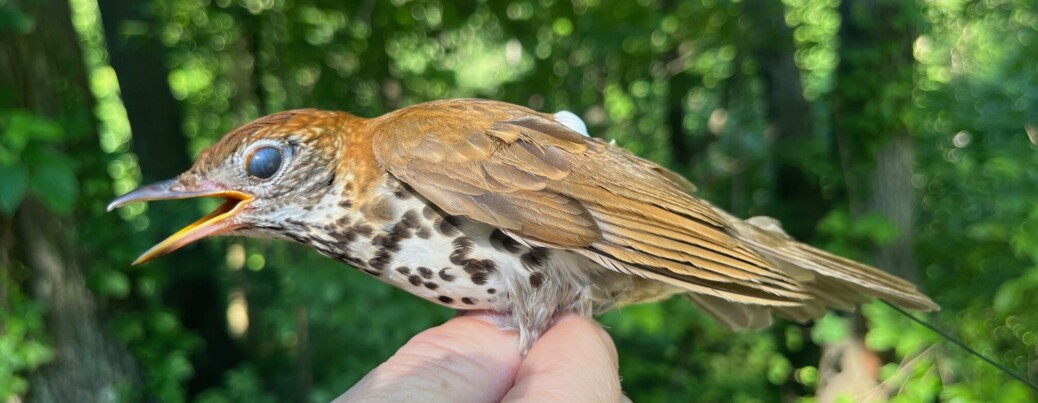
Notes and photos from Chasing Melody project work.
Chasing Melody spring migration update, Wood Thrushes are on the move!
3/17/2026
Spring migration is almost here, and we are excited to be entering year three of continued monitoring for both our 2024 birds and our 2025 cohort as they begin their journey north. Over the coming week or so, we expect to see the first Wood Thrushes reaching the Gulf Coast, which means the return trip is officially getting underway.
We have already seen some encouraging activity this winter. One bird in particular, Elijah Wood Thrush, Motus tag #95593, was banded last June at Purdue Wildlife Area by Lena Rifai, and has been spending the winter in Honduras. We will be especially eager to see whether he makes it back to Indiana, or whether Kevin will return to Mary Gray Bird Sanctuary within the next month or so. Every detection helps tell a larger story about migration, survival, and the challenges these birds face along the way, and we look forward to sharing those updates with you as they come in.
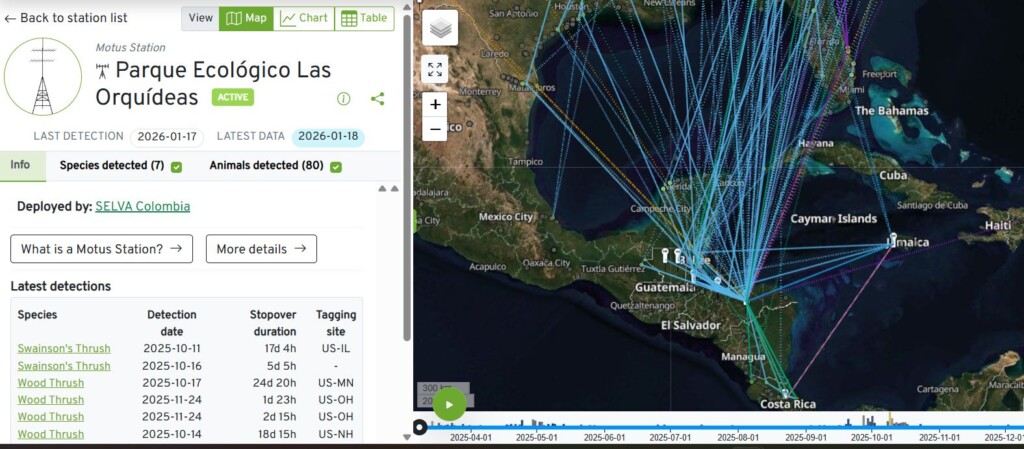
Like many of you, we also felt the impact of the recent storms and heavy winds. While you may have lost a few shingles or dealt with a power outage, one of our Motus towers at Fort Harrison State Park took a hit as well. The station is still live and operational, but the storm damaged the omni antenna, which is the piece that allows us to detect birds moving through the immediate area. That antenna is especially important for tracking Wood Thrushes at Fort Harrison during spring migration.
We are now working to replace it before the birds begin arriving in larger numbers next month. The antenna itself costs more than $300, and installation can add to that total. A gift of $25 or $50 would go a long way toward helping us get the station fully operational again in time for spring movement. If you would like to help, please consider making a donation in 2026. We also hope to offer another Chasing the Melody trip this summer to see what our birds are up to. Stay tuned.
Thank you for being part of Chasing Melody and for helping us follow these remarkable birds across continents and weather events. We are excited to share the first spring arrivals with you soon.
11/20/2025
Hi everyone,
Even though the field season wrapped in August, the birds are still writing the second half of the story as I type. Migration has been rolling along, and we’ve seen several Wood Thrush begin to ping various towers, and we’re happy to report some recent updates as we watch for our birds to settle into winter territories.
Fresh Detections From the Motus Network
Several of our Indiana birds made big moves in late October and early November.
- Willow (the DNRs 2024 adult female) checked in from Jardín Botánico Lancetilla in Honduras on November 13.
- Scout, tagged at the Dunes, turned up in Honduras as well, confirmed in late October.
- Frankie Turdatra from this year, and last year’s Wilson, both registered detections in Belize on November 4 and October 17.
What about Kevin?
Our steady resident at Mary Gray, Kevin, has now shown the same departure pattern two years in a row. After apparently leaving October 1, he appeared again off and on until October 7.
We picked him up again during the early morning hours of October 8. He couldn’t slip past one of the antennas at The Nature Conservancy’s Fortress Preserve Station in Kentucky, just outside of Bowling Green, KY. His appearance was around 7am, suggesting a clear morning descent. That timing suggests he flew roughly 230 miles overnight, a solid push for a Wood Thrush. After that, the signal dropped again, and we expect he continued into Central America undetected. Good luck little buddy!
A Look at the Border Crossings: What Honduras Is Telling Us
One of the strongest windows into fall migration now sits right in northern Honduras, thanks to the two Motus stations installed earlier this year at Pico Bonito and Jardín Botánico Lancetilla by the Sam Shine Foundation.. The Lancetilla station is the same one that just detected Willow. That single tower pulls in traffic from a long list of migrants, and when you zoom out to see what hits it each fall, it looks like someone spilled a rainbow across Central America.
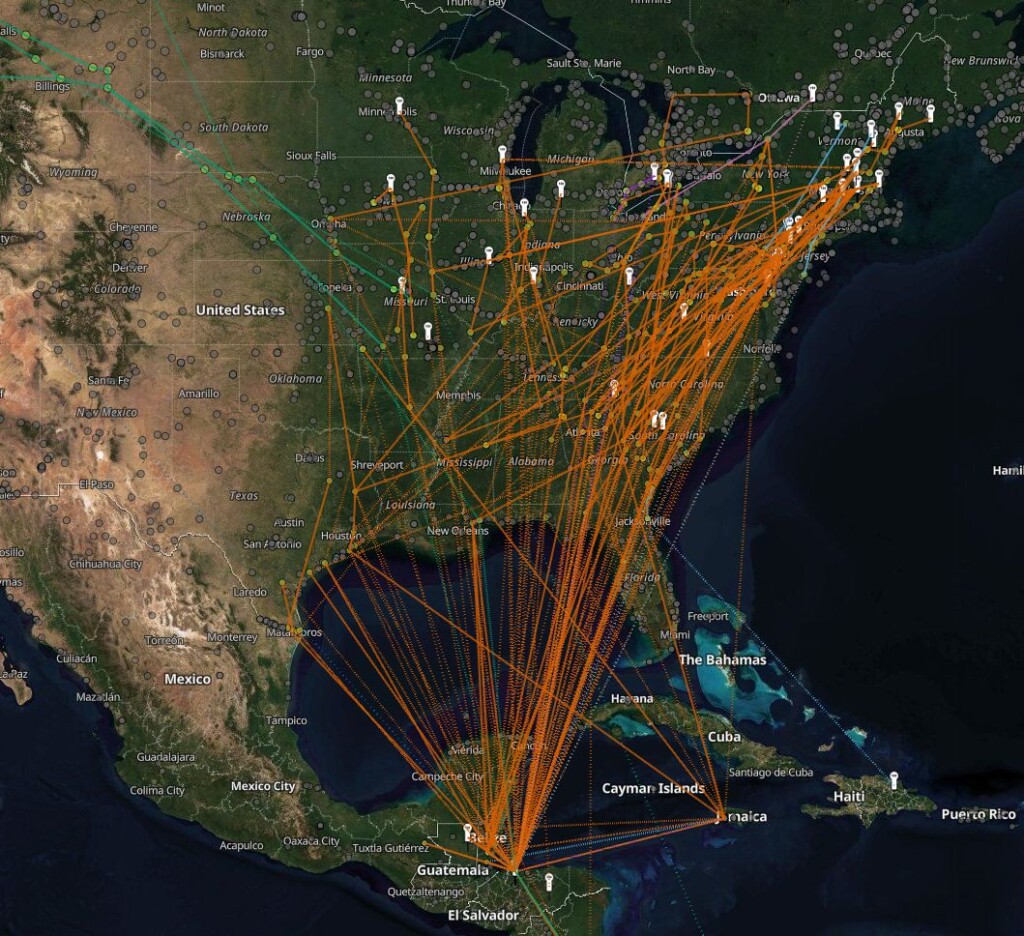
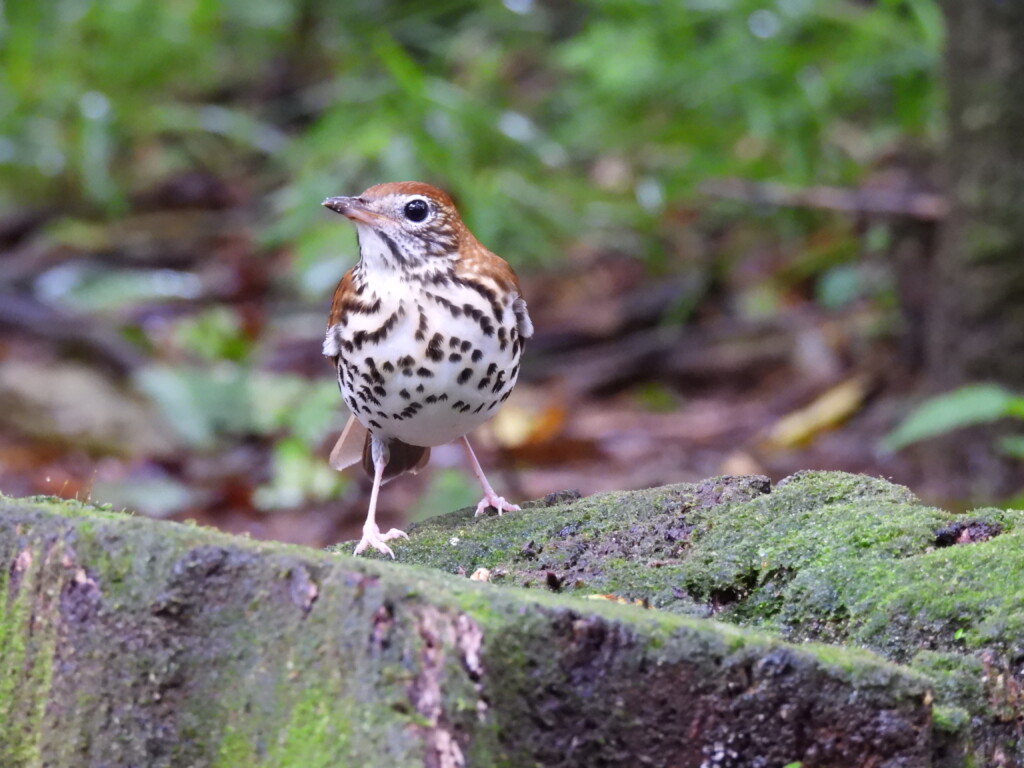
Wood Thrushes move through that corridor along with Swainson’s Thrushes, flycatchers, and a parade of warblers. The tower logs hundreds of individuals every season, and each arc of data reminds us that our Indiana birds are just one small part of a major funnel of migrants. Mixed into that steady flow are the individuals we know by name.
When you compare that station’s traffic with the broader Motus map, the scale becomes even clearer. Roughly 1,800 Wood Thrushes have been tagged across the full partnership. That is the population picture behind birds like Kevin, Willow, Scout, and Wilson. All their individual pathways sit inside a migration highway stretching from Canada to Panama.
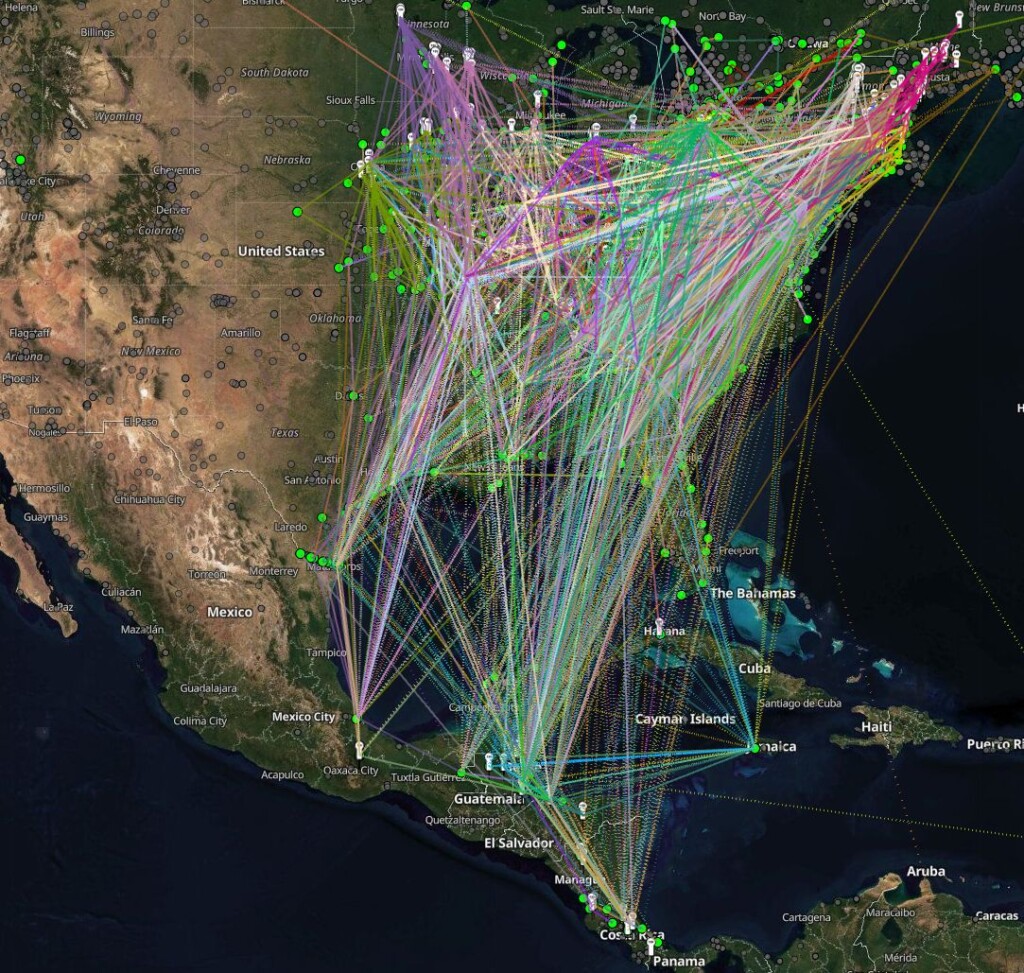
For us, these detections confirm that Indiana’s birds move through the same western Caribbean corridor as the rest of the eastern population, then fan out once they reach Central America. Where they settle for winter is the mystery we are closing in on.
Thanks again for supporting this project. Each tag and each detection helps us understand how these birds survive the long stretch between Indiana and the tropics. As we close out the year, we invite you to help us carry this work into 2026. Your support strengthens our long term monitoring and helps launch the next round of projects that are already waiting in the wings. If you are able, a year end gift keeps the signals flowing and the science growing.
Thank you for being part of the journey!
10/14/2025
The field season may be behind us, but migration is just hitting its stride. Across the Midwest, our tagged Wood Thrushes are on the move, and the data streams are starting to hum with activity.
Kevin Takes Flight (Again)
Our longtime Mary Gray resident, Kevin, has officially departed for his second recorded migration. After spending the summer right where he left off last year, his tag went silent this week, a strong signal that he’s headed south. Last year, Kevin completed a full migration cycle, wintering far to the south before returning right back to his same Indiana patch. We’ll be watching closely to see where his signal turns up next. Amazing that Kevin departed exactly on the same day again this year… October 1st.
Migration on the Airwaves
The Chicago Bird Migration Monitoring Network has joined the symphony of fall data with some fascinating results. Using autonomous recorders similar to our Echoes in the Night Sky program, they’ve been tracking nocturnal flight calls across the region. Looking just at Wood Thrush detections, two major movement nights stand out: September 23 and October 6. Those peaks likely mark the big southbound waves we’re now seeing across Indiana.
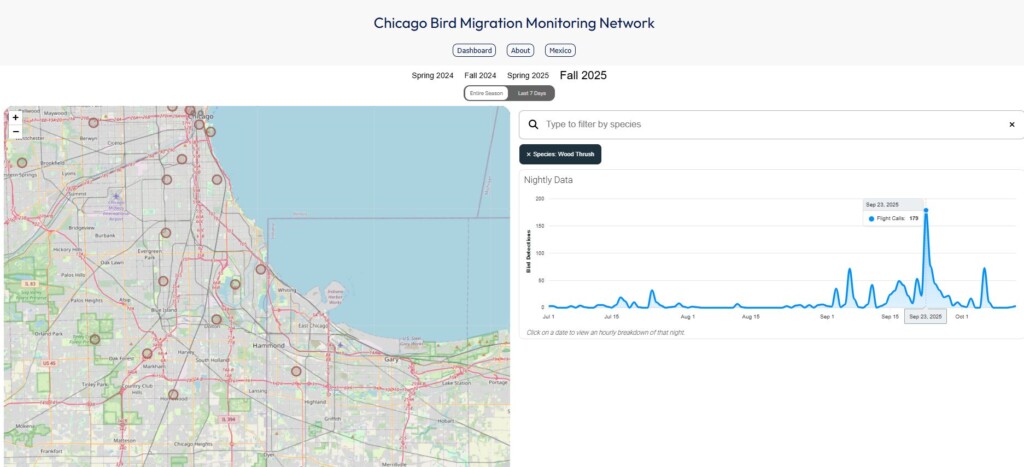
You can explore their dashboard yourself at chicagobirdmigration.net to see how migration unfolds in real time.
Patterns Taking Shape
Across the Motus network, detections are confirming what the microphones are already telling us. Wood Thrushes are peeling away from their summer territories and slipping quietly south. Each blip on the map adds another verse to the song, showing us how individual birds navigate their full annual journeys.
As we move deeper into fall, those signals will keep telling the story: where they stop, how long they stay, and which routes they choose. Kevin’s already on his way, and soon the rest will follow! Stay tuned for the next update as we track the melodies moving through the skies this season.
9/8/2025
The Wood Thrush field season has come to a close, and what a season it was. Our Indiana crew worked hard to deploy nearly all of our tags this summer. Only a couple remain, and those will head to Mexico soon to join the international effort. With that, Indiana’s role in this year’s work is wrapped, and now the fun begins as we wait for the first fall migration signals to come through.
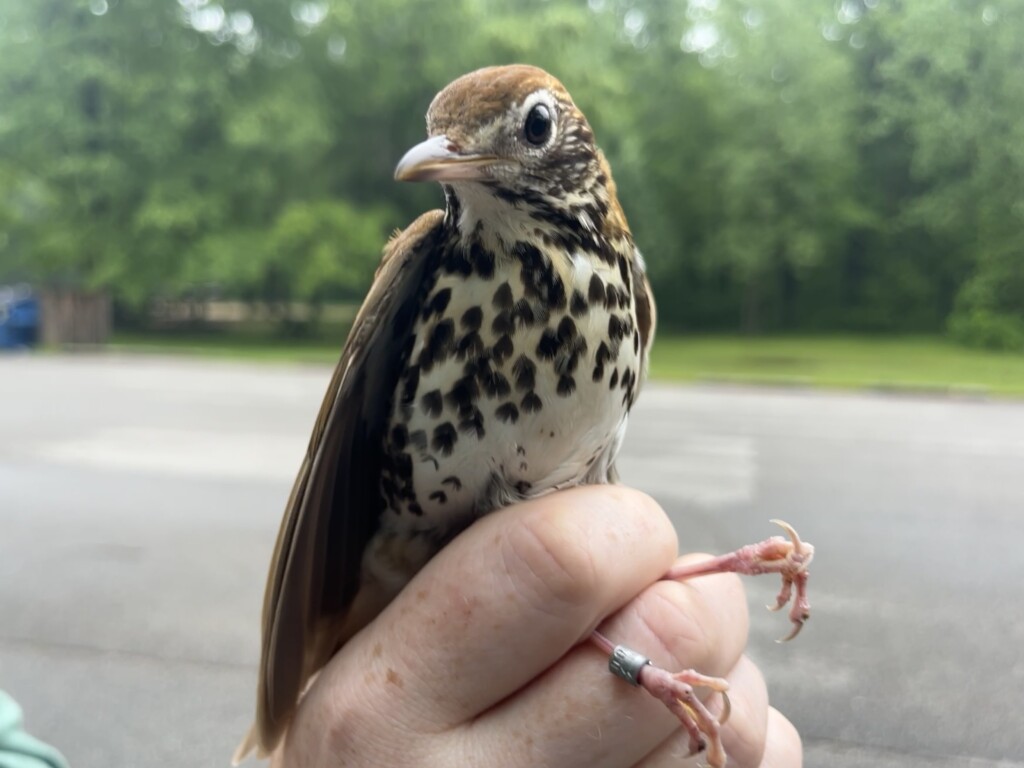
Here at home, the project pushed forward smoothly. We placed tags on local Wood Thrushes across our study sites and are eager to see how their journeys compare to the broader population. Across the full range, the numbers are staggering. Combined, 1,133 Motus tags have been deployed on Wood Thrushes. The work stretched across 27 U.S. states and Ontario, down through Mexico, Guatemala, Honduras, Belize, and Costa Rica. It took a true coalition to make that happen: 17 state agencies, one federal agency (U.S. Fish and Wildlife Service), seven universities, and 22 nonprofit organizations.
“WHOA” hardly covers it. This scale of collaboration is what it takes to follow a migratory songbird through its full life cycle.
With Phase I (field tagging) complete, the project shifts gears into Phase II. That means cleaning, processing, and analyzing the mountain of incoming data. Migration detections are already starting to appear, and over the next year those pings will turn into an extraordinary story of movement across their worldwide range. More updates on that are expected in the months ahead.
From Indiana’s side of the project, we are proud to be part of this massive collaboration. None of this would happen without the energy and commitment of so many partners in so many places. The fieldwork may be over, but the migration is just beginning. As the Wood Thrushes take flight this fall, so does the next chapter of discovery. We look forward to where our birds go next!
8/14/25
Fort Harrison Motus Tower is Live!
Birds passing over Indianapolis just got a little less sneaky. Thanks to support from the Science Tech Foundation, the Fort Harrison State Park Motus Wildlife Tracking Station is now online and streaming detections of migrating birds in real time.
This is the first Motus station to provide coverage in Marion County, and we hope it will be the first of several that help us study migration over Indiana’s largest city. The station will detect tagged birds from projects like Chasing Melody, as well as research efforts from across the continent, giving us valuable insight into how and when birds move through urban landscapes.
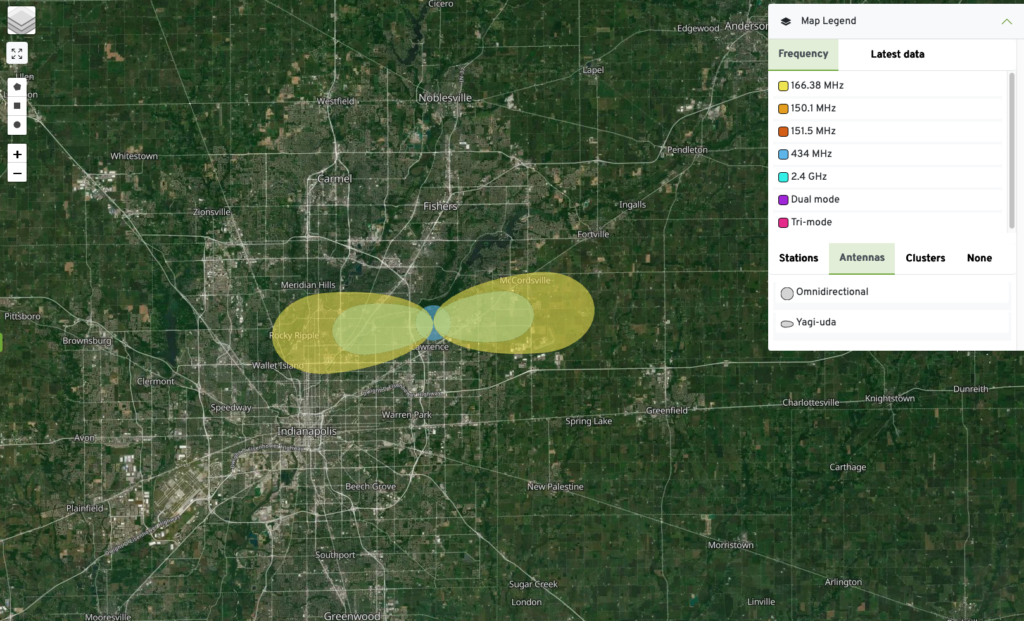
We look forward to the data it will bring, and to seeing which of our feathered travelers pass through Indy’s airspace this season. You can visit the Fort Harrison SP Motus Page Here to follow along with sightings.
7/31/25
Chasing Melody: Wood Thrushes on the Move
It’s been a busy few weeks as our team continues to slog through a hot and humid summer, and our birds start to quiet down. Our team netted seven new Wood Thrushes in the last couple week. However, none have had the added heft needed to carry a transmitter, so three tiny “backpacks” are still waiting in a Ziploc, ready for the right birds. The season is winding down and that is normal. Any tags deployed from here on out are bonus datapoints. If they stay unused, we will ship them south for a winter deployment in Mexico, giving us a fresh angle on migration.
Motus towers across Indiana have already detected returning signals from birds that wintered in Mexico, Belize, and Honduras. Even better, our nocturnal flight-call stations have picked up southbound Wood Thrushes on the microphones this week. Fall migration is officially under way!
Join Us in the Field
You can watch this story unfold in real time. “Chasing Melody in the Field” sessions put you shoulder-to-shoulder with our researchers as they track banded Wood Thrushes by radio telemetry. These sessions are timed with evening roosting movement of our already tagged Wood Thrush. The first two dates are posted, and help support the Chasing Melody project.
| Session | Date & Time (ET) | Location | Reserve |
|---|---|---|---|
| Fort Ben Session | Thu, Aug 14 · 4:00 p.m. | Fort Harrison State Park, Indianapolis | Save your spot |
| Mary Gray Session | Fri, Sep 5 · 5:00 p.m. | Mary Gray Bird Sanctuary, Connersville | Save your spot |
7/3/25
The 2025 Returnee Report:
Here’s a July recap starring 26 wood thrushes, 3 banders, a broken toe, and one very confused Motus tower.
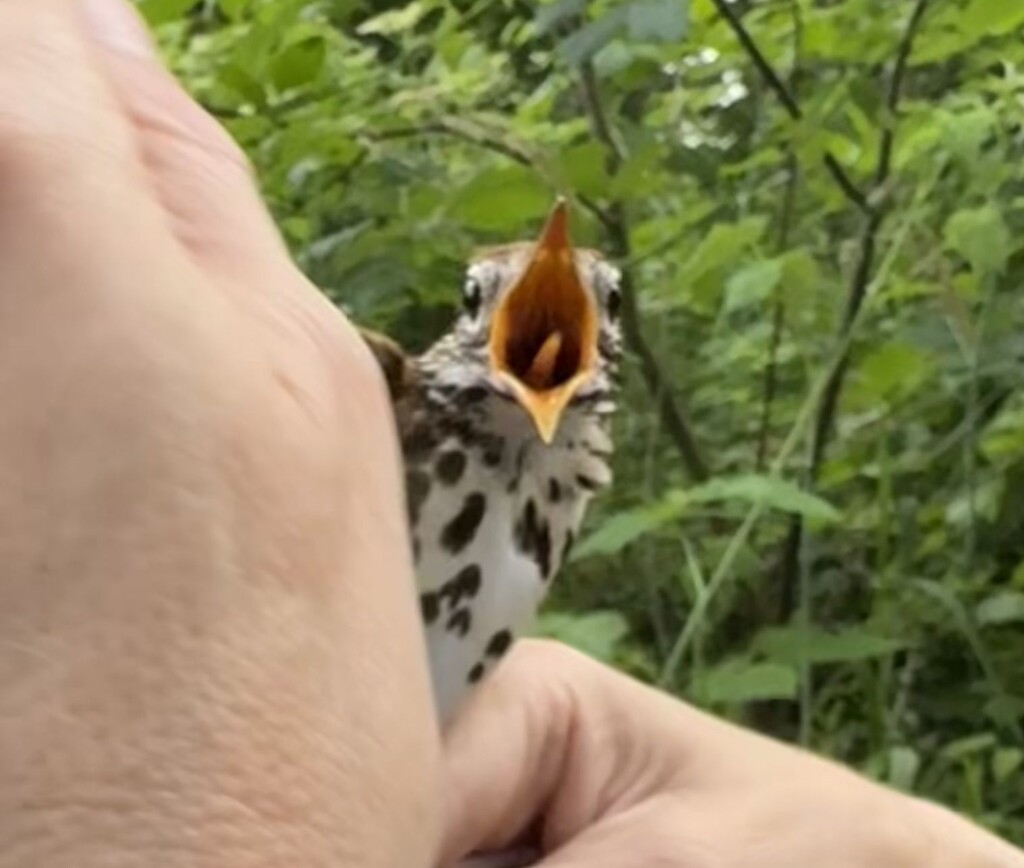
Act I: The Returnees
As spring migration wrapped, our 2024-tagged wood thrush cohort has started checking back in, some loud, some quiet, some clearly still on bird vacation. Out of 26 tagged birds, 10 have confirmed returns to Indiana, giving us a 38.5% return rate so far. Most are second-year males. Only two females have returned.
Even more intriguing? Seven birds returned to the exact same Motus range where they were tagged last year.
Act II: The Loyalists
Melody (tagged at Sam Shine) is officially our diva in residence. She made a clean migration to Mississippi last fall, pinged Goose Pond on April 22, and was back at Sam Shine Foundation Preserve by June 28. Zero drama.
Kevin, the very first bird we ever tagged, returned to Mary Gray Bird Sanctuary like he had a standing reservation. No stops recorded in between. He’s been picked up daily since April 22.
Chase made it back to JPFWA and settled into the same turf from 2024. Same trees, same attitude. He even serenaded our bander, Lina, with a round of warning calls. Chase still holds a grudge.
George & Thor are back at Martell Forest, now occupying neighboring territories again. Thor, like a shady real estate flipper, appears to have taken over Gallus Gallileo’s old spot.
Pawpaw pinged back at Goose Pond in May and has since vanished into the foliage. Those leaves are big though!
Act III: The Wanderers
Willow, Melody’s ASY sister from Sam Shine, took the long way home. She migrated through Tennessee and Georgia in a single day, then vanished for months. She finally resurfaced at Goose Pond in late April, and by May 6, she casually reappeared at Sam Shine. No text. No warning.
Archeopturdyx, the original tagged turd, is rewriting the definition of mysterious. Last known location was Mexico in October 2024. Then, in June 2025, one brief 75-second ping in Massachusetts. Probably a data glitch?
Gallus Gallileo hasn’t officially checked in. Thor may have claimed his old stomping grounds. We’re watching and waiting.
Wilson & James Pond showed signs of life on migration routes but have yet to check back into their home sites. Possible stealth mode. Or maybe they’re just over Motus.
Act IV: Field Notes from the Brink
Behind all these blips and blips-not lies, our banders’ epic field sagas. They’ve pulled 17-hour days, got no bird detections, smashed broken toes with steel poles, and still managed to manually confirm returns with a handheld Yagi antenna. It’s part soap opera, part endurance sport.
Act V: Why This All Matters
Because of these uniquely tagged birds, we’re learning more about:
- Territory fidelity
- Migration speed and routes
- Sex-based behavioral differences
- The limits (and quirks) of Motus
This isn’t just data. It’s character development. These birds have stories. And without the messy, marvelous efforts of our banding crew and all the supporters, like you,, we’d miss the nuance entirely.
We’re not just chasing melodies anymore. We’re following the entire soundtrack this summer!
6/27/25
We’ve officially crossed the halfway mark in this year’s Wood Thrush banding season, and the numbers are looking strong. From the map and data, we’ve already banded more than half of our planned thrushes, with birds representing a range of ages and sexes. Even better, we’ve recorded banding efforts at sites all across the state, stretching from Tippecanoe and Porter counties to the southern border.
Each of these birds now carries a tiny Motus tag as they prepare to journey thousands of miles to Belize, Mexico, or Costa Rica… and (hopefully) back again. It’s early, but the season is already showing signs of success.
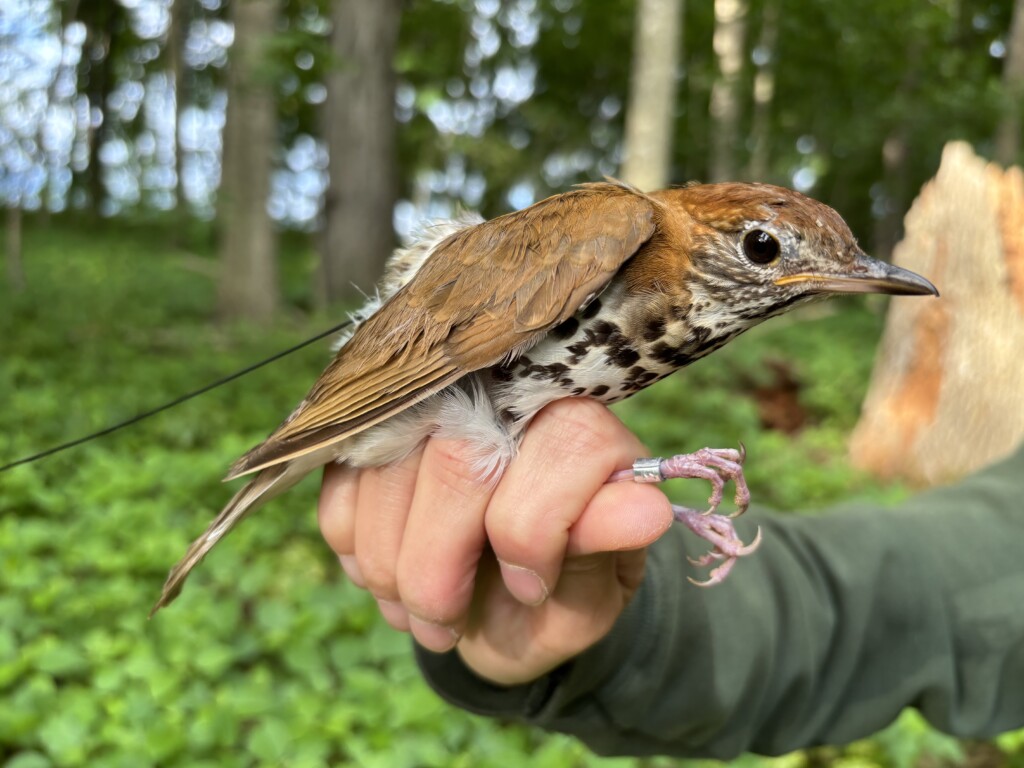
If you’re not already a Forest Steward, there’s still time to get involved:
- Sponsor an entire bird’s journey: Your support covers the full lifecycle cost of one bird, from Indiana to the tropics and back.
- Adopt a Thrush: You’ll get access to track an individual bird’s migration using the Motus Wildlife Tracking System, along with some neat updates and surprises along the way.
Where Are They Now? — 2024 Cohort Updates
We’ve got eyes (well, towers) on a few familiar friends from last year:
- Kevin, the first thrush banded last spring at Mary Gray Bird Sanctuary, is still going strong. He returned this season and has been pinging the Mary Gray Motus tower nearly every day. He was last recorded within the last 24 hours!
- Willow, an adult female banded at Sam Shine Foundation Preserve on June 4, 2024, is back as well. She’s been consistently active around Sam Shine for the past month. Home sweet home.
- Chase, banded last summer at Jasper-Pulaski, made it back into the state in April. He pinged Goose Pond on April 18, after a confirmed pass through Texas. Since then? Radio silence. He’s somewhere out there, doing whatever secretive thrush things secretive thrushes do.
- Melody, another female banded at Sam Shine, also returned to Indiana. She was last detected overhead at Goose Pond on April 22, following a successful fall journey through Mississippi. Like Chase, she hasn’t checked in again, but we’re hopeful she’s just off the grid in thick spicebush and dogwoods.
The Work Continues
As always, the success of this project depends on a community of supporters, scientists, and curious bird lovers like you. Every ping from a Motus tower is a small miracle—and a big data point. We’re learning more every season about the secret lives of Wood Thrushes, and it’s all thanks to your help.
Got questions? Want to adopt a bird? Ready to step up as a Forest Steward? Visit here and we’ll get you started.
6/10/25
Chasing Melody: A Rainy Trail, A Few Songs, and 8 New Stories
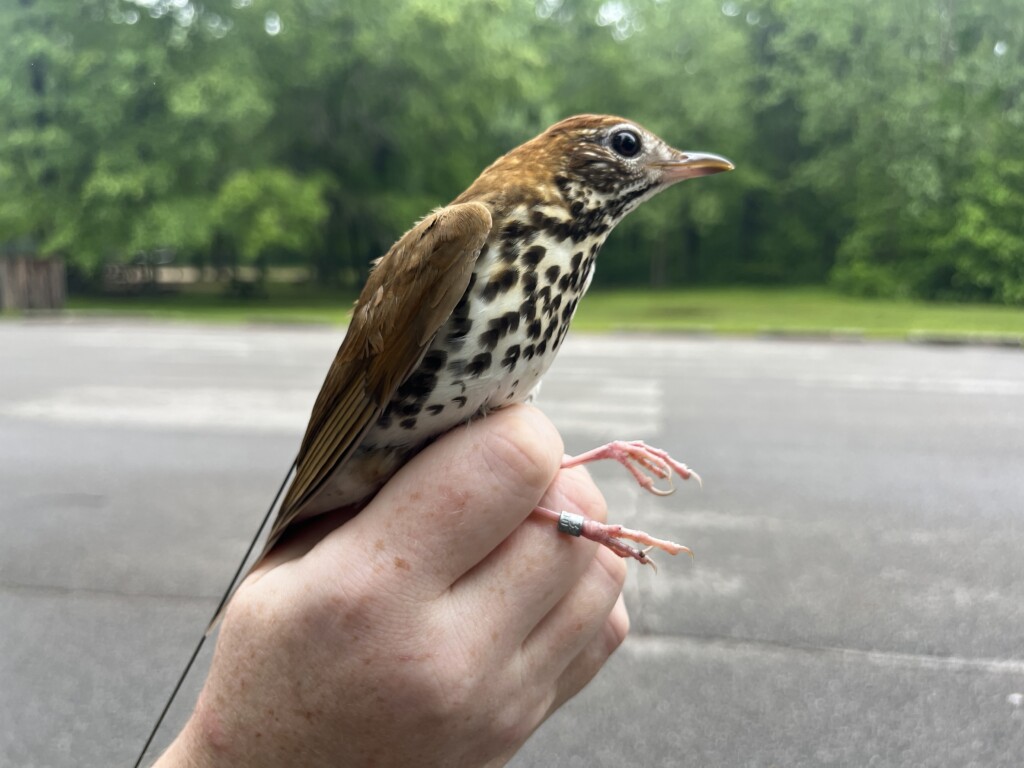
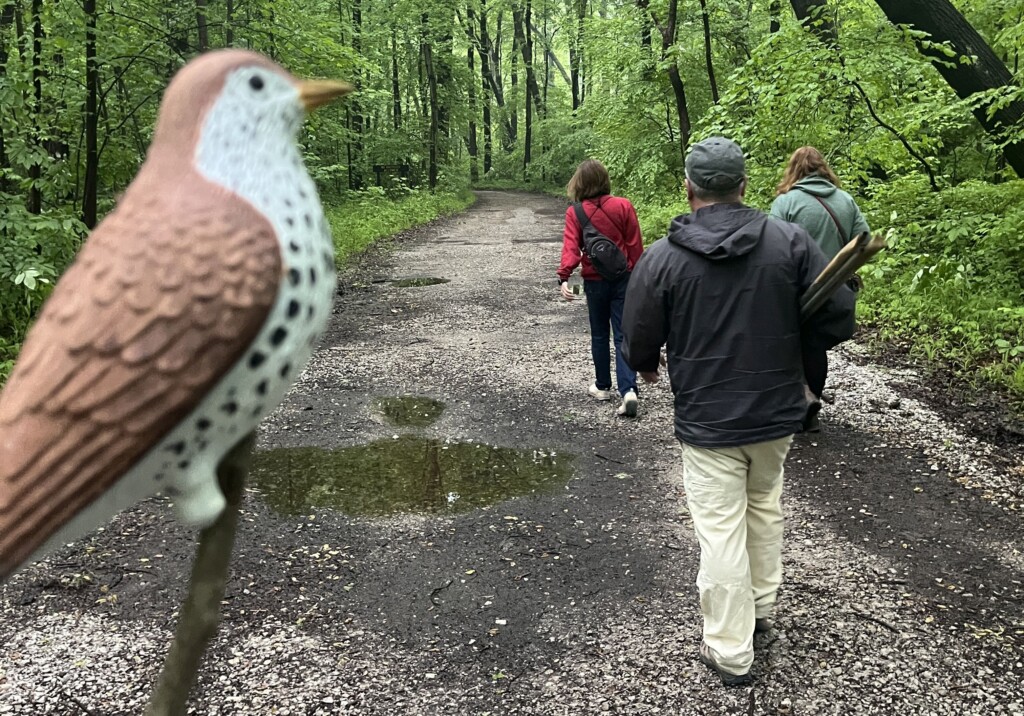
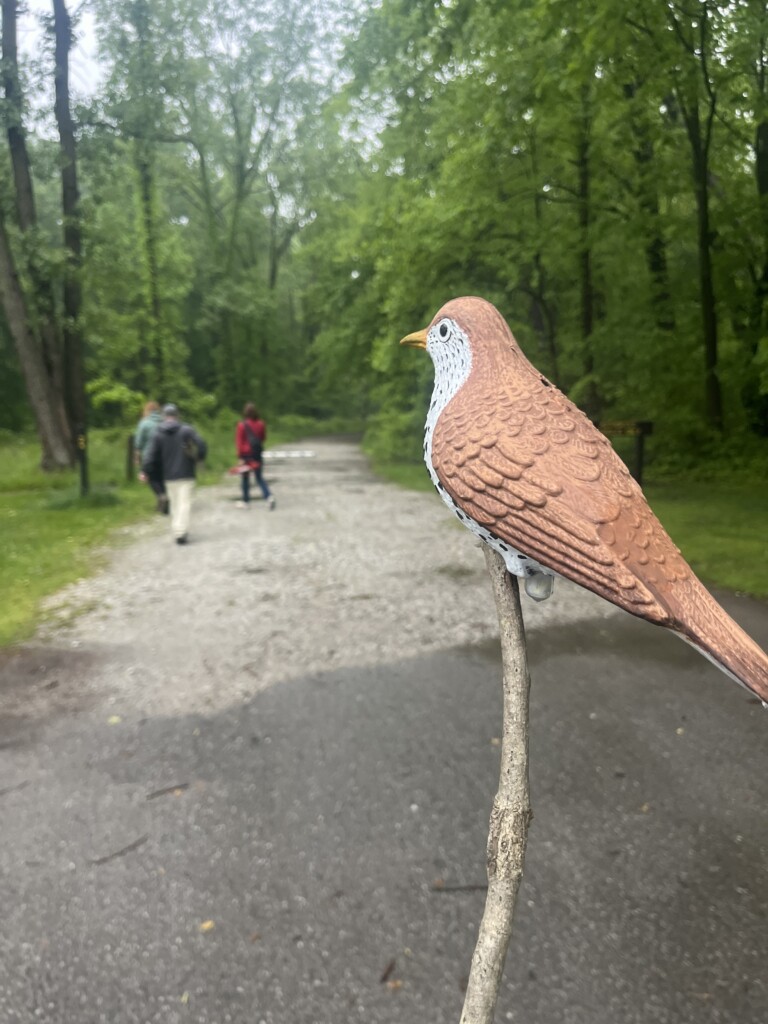
Some mornings, banding birds feels like a quiet meditation. Other days, it is a jungle gym adventure through a dripping Indiana forest with your best field crew and a decoy thrush leading the way. The past few weeks have served up plenty of both, and the season is just getting started.
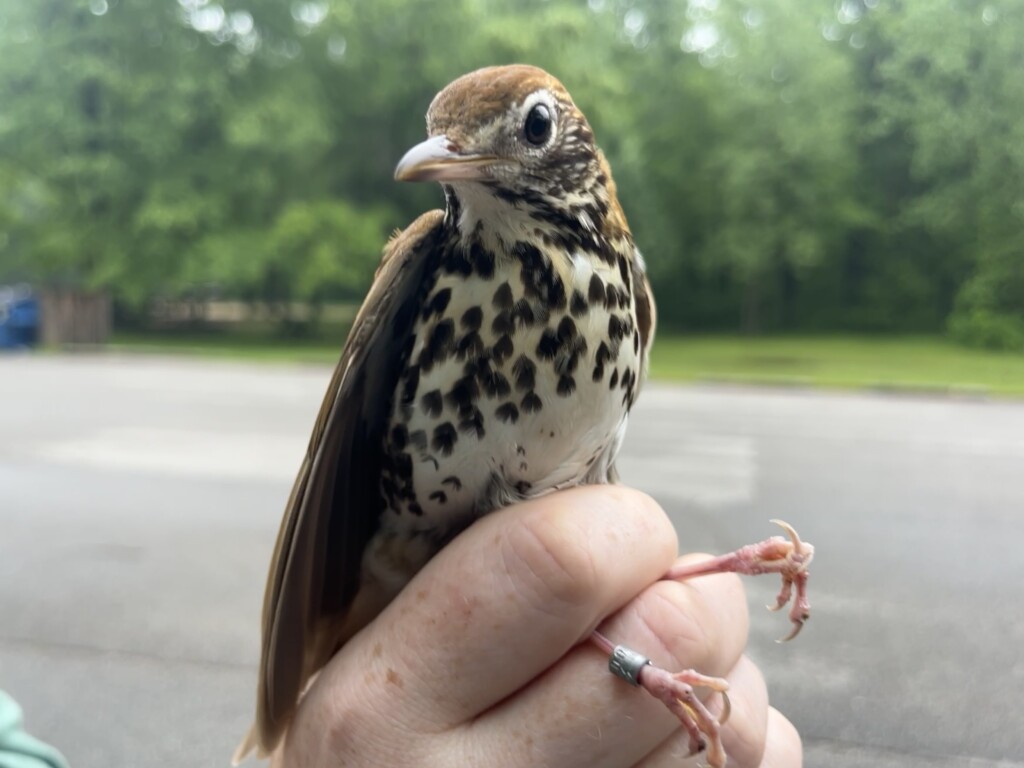
Despite the rain, muddy trails, and more than a few low-hanging branches, our Chasing Melody team has been busy in the woods chasing the flute-like song of the Wood Thrush. With nets in tow and coffee in hand, we have banded and tagged 8 Wood Thrushes so far this season. Each banded bird represents a small triumph and a big step toward understanding this iconic species.
What We’ve Found So Far
- 8 Wood Thrushes banded and tagged
- 7 males and 1 female (the ladies, as always, are making us work for it)
- 5 adults (ASY) and 3 younger (SY) birds
The diversity around the state of our banding sites reflects the rich tapestry of Indiana forest habitats where these thrushes return to breed each summer. From the deep greens of southern Indiana’s preserves to the oak and maple woods of the dunes and Mary Gray, each capture brings new data and new hope for conservation.
Why Now Is the Perfect Time to Adopt
Right now, the woods are alive with birds feeding, defending territories, and raising young. But in just a few months, these thrushes will embark on an incredible journey south to Central America. Adopting a Wood Thrush now lets you follow its story through the rest of the summer and into migration. You will receive updates on your bird and help fund critical research to protect them on both ends of their journey.
Adopt a Wood Thrush or learn more here. (And yes, you can give one as a gift too. The birds won’t mind.)
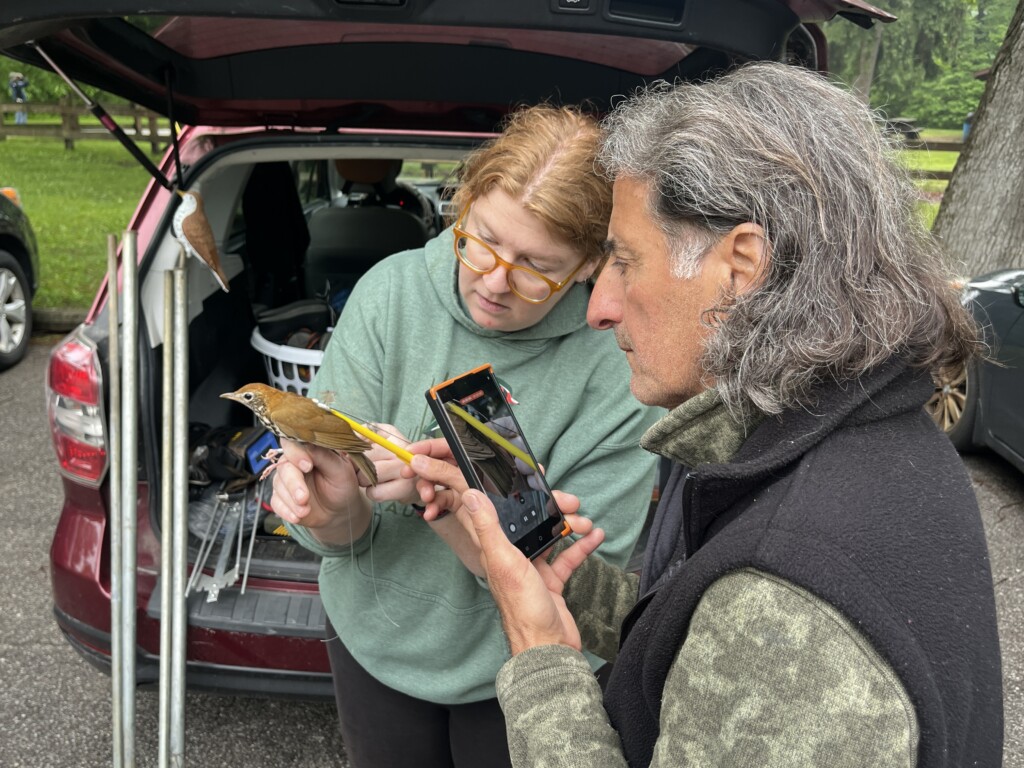
Here’s some photos of our happy crew seeking out thrushes this past week.
5/28/25
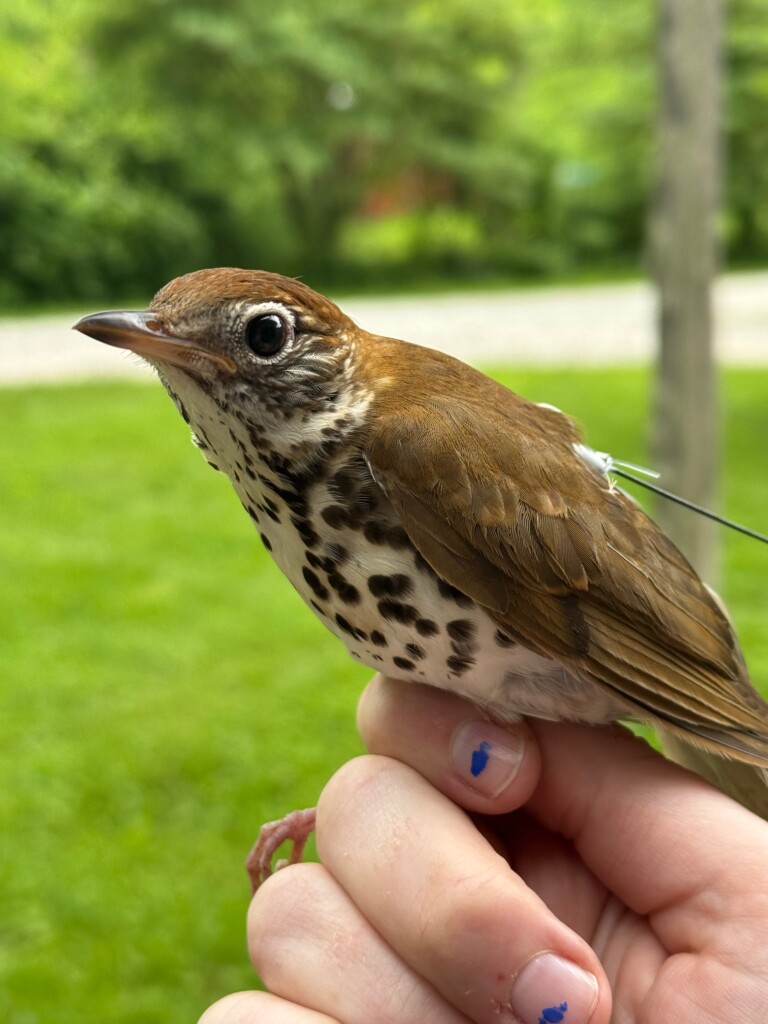
We’ve officially banded the first four Wood Thrushes of the season, two at Sam Shine Preserve (2 males) and our first pair at Mary Gray Bird Sanctuary, a male and female. It’s a strong start. Twenty-one more birds will soon join the class of 2025. Our first adoption certificates will go out in the coming weeks.
Stay tuned for updates from the Dunes, central Indiana, and even a few encore performances from last year’s cohort.
4/21/25
The melodies are on their way! We’re thrilled to share that the first Wood Thrush from our Indiana-tagged cohort has officially returned to the United States for the 2025 season! Detected near Houston, Texas, this bird is none other than Pturdodactyl—originally banded in Monroe County and later picked up on the Motus network in Mexico last fall. A big shoutout to Allisyn Gillet and Dr. Lina Rifai for spotting the detection and giving us this early cause for celebration.
You can follow Pturdodactyl’s journey here: Motus Track Link
These exciting spring detections are just the beginning. With birds already pinging stations across Texas, Illinois, and Missouri, it won’t be long before we’re hearing the flute-like song of the Wood Thrush once again echoing through Indiana forests. We have several other birds from other states’ projects all inbound as well.
The Chasing Melody project will be banding another 25 new Wood Thrushes in May and June 2025. These efforts are part of our full life-cycle research initiative that tracks breeding, migration, and overwintering patterns using Motus nanotags. Stay tuned for updates and field photos from our dedicated team in the coming weeks!
Later this summer, Indiana Audubon will also be offering guided field trips to visit key sites where tagged Wood Thrushes have been banded. These events are a great chance to see our research in action and hear firsthand about the conservation challenges these birds face across their range.
This year brought unexpected costs, including increased tariffs on imported tracking tags and equipment. Thanks to the incredible generosity of our supporters—including new Forest Stewards and Thrush Adopters—we’ve been able to keep the program on track. Your gifts help ensure we can continue uncovering the migratory secrets of one of Indiana’s most iconic songbirds.
There’s still time to become a Forest Steward or adopt a thrush for the 2025 season. These contributions directly support our fieldwork and data analysis and help amplify our impact beyond Indiana’s borders. Watch for more details coming soon via our website and newsletters.
Let the chorus begin—Pturdodactyl is back, and more thrushes are sure to follow.
2/27/25
Two new Motus Wildlife Tracking Stations in Honduras are helping us better understand Wood Thrush migration, thanks to the Sam Shine Foundation. These stations, strategically placed at Pico Bonito Lodge and Jardín Botánico Lancetilla, are already yielding valuable data—like the first Wood Thrush detection right after installation! These stations also support local capacity-building efforts, training staff on tracking technology. To dive into the details, read this blog post on the Cardinal Online.
10/5/24
We have birds on the move! Throughout the state, approximately half of our Wood Thrush have begun their migration and been detected at various Motus towers across the southern United States and even Mexico already. Some thrushes have passed by the exact same tower or national wildlife refuge on their journey. We’re excited to see more detections as they make their way to the wintering areas.
Additionally, we’re excited to announce that we will be returning again in 2025 with 25 more tagged birds, thanks to additional support from the Sam Shine Foundation next year!
7/24/24
It’s hot and humid, but fall migration has begun. We’re excited to share that in addition to the 26 Wood Thrushes that now have deployed Motus tags, a grand total of 527 total birds have been successfully tagged across the entire eastern range of the project.
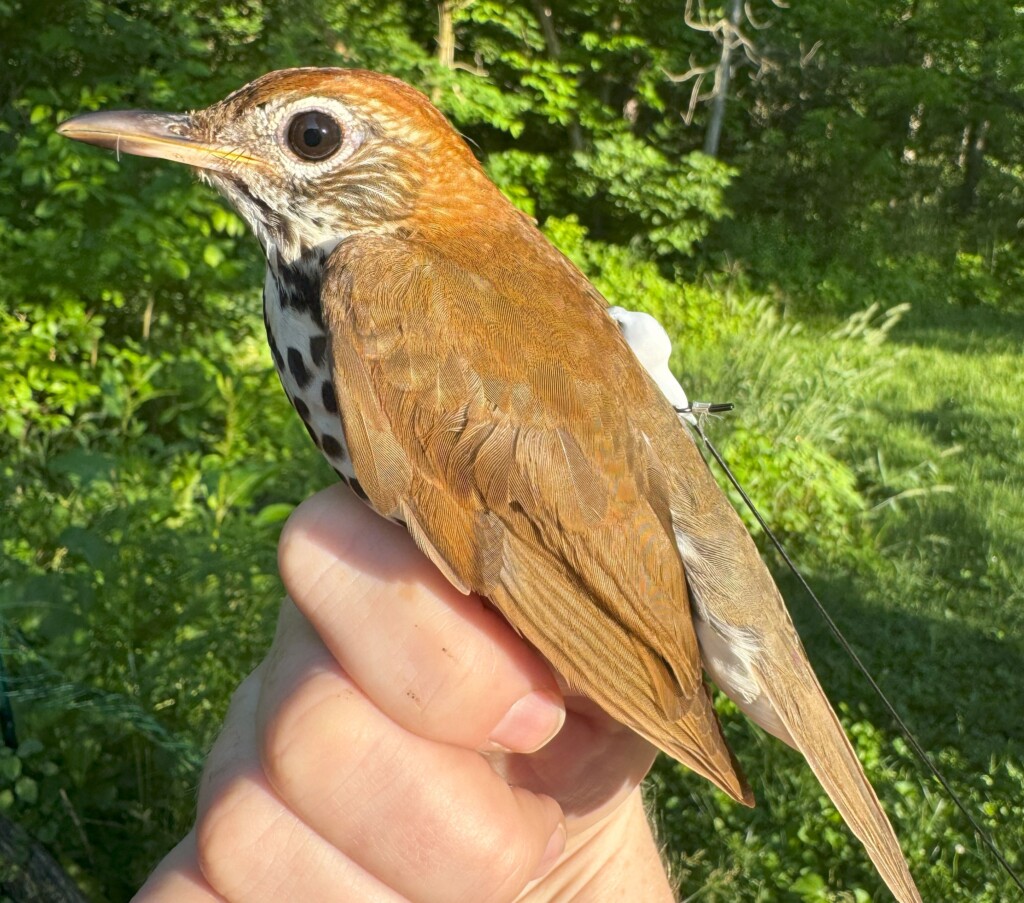
For us in Indiana, it’s been fun to see how long they stay before they begin their migration. Take 3231-00503 for example. “Kevin” as he came to be known, was banded at Mary Gray Bird Sanctuary in May, as our first project bird. As of yesterday, he was still palling around at MGBS. The red timeline below shows each detection we have had with Kevin and the Motus tower antenna at MGBS. Want to adopt Kevin, or any of the other Wood Thrush, consider visiting our Adopt a Wood Thrush page to learn more.
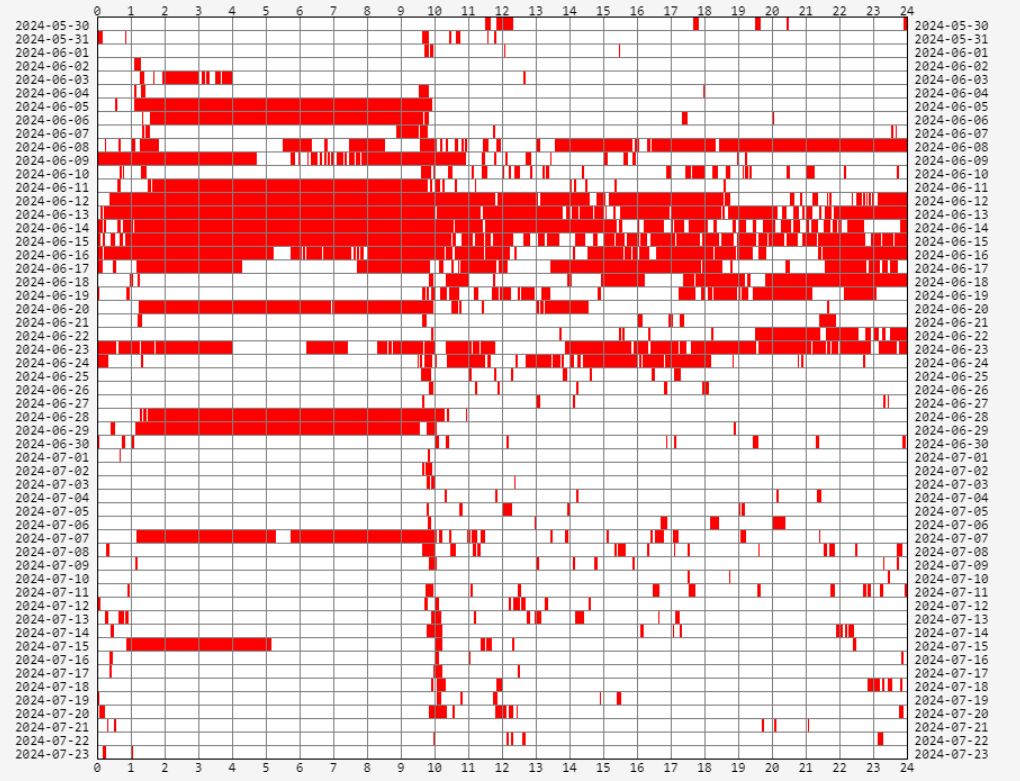
So when will Kevin and our other Wood Thrush start leaving? While it may seem like we’re in the midst of summer, the fall migration has begun, and we know via NFC microphones, such as with our Echoes of the Night Sky Project, that Wood Thrush are already migrating. Check out this NFC checklist in SE Wisconsin already recording migrating Wood Thrush.
7/8/24
#26 of 26 has been officially deployed! It has been getting harder and harder to catch Wood Thrush as they become less territorial. In the past few weeks we’ve used both audio lures and decoys meant to fool the males into coming closer. Additionally, we have weight requirements to ensure that the thrushes can handle the transmitters, albeit as super tiny as they are. Fortunately, our chunky all-star appeared at the Purdue Richard Lugar Farm.
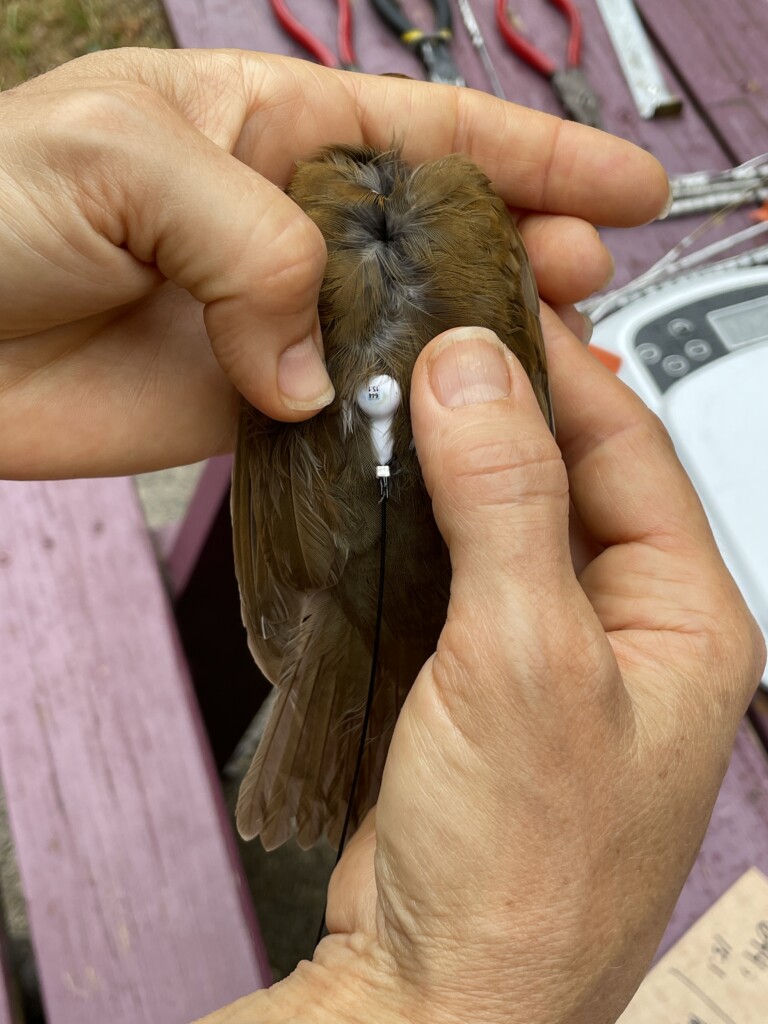
Our 26th bird came accompanying an entire family of Carolina Wrens, lining up to jump into the net every time we tried to close it up!
7/2/24
Progress continues after the sometimes difficult to catch Wood Thrush. The territorial nature of many male Wood Thrushes has begun to decline noticeably.
Just like grinding out that last stretch in a run or jog, we’re slowly getting towards our 2024 breeding season banding finish line. Bird number #25 of 26 motus tags being deployed was sent out early this morning on July 2 at Mary Gray Bird Sanctuary.
Despite everything we just said above, this punky male was highly aggressive, and flew directly towards the banders as soon as the net was set up. Only one more to go!
6/19/14
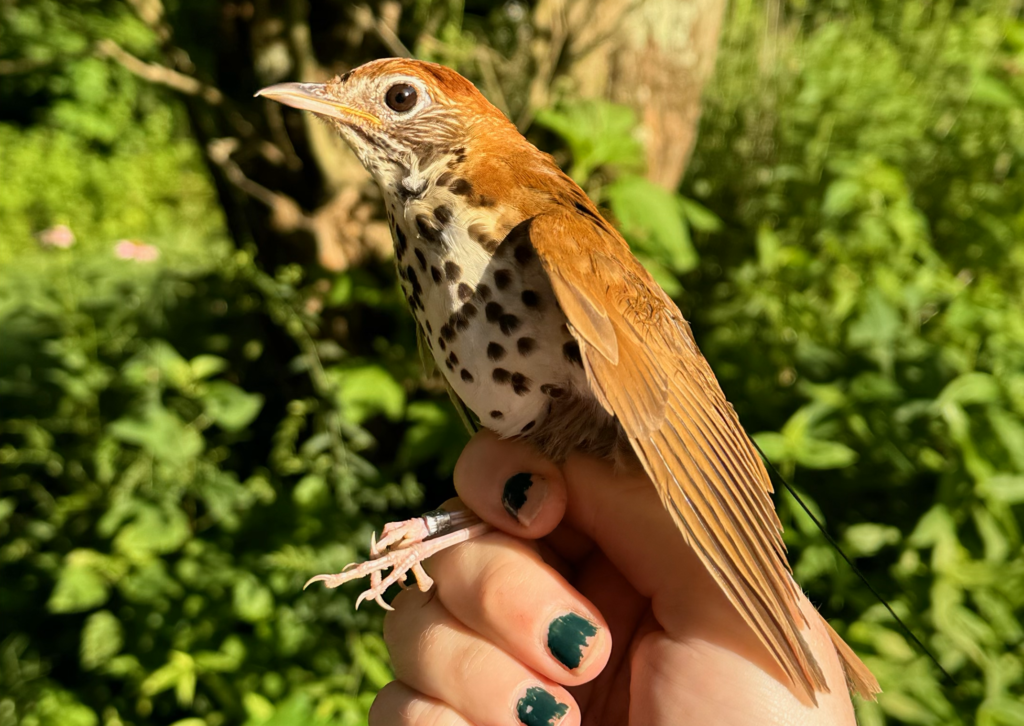
We’re excited to report that we’ve now deployed tags on 22 of 26 birds! However, birds are already starting to show less interest in their territories in the south, and second broods are starting now in the north. Getting the last four birds may prove to be difficult, even though there feels like lots of summertime left!
Males are naturally easier to capture than females due to their territorial nature this time of year. That is reflected in this year’s totals thus far. 14 of the 22 birds (64%) have been males.
You can adopt any of our Wood Thrush in the online store. Include a location or bird if you want to adopt a specific Wood Thrush.
6/12/14
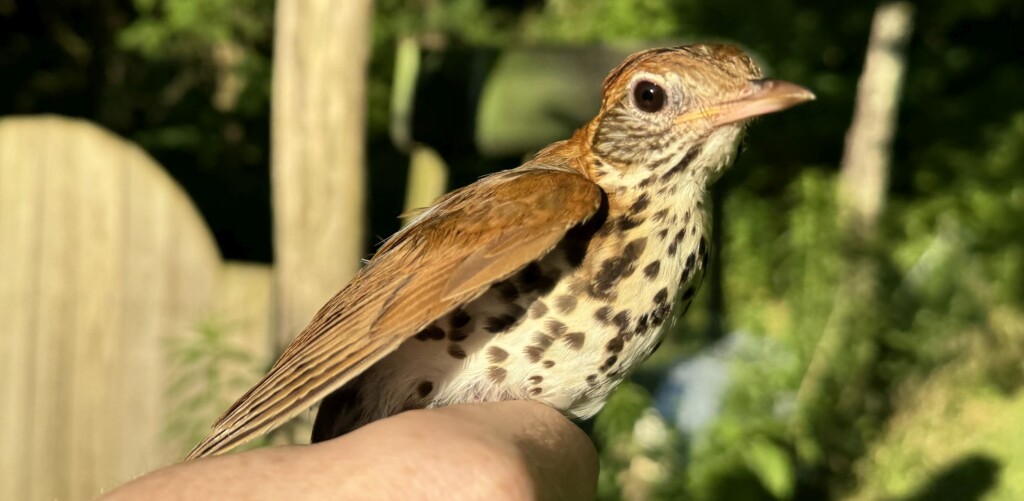
What a 24 hours! 8 birds were tagged statewide on Tuesday, June 11. This included 3 in the Indiana Dunes, 4 at Purdue University (split between Martell Forest and the Purdue Wildlife Area, and one far bird all the way down at Hovey Lake FWA in Posey County. We’ve now tagged and are tracking 19 of our 26 Wood Thrushes being targeted this year.
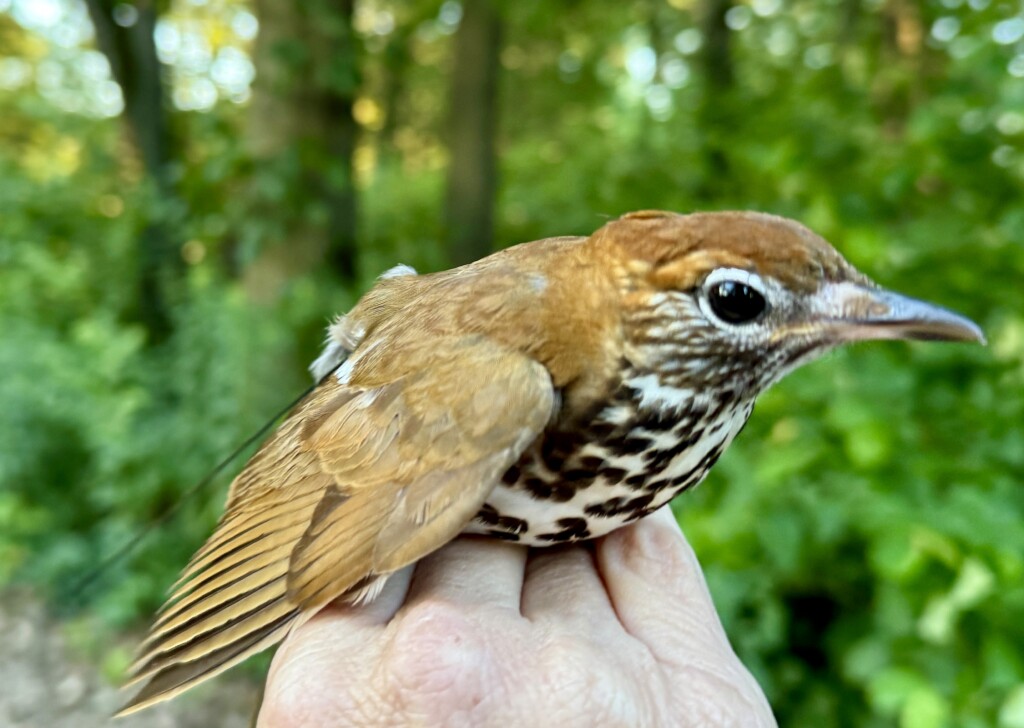
By now, many Wood Thrush just don’t respond like they did in May. One one day this week, it took 3 different sites to finally capture a bird. Sometimes, a male is so territorial, you can catch him in 30 seconds! Check it out in this video!
6/10/24
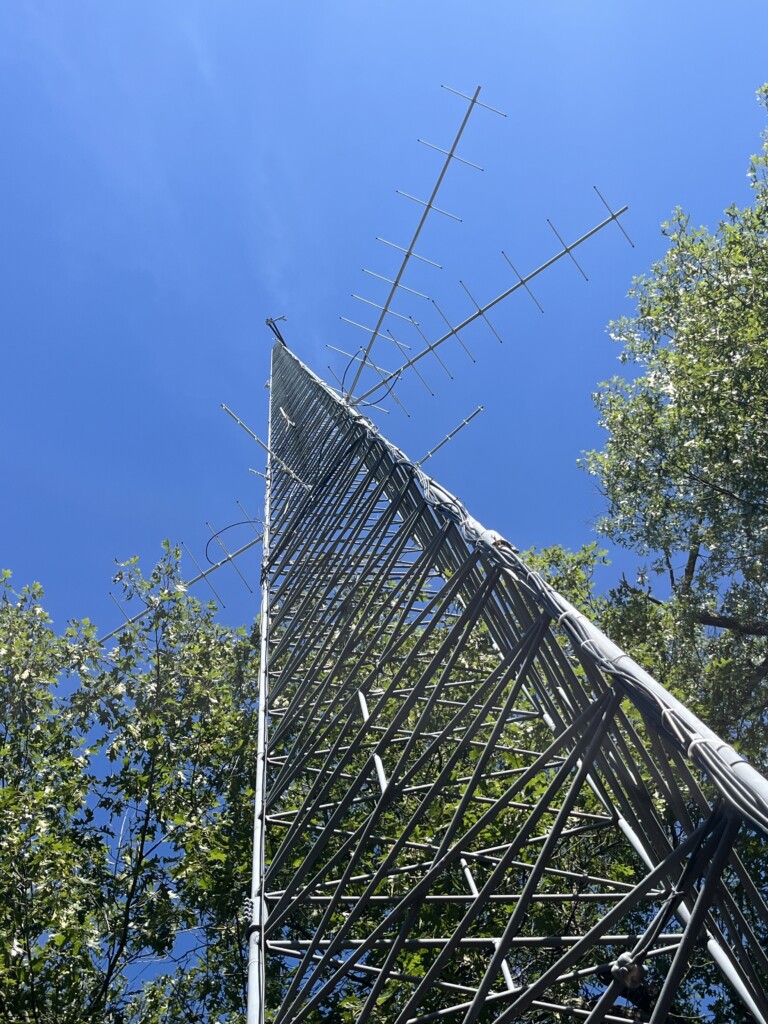
Teams have now been out capturing birds north to south, and in ten quick days we’ve now captured and banded over 40% of our target number of birds. Wood Thrush have been currently deployed with Motus tags at Jasper Pulaski FWA, Martell Forest, Indiana Dunes, and the Sam Shine Foundation Preserve.
The breeding season is progressing rapidly. For most Wood Thrush in the state, the first brood is concluding, and the second is beginning. This gives us a prime four-week window to spot territorial adult birds. After this period, the birds become more elusive, their singing decreases, and by mid-August, many adults have quietly begun their migration to the tropics.
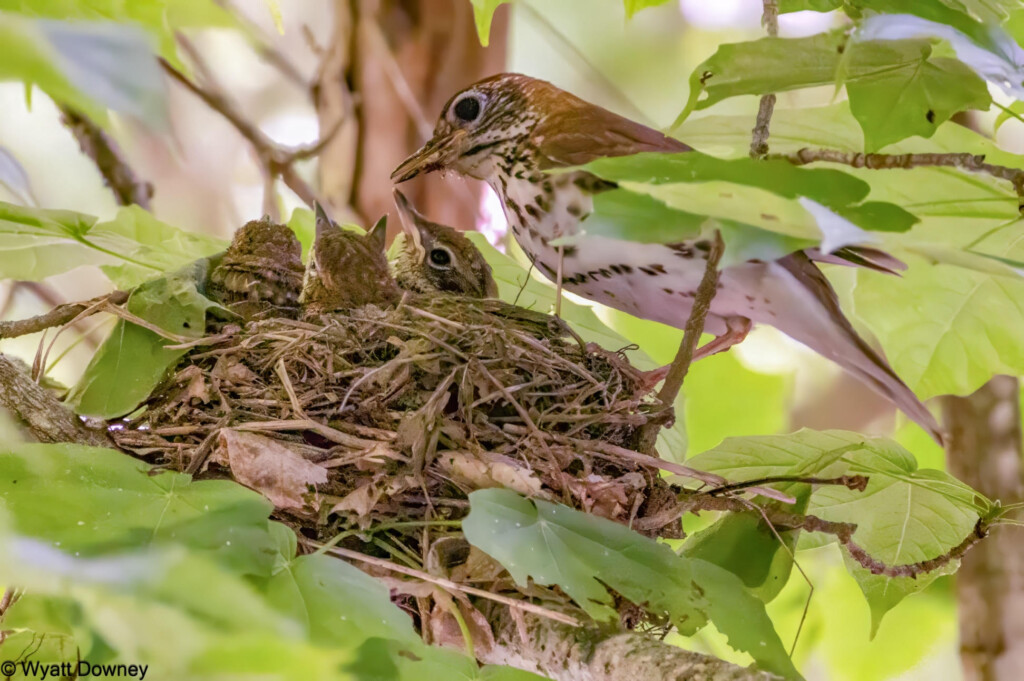
6/6/24
Wood Thrush adoptions are now out! You can support Chasing Melody by adopting a motus tagged bird, which gives you the chance to track and follow your thrush through the fall and spring migration. Learn more about adoptions at https://inaudubon.square.site/
You can also purchase one of these amazing and limited edition Wood Thrush woodblock art pieces by Wildwood Press. Visit their Audubon Collaboration Page to see this print and others!